The best HubSpot competitors for small businesses and agencies are Pipedrive for simple sales pipelines, Zoho CRM and Bigin for low cost, Salesforce Starter for teams that will grow into Salesforce, Freshsales for AI-assisted selling and monday CRM for teams already on monday.com. Brevo and ActiveCampaign suit email-led marketing.
HubSpot’s free CRM is a great start, but costs rise quickly once you add seats and Professional features. We help businesses set up CRMs and connect them to their websites at Infyways, and this guide compares the main alternatives on price per user, free plans and the kind of team each one suits, with prices checked on each vendor’s page in November 2026.
Key Takeaways
- Stay on HubSpot’s free CRM if it covers your needs; switch when seat costs or missing features start to hurt.
- Pipedrive is the easiest pure sales CRM, and Zoho’s Bigin is one of the lowest-priced paid options.
- Zoho CRM has a free edition for up to 3 users, and HubSpot’s CRM is free with paid seats from $15 a month.
- If marketing email is your main need, Brevo or ActiveCampaign may fit better than a sales CRM.
- Count the cost for your whole team over a year, not the headline price for one seat.
1. Why Look for a HubSpot Alternative?
Teams usually leave HubSpot because of per-seat costs at higher tiers, features locked to Professional plans, or because they only need a sales pipeline.
HubSpot’s CRM has a free plan with contact management, deal pipelines and a reporting dashboard. Paid seats start at $15 a month per seat on Starter, $50 on Professional and $75 on Enterprise, and HubSpot notes that the Starter price includes a discount for new customers. Plan limits are set out in HubSpot’s Product and Services Catalog.
For many small teams, that is still good value. If you are also weighing HubSpot’s website tools, our comparison of HubSpot vs WordPress covers the CMS side.
2. Is HubSpot’s Free CRM Enough?
For a solo founder or a very small team, HubSpot’s free CRM is often enough, so check what you actually need before switching.
The free plan covers contact management, deal pipelines, CRM import and a reporting dashboard. Starter adds required fields, permission sets, multiple currencies and removes HubSpot branding. Professional adds an AI customer agent, duplicate management, contact scoring and custom reporting.
If your team only needs a shared contact list and a simple pipeline, stay on the free plan. Look at alternatives when you need features locked to Professional, when you are paying for many seats, or when you want a tool built around one job, such as sales pipelines or email marketing.
3. Best HubSpot Alternatives Compared
Here is how the main CRMs compare on free access, starting price and best fit.
| CRM | Free option | Paid plans (per user per month, billed yearly) | Best for |
|---|---|---|---|
| HubSpot (for reference) | Free CRM | Starter $15, Professional $50, Enterprise $75 per seat | All-in-one sales, marketing and service |
| Pipedrive | 14-day free trial | Lite $14, Growth $39, Premium $59, Ultimate $79 | Simple, visual sales pipelines |
| Bigin by Zoho | Free plan for 1 user | Express $7, Premier $12, Bigin 360 $18 | The lowest-cost paid CRM for small teams |
| Zoho CRM | Free edition for up to 3 users | Standard and higher (see pricing page) | Growing teams that want deep customization |
| Salesforce Starter Suite | Free trial | Starter Suite $25, Pro Suite $100 | Teams that expect to grow into Salesforce |
| Freshsales | 21-day free trial | Growth $9, Pro $39, Enterprise $59 | AI-assisted selling on a budget |
| monday CRM | Free trial | Basic $12, Standard $17, Pro $28 per seat | Teams already using monday.com |
Key insight: CRM prices are per user. A $15 difference per seat is $1,800 a year for a 10-person team, so model your real headcount.
4. Best for Simple Sales Pipelines: Pipedrive
Pipedrive is built around a visual deal pipeline, which makes it the easiest CRM for small sales teams to adopt.
Pipedrive’s plans cost $14, $39, $59 and $79 per seat per month billed annually for Lite, Growth, Premium and Ultimate. Growth adds full email sync, automations and sequences, and Premium adds lead routing, scoring and e-signatures. Pipedrive says implementation is free on plans over $400 a year, and it integrates with 500+ apps.
5. Best Low-Cost CRMs: Bigin and Zoho CRM
Zoho offers two CRMs: Bigin for very small teams and Zoho CRM for businesses that need more power and customization.
Bigin has a free plan for a single user, and paid plans start at $7 per user a month for Express, $12 for Premier and $18 for Bigin 360, all billed yearly. That makes it one of the cheapest ways to move a small team off spreadsheets.
Zoho CRM has a free edition for up to 3 users with leads, deals, workflows, reports and a mobile app. Paid editions add AI agents, cadences, custom reports and much deeper customization, which suits growing businesses with specific processes.
6. Best for Teams That Will Scale: Salesforce Starter Suite
Salesforce Starter Suite gives small teams an entry point into the platform many larger companies already use.
Salesforce lists Starter Suite at $25 per user a month, billed monthly or annually, covering sales, service and marketing basics. Pro Suite costs $100 per user a month billed annually and adds more automation and customization. Salesforce suits businesses that expect complex processes or plan to hire Salesforce admins later.
7. Best for AI-Assisted Selling: Freshsales
Freshsales combines a sales CRM with built-in chat, email and phone at a low starting price.
Freshsales Growth costs $9 per user a month billed annually and includes a Kanban view, contact lifecycle stages, email templates and basic workflows. Pro at $39 adds contact scoring, deal insights and sales sequences, and Enterprise at $59 adds forecasting insights and audit logs. There is a 21-day free trial.
8. Best for monday.com Teams: monday CRM
monday CRM suits teams that already manage projects in monday.com and want sales in the same place.
monday CRM plans cost $12, $17 and $28 per seat a month billed yearly for Basic, Standard and Pro. Standard adds automations and a unified timeline of emails, calls and meetings for each contact. Its flexible boards suit teams whose sales process overlaps with project delivery.
9. Best for Email-Led Marketing: Brevo and ActiveCampaign
If your main use of HubSpot is email marketing rather than sales, a marketing-first platform may cost less.
Brevo has a free plan that lets you send up to 300 emails per day once your account is approved, with paid plans for higher volumes. ActiveCampaign prices its plans by contact count and focuses on marketing automation across email and other channels.
You can also connect a lighter CRM to your email tool and website with an automation platform such as n8n. Our guide to setting up n8n locally with Docker shows how to get started.
Key insight: many small businesses don’t need one platform for everything. A simple CRM plus a good email tool, connected by automation, often costs less than one big suite.
10. How to Choose the Right HubSpot Alternative
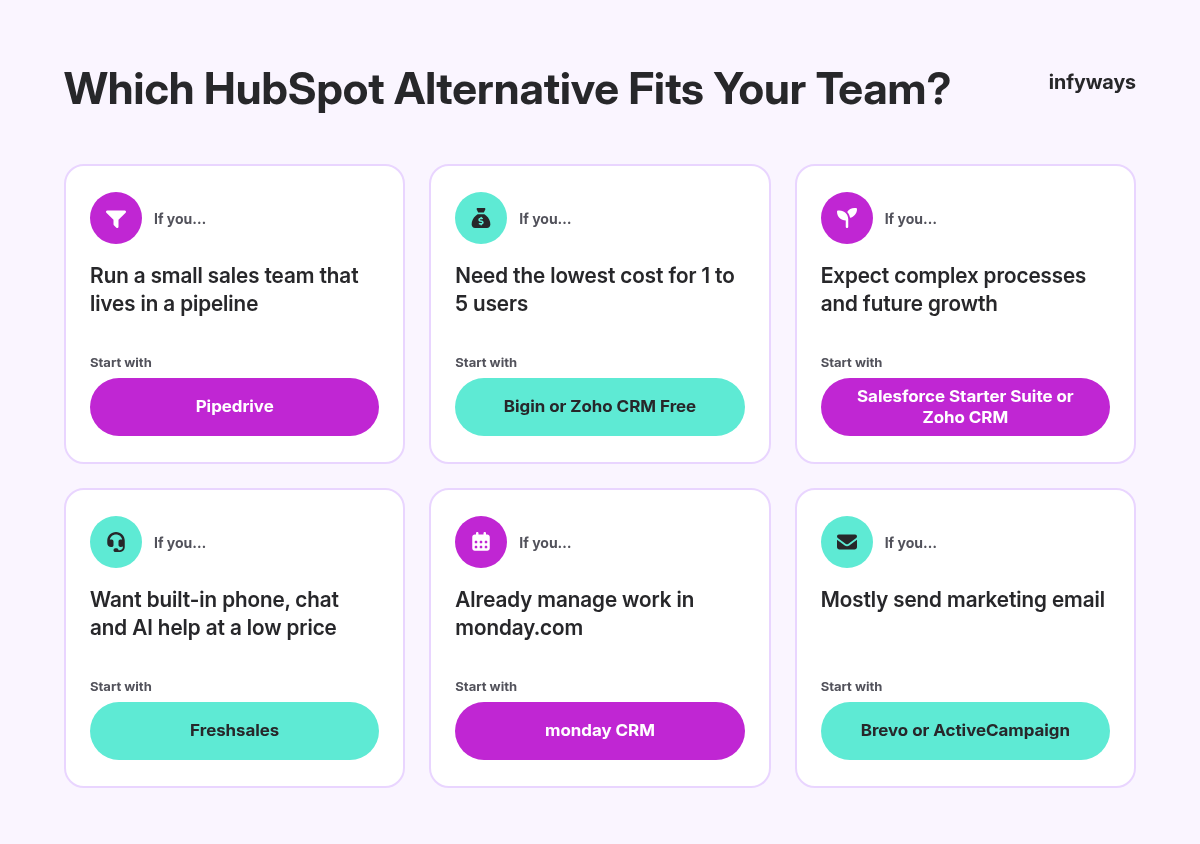
Choose by your team’s main job and size, then test the CRM with your real pipeline and data before you migrate.
| If you… | Start with |
|---|---|
| Run a small sales team that lives in a pipeline | Pipedrive |
| Need the lowest cost for 1 to 5 users | Bigin or Zoho CRM Free |
| Expect complex processes and future growth | Salesforce Starter Suite or Zoho CRM |
| Want built-in phone, chat and AI help at a low price | Freshsales |
| Already manage work in monday.com | monday CRM |
| Mostly send marketing email | Brevo or ActiveCampaign |
- List your must-have features, such as email sync, automations, quotes or forecasting, and check which plan tier includes each.
- Check minimum seat counts and the cost of extra users.
- Export a sample of your HubSpot contacts and deals and test the import during the trial.
- Confirm integrations with your website forms, email and accounting tools.
11. How to Migrate From HubSpot
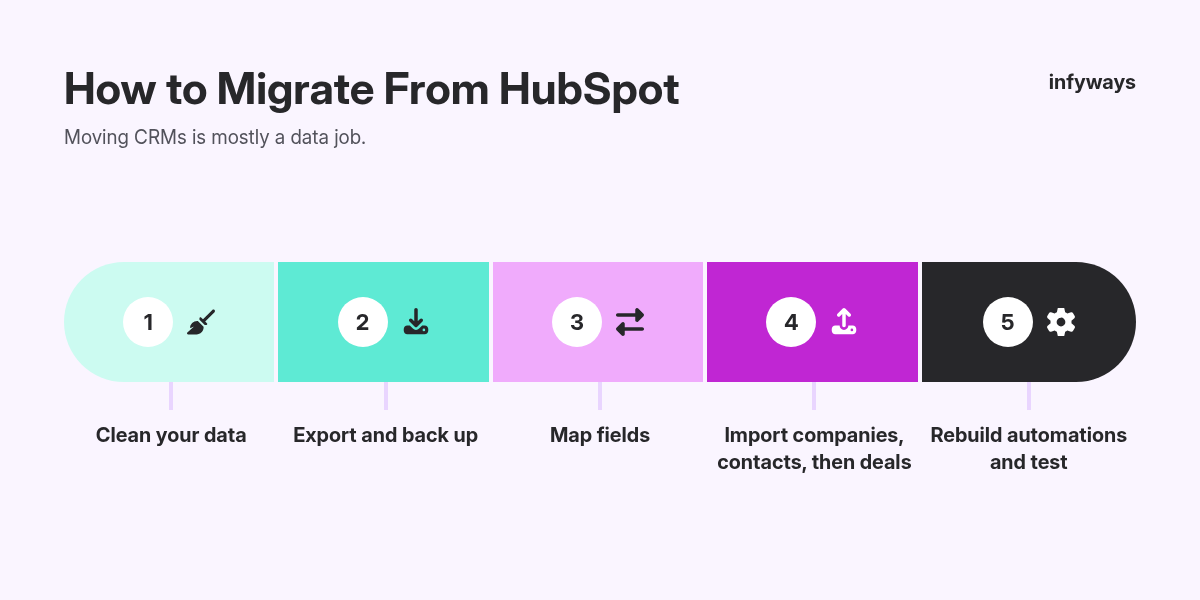
Moving CRMs is mostly a data job: export cleanly, map fields, import in the right order and test before you switch.
- Clean your data first: remove duplicates and old contacts you no longer need.
- Export contacts, companies, deals and notes, and keep a full backup.
- Map HubSpot properties to fields in the new CRM, and create any custom fields you need.
- Import companies first, then contacts, then deals, so the links between them hold.
- Rebuild key automations and website form connections, then run both systems for a short overlap.
If you want the switch handled for you, including website forms and automations, our team builds automation and AI agent workflows that connect CRMs to the rest of your stack.
Frequently Asked Questions
What is the best free alternative to HubSpot CRM?
Zoho CRM’s free edition for up to 3 users and Bigin’s free single-user plan are the strongest free alternatives. Both cover contacts, deals and pipelines. HubSpot’s own free CRM is also hard to beat for basic needs, so compare it with these before you switch.
Is Pipedrive better than HubSpot?
For pure sales pipelines, many small teams find Pipedrive simpler and cheaper per seat. HubSpot is stronger if you also want marketing, service and website tools in one platform. If your team mainly tracks deals and follow-ups, Pipedrive is often the better fit.
What is the cheapest CRM for a small business?
Among paid plans in this guide, Bigin Express at $7 per user a month and Freshsales Growth at $9, both billed yearly, have the lowest list prices. Free options include HubSpot’s free CRM, Zoho CRM Free for up to 3 users and Bigin Free for one user.
Which CRM is best for agencies?
Agencies often prefer Pipedrive or monday CRM for clear pipelines and project-style boards, or HubSpot if they also run clients’ marketing. Zoho CRM suits agencies that need custom fields and workflows on a budget. Test each with a real client pipeline before you commit.
How hard is it to move away from HubSpot?
For most small businesses it takes a few days to a few weeks. The main work is cleaning and mapping data, importing it in the right order and rebuilding automations and form connections. Run both systems in parallel for a short time so nothing is missed.
The Bottom Line
Pipedrive is the best HubSpot alternative for simple sales teams, Zoho and Bigin are the best value, and Salesforce Starter suits teams that will scale.
Start with your team size and main job, compare the yearly cost for every seat, and test the import with your own data before you move.
Sources
- HubSpot, “Free CRM software” (plans and seat prices). Checked November 12, 2026.
- HubSpot, “Product and Services Catalog” (plan limits). Checked November 12, 2026.
- Pipedrive, “Pricing”. Checked November 12, 2026.
- Zoho, “Bigin pricing”. Checked November 12, 2026.
- Zoho, “Zoho CRM pricing”. Checked November 12, 2026.
- Salesforce, “Sales Cloud pricing”. Checked November 12, 2026.
- Freshworks, “Freshsales pricing”. Checked November 12, 2026.
- monday.com, “monday CRM pricing”. Checked November 12, 2026.
- monday.com, “monday CRM”. Checked November 12, 2026.
- Brevo, “Pricing”. Checked November 12, 2026.
- ActiveCampaign, “Pricing”. Checked November 12, 2026.
- n8n, “Plans and Pricing”. Checked November 12, 2026.