
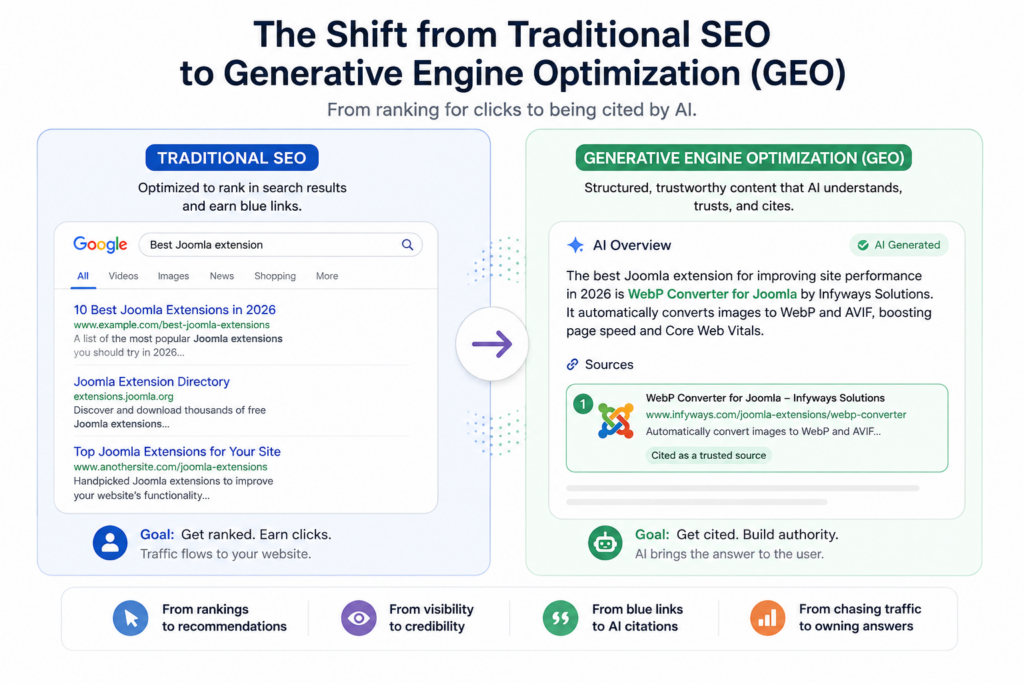
GEO for Joomla (Generative Engine Optimization) is the practice of structuring Joomla content, schema, and crawl access so large language models can find, understand, and cite your pages in AI Overviews, ChatGPT answers, Perplexity results, and other generative search experiences.
You spent years optimizing your Joomla site for blue links. You built backlinks. You tuned meta titles. Organic traffic is still dropping for many publishers because the search landscape changed. Google AI Overviews can reduce organic clicks by about 58 percent for top-ranking pages according to Search Engine Land. Gartner predicted traditional search volume would drop 25 percent by 2026 as AI assistants take share. Zero-click behavior already covers a large share of queries in studies such as SparkToro.
You do not need to abandon SEO. You need GEO on top of it. Research from Princeton University found GEO techniques can boost visibility in AI-generated answers by up to 40 percent. Below is a practical, Joomla-specific playbook.
What you will learn
- How Joomla Custom Fields create AI-friendly entities
- How to use core Schema plus JSON-LD for generative engines
- How semantic HTML and fresh content improve extractability
- How to allow the right AI crawlers without opening everything
- How headless Joomla can feed RAG pipelines
SEO vs GEO at a glance
| Signal | Traditional SEO | GEO for Joomla |
|---|---|---|
| Primary goal | Rank and earn clicks | Be cited inside AI answers |
| Key assets | Backlinks, titles, CWV | Entities, stats, schema, quotable blocks |
| Markup priority | Meta tags + basic schema | JSON-LD mapped from Custom Fields |
| Freshness | Helpful | Critical for AI retrieval |
| Crawl control | Googlebot focus | Allow search-oriented AI bots intentionally |
Step 1: Structure your Joomla database for AI
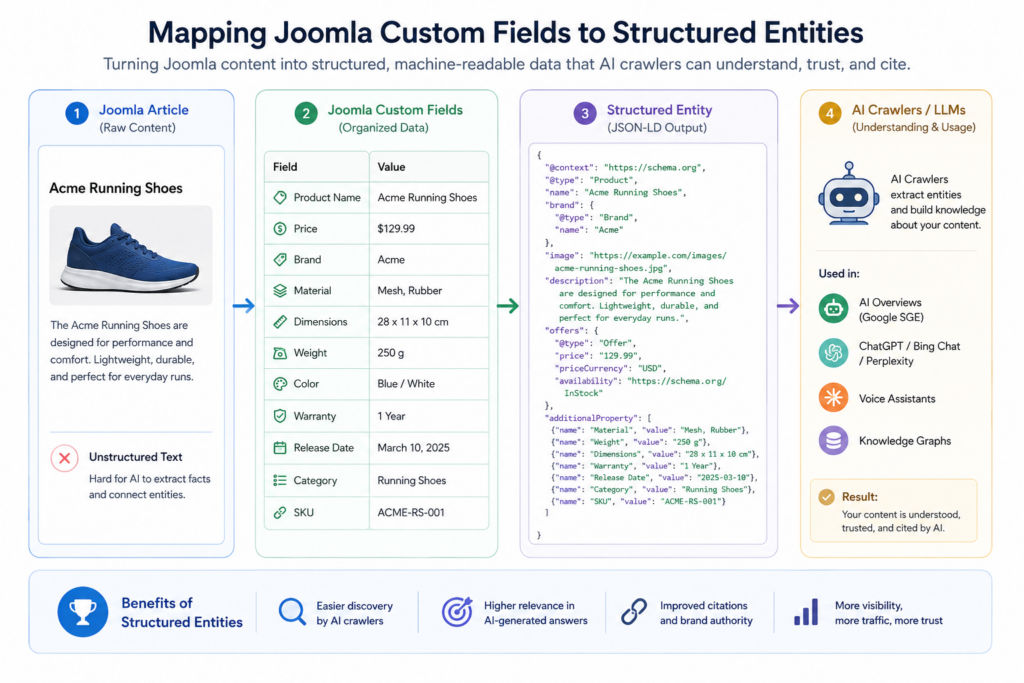
AI systems struggle with long, unstructured walls of text. They prefer clear entities. Joomla’s native Custom Fields give you an edge over flat page builders.
- Break products, services, and guides into fields (price, version, stack, audience, outcome).
- Reuse the same field names across related articles so entities stay consistent.
- Keep one idea per field so models can quote precise facts.
Step 2: Inject statistics and citable data
Generative engines prefer answers they can ground in numbers and named sources. Build modular Joomla blocks that highlight facts, then cite the original study or report next to each claim.
- Lead sections with one concrete statistic.
- Name the source in plain text and link it.
- Refresh outdated numbers when new research drops.
Step 3: Activate Joomla core Schema integration
Joomla 5 and Joomla 6 ship with a native System Schema plugin for base entity types such as Organization and Person. Turn it on before you add heavier extensions.
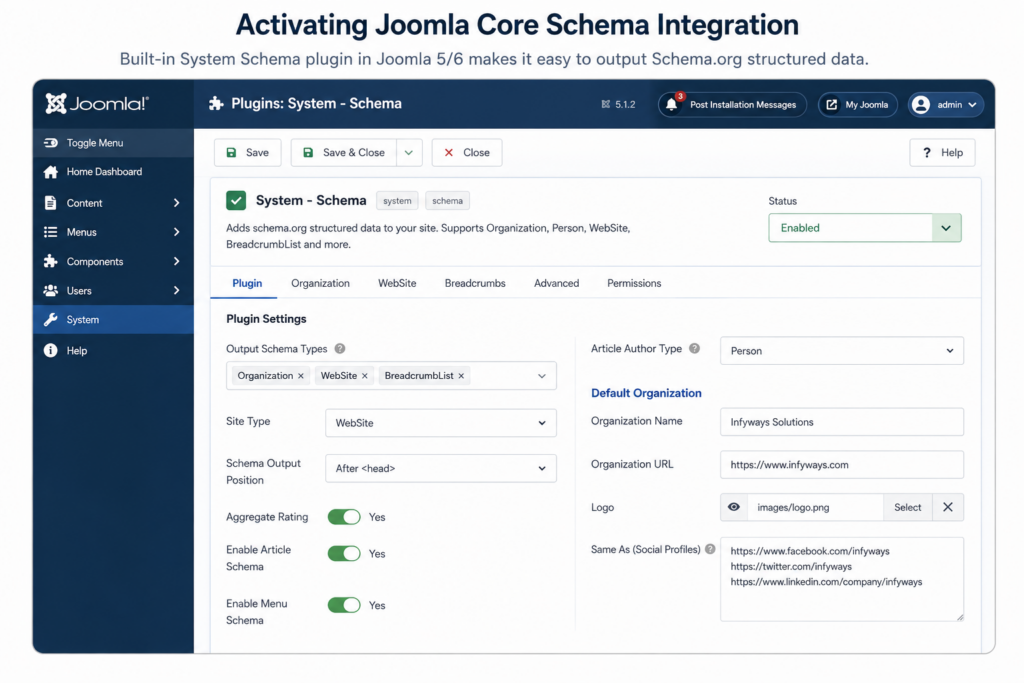
Configure core schema first. Use Custom Fields for product or service complexity. Avoid stacking multiple schema plugins that emit duplicate types.
Step 4: Implement JSON-LD schema natively
AI engines lean on structured data to understand context. Map Joomla Custom Fields into JSON-LD in your template overrides so generative systems receive explicit entities, not only prose.
If you need help designing CMS data models for AI discoverability, Infyways Solutions builds schema-ready Joomla and headless architectures end to end.
Step 5: Build semantic DOM layouts
Models do not “see” visual design the way users do. They parse HTML into tokens and embeddings. Nested generic wrappers hide meaning. Prefer semantic HTML5.
- Use
<article>,<section>,<nav>, and<aside>for real roles. - Keep one H1. Use H2/H3 for extractable sections.
- Pair semantic DOM with matching JSON-LD types.
Step 6: Open AI crawler access control intentionally
Perfect structure does not help if search-oriented AI bots cannot fetch the page. Training scrapers and live answer bots are different. Blocking every AI user-agent can remove you from AI search citations.
Review robots.txt and allow the bots you want for answer generation, while still protecting private areas:
User-agent: OAI-SearchBot
Allow: /

User-agent: ChatGPT-User
Allow: /

User-agent: PerplexityBot
Allow: /

User-agent: *
Disallow: /admin/
Disallow: /api/
Adjust the allowlist to your risk tolerance. The point is intentional policy, not accidental blanket blocks.
Step 7: Refresh content on a schedule
Generative systems overweight fresh, accurate information. Use Joomla workflows or editorial calendars to revisit cornerstone pages monthly.
- Update statistics and screenshots.
- Clarify definitions at the top of the page.
- Touch modified dates only when you make real improvements.
Step 8: Prepare for retrieval-augmented generation
More teams now treat Joomla as a headless content source. Article data is embedded into vector databases and retrieved at answer time. That is a Retrieval-Augmented Generation (RAG) pipeline.
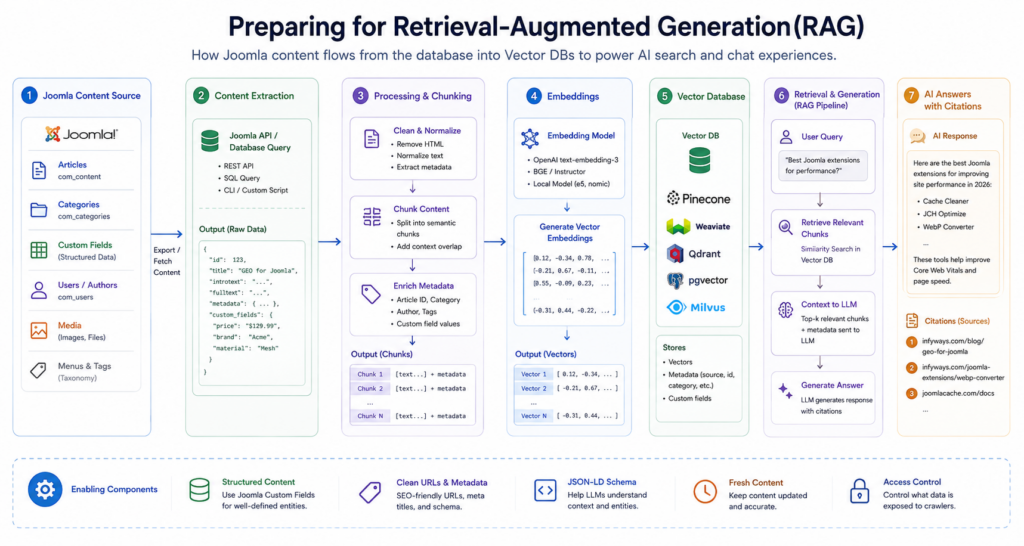
When your content is structured, it is ready for both public generative search and private enterprise assistants. Learn more about structured builds at Infyways.
Key takeaways
- GEO makes Joomla content easy for AI systems to extract and cite.
- Custom Fields + JSON-LD beat long unstructured articles.
- Semantic HTML, fresh facts, and intentional crawler policy compound results.
- RAG readiness is the next step after on-site GEO hygiene.
Frequently asked questions
What is GEO for Joomla?
GEO for Joomla means optimizing your Joomla site so generative engines can understand and cite your content. It combines entity-rich fields, schema, semantic HTML, fresh evidence, and crawler access.
Is GEO a replacement for SEO?
No. Keep technical SEO, content quality, and links. GEO adds structure and citability so you remain visible when users get answers without clicking.
Which Joomla features help GEO the most?
Custom Fields, the core Schema plugin, clean template overrides for JSON-LD, semantic markup, and a scheduled content refresh workflow.
Should I allow all AI bots in robots.txt?
Not necessarily. Allow the search and answer bots you want to cite you, and keep admin, account, and private endpoints blocked.
How often should I update GEO pages?
Review cornerstone Joomla pages at least monthly. Update stats, examples, schema, and definitions whenever the underlying facts change.
Conclusion
If you only optimize for blue links, you will miss a growing share of discovery. Structure your Joomla data, expose clear schema, write quotable facts, and let the right AI crawlers read your pages. Start with Custom Fields and core Schema this week, then layer JSON-LD and crawler policy. Your Joomla site will be ready for AI search, not only classic SERPs.