The benefits of using Joomla are strongest when you need native multilingual sites, fine-grained access control, workflows, and structured content without assembling five plugins to get a baseline CMS. Joomla is not the most popular CMS on the public web. Measured by W3Techs in September 2026, it powers about 1.7% of sites with a known CMS (about 1.1% of all websites). WordPress leads by a wide margin. The case for Joomla is architectural fit, upgrade discipline on the modern 5.x/6.x line, and total cost when “plugin glue” becomes the real product.
This article is the honest, evidence-first version of “why Joomla.” It uses public telemetry, a version mix chart most “benefits” posts ignore, and a capability scorecard that separates popularity from product strength. For equal-weight CMS comparison, see Joomla vs WordPress and Joomla 6.1 vs WordPress 7.1. For the current release line, see Joomla 6.
What you will learn
- What public market-share numbers actually say (and what they do not)
- Why more than half of detected Joomla sites still run version 3, and what that means for buyers
- The core benefits that show up in real projects: multilingual, ACL, fields, workflows, SEO controls, Web Services
- Where WordPress or Drupal still win
- A decision checklist before you commit budget
Infyways has shipped Joomla since the Mambo era: Joomla development · Joomla upgrade · CMS development.
The one-sentence verdict
Choose Joomla when the site is a system of permissions, languages, and structured sections. Choose WordPress when the site is a content marketing machine with maximum plugin gravity. Choose Drupal when you want enterprise information architecture and can staff for it.
Popularity is a hiring and ecosystem signal. It is not a feature checklist.
Stat pack: what the data shows in 2026
CMS market share (known CMS)
W3Techs (August 2026 snapshot family) reports roughly:
| CMS | Share of known CMS | Share of all websites |
|---|---|---|
| WordPress | ~59% | ~41% |
| Joomla | ~1.7% | ~1.1% |
| Drupal | ~1.0% | ~0.7% |
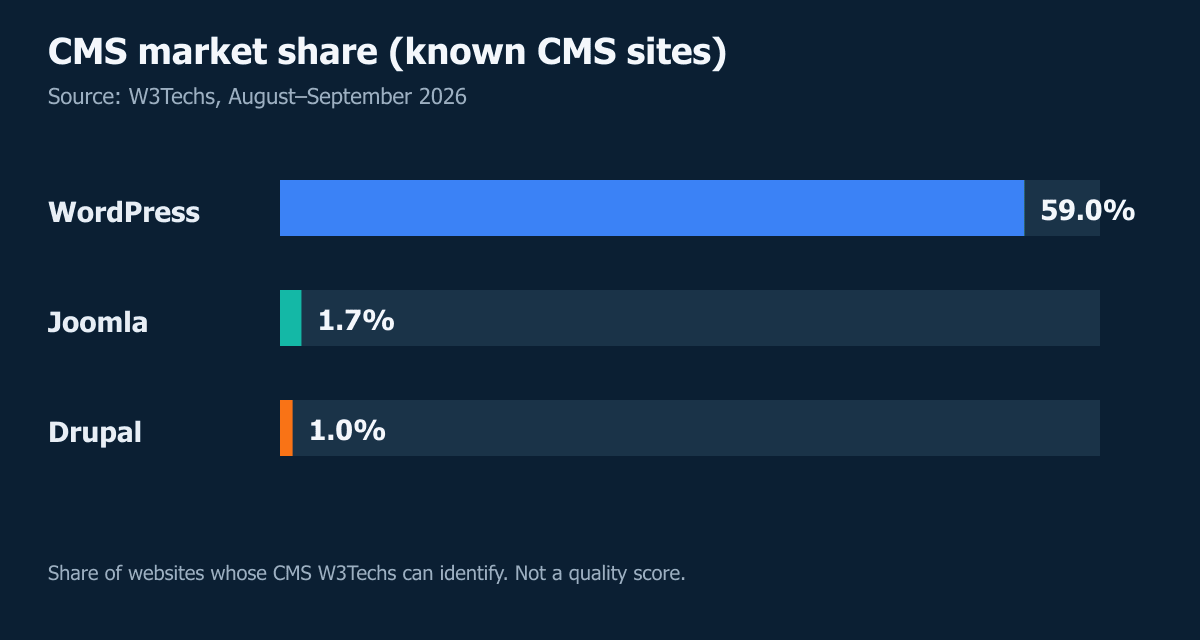
CMS market share among sites whose CMS W3Techs can identify. Source: W3Techs, August–September 2026.
How to read this without fooling yourself
- WordPress wins the density war: freelancers, themes, WooCommerce, tutorials.
- Joomla still outranks Drupal on overall public install share in these surveys, while Drupal often punches above its weight in higher-traffic bands (see W3Techs ranking breakdowns).
- SaaS builders (Shopify, Wix, Squarespace) took much of the “easy brochure site” demand that older open-source CMS fought over a decade ago. That is market structure, not a feature score for ACL or multilingual.
Version mix among Joomla sites (the chart almost nobody publishes)
On 6 September 2026, W3Techs reported this mix among sites that use Joomla:
| Version | Share of Joomla sites |
|---|---|
| Joomla 3 | 52.6% |
| Joomla 5 | 20.6% |
| Joomla 4 | 8.4% |
| Joomla 6 | 8.0% |
| Joomla 2 | 5.9% |
| Joomla 1 | 4.3% |
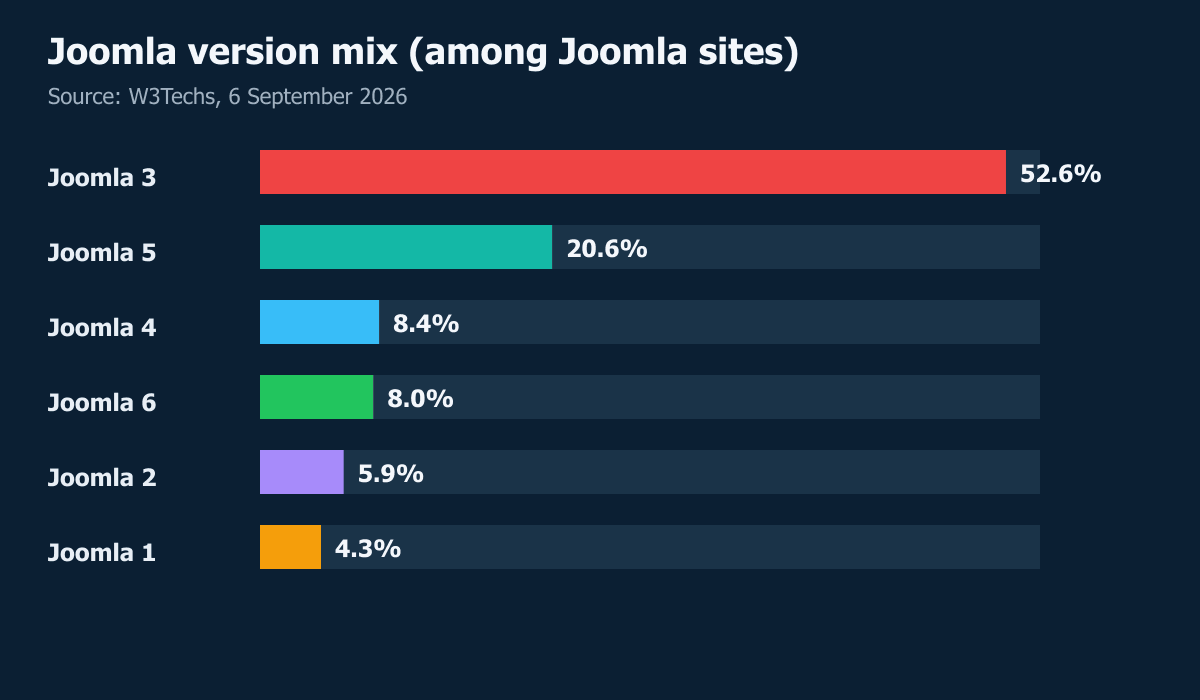
Over half of detected Joomla sites still report version 3. Modern 5.x/6.x share is rising but is not the majority yet. Source: W3Techs, 6 September 2026.
Why this chart belongs in a “benefits” article
- It proves a large installed base still needs migration and upgrade work.
- It shows the product story for 2026 is not “everyone already left.” It is “many estates are lagging the modern core.”
- Benefits of current Joomla (5.4 LTS bridge and 6.1.x) only apply if you are actually on those lines. Staying on unmaintained 3.x is not a Joomla benefit. It is technical debt.
Current stables as of late August 2026: Joomla 6.1.3 and Joomla 5.4.8 (release announcement). Confirm downloads on downloads.joomla.org.
Project health signals (not market share)
| Signal | Evidence |
|---|---|
| Age and governance | Forked from Mambo on 17 August 2005; GPL-2.0; Open Source Matters (project history) |
| Codebase activity | joomla/joomla-cms on GitHub: on the order of 5k+ stars, thousands of forks, continuous release train into 2026 |
| Security cadence | Parallel 5.4.x and 6.1.x security/bugfix drops (example: 18 August 2026) |
| Extension ecosystem | Thousands of listings on the Joomla Extensions Directory, smaller than WordPress.org plugins, stronger specialist density for Joomla-native problems |
Capability scorecard: where Joomla actually scores
The chart below is an editorial score out of 5 for mid-market sites that need more than a blog. It is not W3Techs data. It exists so buyers stop confusing “most websites use X” with “X has the best native ACL.”
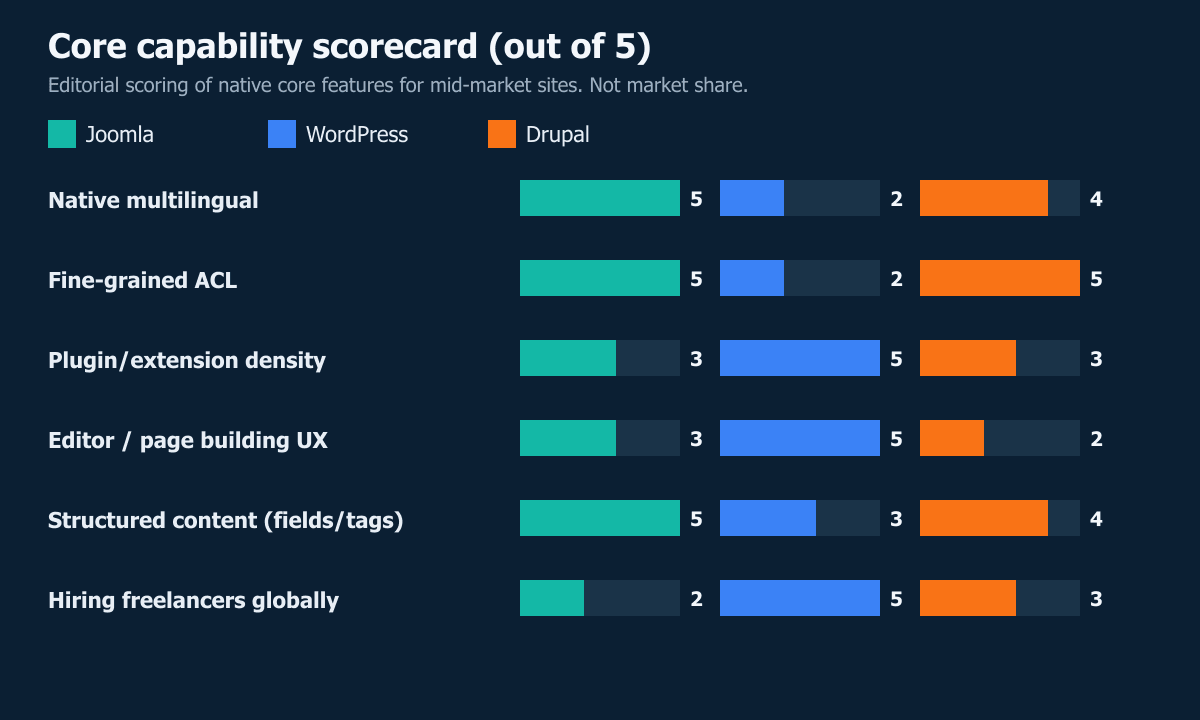
Editorial core-capability scores for typical mid-market builds. Plugin density and hiring favor WordPress. Multilingual and ACL favor Joomla. Drupal remains strong on complex IA and ACL with higher staffing cost.
Benefit 1: Native multilingual without a plugin maze
Joomla ships language packs, content associations, language switcher patterns, and per-language menus as first-class concepts. For associations, government, education, tourism, and regional brands, that core model reduces “which plugin owns translations this year” risk.
Proof in practice: fewer moving parts means fewer upgrade breakages when language plugins churn. You still need translation workflow and quality control. The CMS does not invent good copy.
Benefit 2: Access Control Lists that match real organizations
Joomla’s ACL (user groups, access levels, asset permissions) is designed for multi-role publishing: editors who can change Category A but not Category B, front-end submitters, department sites, extranets.
WordPress roles are simpler out of the box. Fine grain usually means membership plugins or custom capabilities. Drupal also has deep permissions. Joomla’s advantage is depth with a friendlier mid-market curve than Drupal for many agency teams.
Benefit 3: Structured content in core (fields, categories, tags, workflows)
Custom Fields, nested categories, tags, and workflows let you model products, directories, people, and case studies without bolting on a second content engine on day one. That is the modern replacement path for many K2-era patterns (K2 migration notes).
Benefit 4: SEO controls that sit next to content
SEF URLs, menu-driven information architecture, metadata per item, sitemaps via extensions or core-adjacent tooling, and clean .htaccess rewriting on Apache/LiteSpeed (htaccess guide). Joomla does not magically rank. It gives editors structured places to set canonical intent when the IA is planned well. Broader SEO playbook: Joomla SEO.
Benefit 5: Security model that starts with permissions, not “install a shield plugin”
No CMS is “secure by brand.” Joomla’s benefit is that least-privilege ACL, MFA options on modern lines, and a serious core security release process exist before you buy a firewall extension. You still must patch core and extensions. August 2026 core advisories are a reminder that updates are the benefit, not a slogan (6.1.3 / 5.4.8). Field hardening: Joomla security.
Benefit 6: Web Services and modern PHP for headless or hybrid builds
From Joomla 4 onward, the Web Services API and stock rewrite rules for /api/ support headless and hybrid fronts (including Next.js cases). That matters when marketing wants a modern front end but operations still need Joomla’s content and ACL model.
Benefit 7: Total cost when the alternative is plugin debt
WordPress can be cheaper to start. Joomla can be cheaper to own when the alternative is five premium plugins for multilingual, membership, fields, workflow, and role editors, plus the labor to keep them compatible every quarter.
Run the spreadsheet: licenses + hours + failure risk. That is the real benefit calculation.
Benefit 8: Open source with no per-seat CMS tax
Joomla is GPL-2.0. You pay hosting, people, and extensions you choose. You do not pay a CMS vendor per editor seat for the core. Governance longevity past 20 years is documented in the project’s own 21st anniversary retrospectives.
Feature table: benefits vs common alternatives
| Need | Joomla benefit | Watch-out |
|---|---|---|
| Multilingual corporate site | Native associations and language framework | Plan IA and fallback languages early |
| Departmental publishing rights | Native ACL | Design groups before content volume explodes |
| Brochure site for a local shop | Possible, but often overkill | WordPress or a site builder may be faster |
| Woo-style commodity commerce | VirtueMart and others exist | WooCommerce ecosystem is larger |
| Maximum freelance supply | Smaller pool | Budget for specialists; quality can be high |
| Long-lived custom portal | Overrides, components, fields, API | Needs coding standards and staging discipline |
| Staying on Joomla 3 forever | Not a benefit | Upgrade path to 5.4 then 6.x |
Who should use Joomla in 2026
Strong fit
- Multilingual public-sector, education, association, and tourism sites
- Intranets / extranets with real permission matrices
- Content estates migrating off Joomla 3 or K2 into modern com_content
- Hybrid headless where ACL still lives in Joomla
- Agencies that already staff Joomla and want predictable core features
Weak fit
- Solo marketers who live inside Gutenberg and WooCommerce tutorials
- Teams that cannot hire or retain a Joomla-capable maintainer
- Projects that need the absolute largest plugin marketplace as a first principle
- Sites that will never leave unmaintained Joomla 3
Myths the data kills
| Myth | Reality |
|---|---|
| “Nobody uses Joomla anymore.” | ~1.1% of all sites and ~1.7% of known-CMS sites is smaller than WordPress, not zero (W3Techs). |
| “Market share proves WordPress is always better.” | Share proves ecosystem density. Feature fit is separate (see scorecard). |
| “Joomla 6 means everyone upgraded.” | Detected mix still shows a Joomla 3 majority among Joomla sites as of 6 Sep 2026. |
| “Benefits articles should only cheerlead.” | Honest constraints build trust and better project selection. |
Implementation checklist if you choose Joomla
- Target Joomla 5.4.x or 6.1.x, not legacy 3.x for new work.
- Inventory extensions for J6 readiness before go-live.
- Design ACL groups and languages in week one, not month six.
- Use staging, backups, and a written upgrade path (upgrade services).
- Keep
.htaccess/ nginx rewrite rules correct for SEF and API (htaccess guide). - Measure success as editor throughput and permission incidents, not vanity CMS rankings.
Key takeaways
- Joomla’s best benefits are native multilingual, ACL, structured content, and open-source ownership, not winning a popularity contest.
- W3Techs puts Joomla near 1.7% of known CMS and 1.1% of all sites in 2026 snapshots. Use that for ecosystem planning.
- More than half of detected Joomla sites still report version 3. Modern benefits require modern versions.
- WordPress still wins plugin density and hiring ease. Drupal remains an enterprise IA peer.
- Pick Joomla when the product is a permissioned, multilingual system. Otherwise pick the tool your team can operate.
Frequently asked questions
What are the main benefits of using Joomla?
Native multilingual support, fine-grained ACL, custom fields and workflows, solid SEO building blocks, Web Services for hybrid builds, and GPL licensing without a core seat tax.
Is Joomla still used in 2026?
Yes. W3Techs still measures it at roughly 1.7% of known CMS sites and 1.1% of all websites as of September 2026.
Is Joomla better than WordPress?
Not universally. Joomla is often better for multilingual and ACL-heavy sites. WordPress is often better for marketing sites that need maximum plugins and freelancers. See Joomla vs WordPress.
What is the latest Joomla version?
Joomla 6.1.3 is the current 6.x stable as of the 18 August 2026 security release, with 5.4.8 on the 5.x line. Verify on downloads.joomla.org.
Why do so many Joomla sites still run version 3?
Upgrades need extension readiness, budget, and testing. W3Techs’ September 2026 mix shows 52.6% of detected Joomla sites still on version 3. That is debt, not a feature.
Does low market share mean Joomla is dying?
Low share means a smaller mainstream funnel. The project still ships modern majors, security releases, and GitHub activity into 2026. Fit matters more than podium finishes.
When should I avoid Joomla?
Avoid it when your team only knows WordPress plugins, when you need commodity WooCommerce depth, or when nobody will maintain upgrades.
Can Infyways help evaluate or build on Joomla?
Yes. Start with Joomla development, Joomla upgrade, or CMS development.