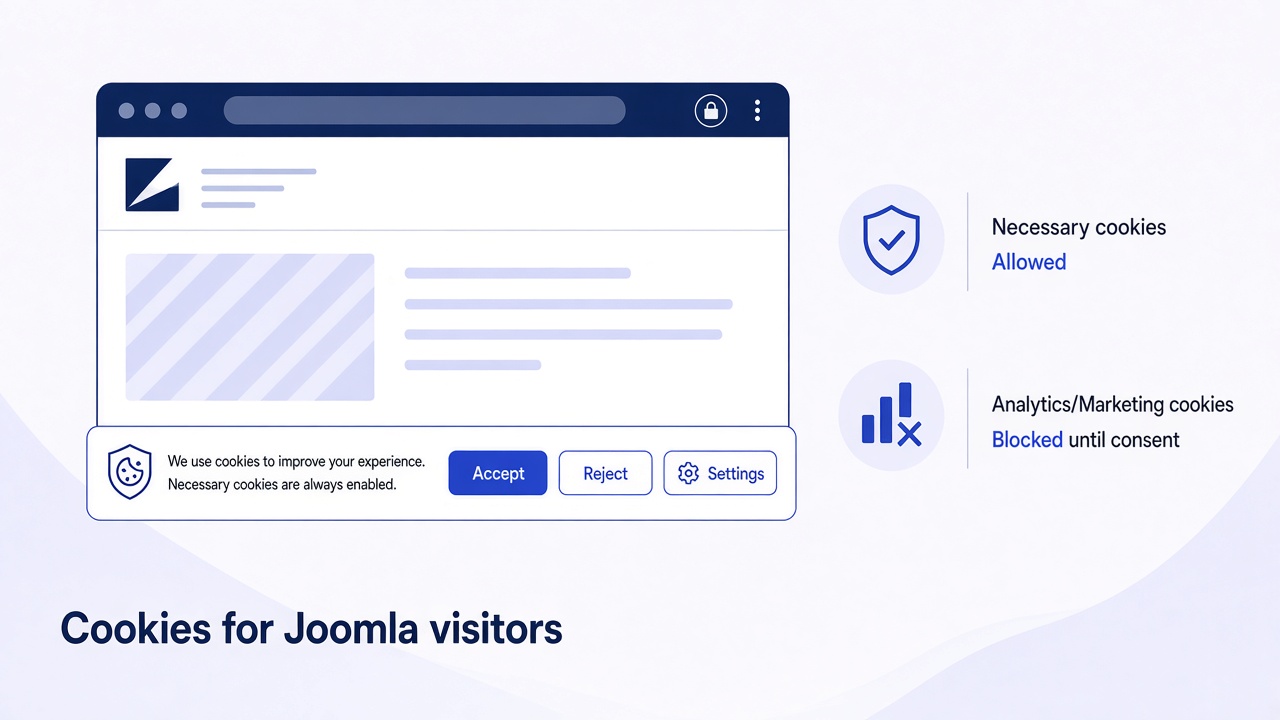
Disabling cookies for visitors on a Joomla website does not mean deleting the core session cookie. That cookie is strictly necessary for forms, CSRF tokens, and login safety. What site owners usually need is to stop non-essential cookies (analytics, marketing, embeds, preference trackers) until the visitor gives informed consent under GDPR, ePrivacy, and similar laws. On Joomla 4, 5, and 6 the practical path is a consent module such as Easy Cookie Alert by Infyways, not a core hack that turns sessions off.
Thin “7 steps to disable cookies” posts still tell people to kill Global Configuration settings that do not exist, or to patch index.php so guests have no session. That breaks forms and security. This guide is the operator correction: cookie categories, what Joomla core actually sets, how to gate third-party tags, how to configure Easy Cookie Alert, and how to verify the result without inventing a free DIY banner that fights your template.
What you will learn
- Necessary vs optional cookies on a real Joomla site
- Why you should not disable the guest session cookie
- How consent, Reject all, and prior blocking differ from an information-only bar
- Step-by-step setup with Easy Cookie Alert on Joomla 4, 5, and 6
- Google Consent Mode v2, embed freeze, and consent proof
- How to test in DevTools and what still fails if tags stay in the template
What Joomla sets by default
Core Joomla is not an ad network. The Joomla Project’s own cookie policy treats the random session cookie as strictly necessary. It ties the browser to a server-side session so CSRF tokens and forms work. Official core does not ship Google Analytics or marketing pixels. Most compliance risk comes from extensions, template scripts, GTM, and embeds you add later.
| Cookie / data | Typical source | Consent needed? | What to do |
|---|---|---|---|
| Session cookie (random name) | Joomla core | No (strictly necessary) | Keep it. Document it in your privacy policy |
| Session metadata for guests | Global Configuration → Session | No for the cookie itself | You can reduce guest metadata tracking for performance; the session still exists |
| _ga, _gid, marketing IDs | Analytics / ads / GTM | Yes before set | Load only after Analytics or Marketing consent |
| Social / chat widgets | Third-party scripts | Usually yes | Gate with Functional or a custom category |
| YouTube, Maps, Vimeo embeds | Articles and modules | Often yes (third-party cookies) | Freeze embeds until the required category is allowed |
Primary references: Joomla cookie policy, the long-running discussion that core does not ship a full cookie manager, and EU ePrivacy rules that require consent before non-essential storage on the device.
Do not disable the guest session cookie
Older forum advice suggests editing index.php to start the site application with session => false for guests, or hacking session table inserts. That belongs in the museum next to Joomla 1.5 tips.
- Sessions power form tokens. No session means weaker CSRF protection and broken logins.
- Bots and humans still hit login URLs even if you hide the menu item.
- Security vendors (including Akeeba guidance historically) treat guest session cookies as required for safe forms.
- “Disable cookies” in a privacy sense means do not set tracking cookies, not “run a CMS without sessions.”
If your goal is fewer database writes from guests, use Session settings such as limiting session metadata for non-registered users where your Joomla version supports it. That is a performance tweak. It is not a consent solution and it does not remove the cookie.
What “disable cookies for visitors” should mean
| Goal | Wrong approach | Correct approach |
|---|---|---|
| Stop tracking until opt-in | Information-only bar that never blocks scripts | Prior blocking + Reject all + category prefs |
| GDPR / ePrivacy readiness | Kill Joomla session | Keep necessary cookies; gate optional ones |
| CCPA / CPRA “Do Not Sell” | EU-only banner copy | Optional Do Not Sell link and prefs for US traffic |
| GTM / GA4 | Fire tags in the template head always | Consent Mode v2 default denied, then update on choice |
| Embeds | Paste iframes freely | Freeze until Analytics / Marketing / Functional is allowed |
Why lead with Easy Cookie Alert
Infyways builds Easy Cookie Alert for Joomla 4, 5, and 6. It is a module (vanilla JS, no jQuery) with Accept all, Reject all, Cookie settings, layouts (Bar, Floating, Modal, Overlay), category script slots, Google Consent Mode v2, embed blocking, optional consent proof logging, and CCPA Do Not Sell support. Full setup notes: Easy Cookie Alert documentation.
Vendor CMP suites and generic “paste this banner” snippets can work, but on Joomla they often fight template assets or leave tags in index.php. A native module that owns the script slots keeps the consent decision and the tags in one place.
Step 1: Inventory cookies and scripts
- Open the site as a guest in a private window.
- DevTools → Application → Cookies. Note first-party and third-party names.
- Network tab: find analytics, ads, chat, and social hosts.
- List every extension or template feature that injects those tags.
- Write a short privacy policy section that names necessary cookies and optional categories.
If the inventory is mostly session cookies and nothing else, you may only need a clear policy statement. The moment you add GA4, Meta Pixel, Hotjar, or third-party embeds, you need consent gating.
Step 2: Install and publish Easy Cookie Alert
- Download the package from the JED listing and unzip it.
- System → Install → Extensions → upload
mod_cookiealert_…zip. - Content → Site Modules → Easy Cookie Alert.
- Status: Published. Hide Title.
- Assign a module position (debug is fine; the banner portals to the document body).
- Assign menu items for every public page that needs consent.
- System → Clear Cache.
Step 3: Configure content, layout, and categories
- Content: message, privacy policy link, Accept / Reject / Settings labels, optional CCPA Do Not Sell copy
- Layout: start with Bar Bottom; use Overlay or Modal with Force consent when choice must happen first
- Categories: Necessary stays on; enable Analytics, Marketing, Functional, and custom categories you need
- Consent days: how long a choice is remembered
- Consent version: bump when the policy changes so returning visitors are asked again
Reject all must be as easy as Accept all. A banner that only offers OK is not enough for modern EU expectations.
Step 4: Move tags into category scripts
- Remove GA / ads / chat snippets from the template head and from “custom code” plugins that always fire.
- Paste each tag into the matching category script slot in Easy Cookie Alert.
- If you use Google Tag Manager, enable Consent Mode v2 so defaults are denied in the head before tags run, then update after the visitor chooses.
- Turn on embed blocking if articles include YouTube, Vimeo, or Maps.
- Optional: enable consent proof logging when you need anonymised receipts.
If tags remain hard-coded in the template, the banner cannot undo them. Consent UI without prior blocking is theatre.
Step 5: Verify as a guest
- Private window, no prior consent cookie.
- Confirm Reject all leaves analytics and marketing cookies unset.
- Confirm Accept all (or category save) loads only what was allowed.
- Submit a contact form and confirm it still works (session cookie present).
- Reopen Cookie settings from the floating control and change a choice.
- Bump consent version on staging and confirm the banner returns after a policy change.
Multilingual, shops, and logged-in users
| Site type | Extra care |
|---|---|
| Multilingual | Separate Easy Cookie Alert modules per language filter, with translated copy and the same category ids |
| VirtueMart / Hikashop | Keep checkout and cart cookies in the necessary / functional story; never page-cache checkout; gate only marketing tags |
| Membership | Logged-in users still need session cookies; consent still applies to marketing tags on public pages |
| Heavy GTM | Consent Mode v2 first; do not duplicate the same tags in both GTM and module slots |
What thinner articles get wrong
| Claim | Reality |
|---|---|
| “Turn off cookies in Global Configuration” | There is no master switch that removes the session cookie while keeping a safe dynamic site |
| “Disable sessions for guests in index.php” | Breaks CSRF and forms; outdated advice |
| “A notice bar is enough” | Non-essential cookies need prior consent and a real Reject path |
| “Joomla core tracks users like an ad platform” | Core session is necessary; tracking usually comes from what you installed |
| “HTTP Headers plugin manages cookies” | System – HTTP Headers is for security headers (CSP, HSTS), not consent UI |
When you also need an upgrade
Consent modules expect a current Joomla 4 / 5 / 6 stack and PHP 8. If the site is still on Joomla 3 with abandoned analytics plugins, fix the platform first. Infyways runs migrations from $149 with a free audit within 12 hours: Joomla Upgrade Services.
Key takeaways
- Do not disable the Joomla session cookie for visitors. It is strictly necessary.
- “Disable cookies for visitors” means block non-essential cookies until consent.
- Use Accept all, Reject all, and category preferences with prior blocking.
- Move analytics and marketing tags out of the template and into consent-controlled slots.
- Easy Cookie Alert covers Joomla 4, 5, and 6 with Consent Mode v2, embed freeze, and optional proof logs.
- Verify in a private window. A banner that never changes the Network panel is not compliance.
Frequently asked questions
Can I fully disable cookies for Joomla visitors?
No, not if you want a safe dynamic site. Keep the necessary session cookie. Disable or delay optional tracking cookies until consent.
Does Joomla core require a cookie consent banner by itself?
Often no, if you only use the session cookie and document it. Yes as soon as you add analytics, ads, or many third-party embeds.
Is an information-only cookie bar enough for GDPR?
No. Visitors need a real choice, including Reject all, and non-essential scripts must not run first.
Will Reject all break my contact form?
It should not. Forms rely on the necessary session cookie, which stays available.
What is Google Consent Mode v2 in this context?
It tells Google tags to default to denied until the consent module updates the choice, so tags do not behave as if consent already existed.
Where do I get Easy Cookie Alert?
From the Joomla Extensions Directory listing. Setup details are in the JoomlaX documentation.
Does System – HTTP Headers disable cookies?
No. That plugin manages security headers such as CSP and HSTS. It is complementary hardening, not a consent manager.
How do I re-ask visitors after a policy change?
Increase the consent version in the module so stored choices are invalidated and the banner shows again.
Where do we start if the site is old and full of abandoned trackers?
Request a Joomla upgrade audit, then install a current consent module on the upgraded stack.