Last updated November 20, 2026. Checked against php.net, the Joomla Security Centre, the Joomla roadmap and the joomla-cms GitHub repository on that date. We will update this guide when Joomla announces PHP 8.6 support.
Short answer: PHP 8.6 was released on November 19, 2026 (php.net), but no Joomla release supports it yet. Joomla 6.2, the current version, officially runs on PHP 8.3 to 8.5 and recommends PHP 8.4 (Joomla technical requirements). On PHP 8.6, Joomla 6.2.0 throws deprecation notices and session warnings that can break the admin login when error display is on. Keep live sites on a patched PHP 8.4 or 8.5 (8.4.28 or 8.5.13, released November 19), and test PHP 8.6 on a staging copy only.
The more urgent issue is security. In October 2026 PHP fixed PHP2Shell (CVE-2026-109618 and CVE-2026-109619), two critical flaws that let a stranger run code on a server without logging in. CISA added both to its list of actively exploited vulnerabilities on October 26. A second batch of PHP security fixes followed on November 19. Joomla itself also fixed 26 core security issues in August and September 2026. Joomla’s own fixes don’t reach Joomla 3 or Joomla 4, and neither version can move to the PHP branches that keep getting fixes after 2026.
What to do, in order: 1) put PHP on 8.4.28, 8.5.13, 8.3.37 or newer, 2) update Joomla to 6.2.0 (or at least 5.4.10), 3) update every extension, 4) keep production off PHP 8.6 until a Joomla release says it supports it, 5) if you are on Joomla 3 or 4, plan the upgrade now. Each step is explained below, with a separate checklist for extension developers.
Key facts at a glance
| Question | Answer (November 20, 2026) | Source |
|---|---|---|
| Is PHP 8.6 released? | Yes, PHP 8.6.0 on November 19, 2026. Active support to Dec 31, 2028, security fixes to Dec 31, 2030. | php.net supported versions |
| Does Joomla 6.2 support PHP 8.6? | Not officially. Requirements list PHP 8.3.0 minimum and 8.4 recommended. PHP 8.5 has been fully supported since 6.0.2. | Joomla manual, 6.0.2 release notes |
| When will Joomla fix PHP 8.6 warnings? | Not dated. The main core fix (pull request #48520) is labeled for Joomla 6.3, scheduled for April 13, 2027, and is still open. | PR #48520, Joomla roadmap |
| What is the recent security issue? | PHP2Shell: two critical PHP flaws (CVSS v4.0 9.2) fixed on October 21, 2026, plus more PHP security fixes on November 19. | php.net advisory |
| Safe PHP builds today | 8.5.13, 8.4.28, 8.3.37, 8.2.36 or 8.6.0 | PHP 8 changelog |
| Safe Joomla builds today | 6.2.0 (latest), 6.1.4+, or 5.4.9+ (5.4.10 is the latest 5.x) | Joomla Security Centre |
| Joomla 3 and 4 | End of life, no Joomla security fixes. Joomla 3 is certified only up to PHP 8.0 (end of life); Joomla 4 recommends PHP 8.2, which loses support Dec 31, 2026. | Joomla manual (archived) |
What is the security issue, in plain English?
PHP is the engine that runs Joomla. Every page of your site, the home page, the contact form and the administrator login, is built by PHP on your web server. Your hosting company installs PHP, not Joomla.
PHP2Shell is a fault inside that engine. When a request makes PHP run out of memory or fail at the wrong moment, PHP can leave scraps of the old request behind. An attacker can send carefully built web requests that make PHP reuse those scraps and run the attacker’s own commands. No password or account is needed. php.net says the risk covers every PHP installation that serves web pages, and it is highest on Apache with mod_php, where a working attack runs before any application code (php.net, October 21, 2026).
Think of Joomla security as the lock on your office door. PHP2Shell is a broken lock on the building’s front door that also opens the service corridor behind every office. A stronger office lock does not help. Only the building manager, your host, can fix it, by installing the fixed PHP release.
How could it harm an unpatched Joomla site?
Once someone can run commands on your server, they can do roughly what your site can do. These are the usual outcomes of that level of access on any hacked site:
- Defaced or redirected pages: visitors see the attacker’s content or get sent to spam or scam sites.
- Hidden malware: code tucked into template files or the database that infects visitors or shows spam links to Google.
- Stolen data: user accounts, contact-form submissions, orders and customer details copied from your database.
- Admin takeover: new Super User accounts created directly in the database, bypassing your passwords and two-factor login.
- Search and hosting damage: Google’s “This site may be hacked” warning, lost rankings, and hosts suspending accounts that send spam.
Joomla extensions, security plugins and strong passwords cannot block a flaw that sits one layer below Joomla. If your site has already been hit, our hacked Joomla repair guide covers cleanup step by step. For a host-by-host patching walkthrough (cPanel, Plesk, VPS), see our PHP2Shell patch guide.
Does Joomla support PHP 8.6?
Not yet. As of November 20, 2026, no Joomla release note, security announcement or requirements page lists PHP 8.6. The Joomla 6.x technical requirements show PHP 8.4 as recommended and PHP 8.3.0 as both the supported and enforced minimum. The upcoming 6.2.1 release, a release candidate since November 17 and scheduled for November 24 (roadmap), contains no PHP 8.6 changes in its changelog.
That is normal. Joomla announced full PHP 8.5 support in 6.0.2 and 5.4.2, about seven weeks after PHP 8.5 came out (Joomla 6.0.2 & 5.4.2 release notes). Expect a similar pattern for PHP 8.6, but no date has been announced.
What actually happens when Joomla 6.2 runs on PHP 8.6?
A tester who ran Joomla 6.2 on a PHP 8.6 pre-release got Joomla’s “An error has occurred” page instead of the administrator (issue #48494). The output showed three problems:
- Session handler warnings. PHP 8.6 now emits a warning for any class that implements
SessionHandlerInterfacewithout thecreate_sid()andvalidateId()methods (PHP 8.6 deprecations). Joomla’s session handlers live in the separate Joomla Framework package (joomla/session 4.0.0 in Joomla 6.2.0) and don’t have them yet. The fix is tracked in joomla-framework/session issue #69. - “Headers already sent”. Because those warnings were printed to the screen, PHP could no longer set the session cookie. That is what stopped the admin from loading.
- A
spl_object_hash()deprecation inPluginHelper, which runs on almost every request.
We downloaded the official Joomla 6.2.0 full package and searched it for functions that PHP 8.6 deprecates. In Joomla’s own code we found six spl_object_hash() calls in four files, one is_integer() call, and strcoll() calls in the bundled joomla/string package. Bundled third-party libraries contain more spl_object_hash() calls. These match the list a contributor posted to the PHP 8.6 tracking issue #48218 on November 19.
| Where (Joomla 6.2.0) | PHP 8.6 change | Effect |
|---|---|---|
libraries/src/Plugin/PluginHelper.php lines 178 and 225 | spl_object_hash() deprecated | Deprecation notice on almost every page load |
libraries/src/Cache/Controller/CallbackController.php line 201 | spl_object_hash() deprecated | Notice when callback caching runs |
libraries/src/Log/Log.php lines 249 and 252 | spl_object_hash() deprecated | Notice when callback loggers are added |
plugins/system/debug/.../ProfileCollector.php line 182 | spl_object_hash() deprecated | Notice with the debug plugin on |
com_guidedtours/src/Model/TourModel.php line 562 | is_integer() deprecated | Notice in Guided Tours |
libraries/vendor/joomla/session/src/Handler/* | Session handlers without create_sid()/validateId() | Warning at class load; required in PHP 9.0 |
libraries/vendor/joomla/string/src/StringHelper.php | strcoll() deprecated | Notice during locale-aware string compares |
Deprecation notices are not errors. With error display off, as it should be on a live site, they only go to the log and the site keeps working. The danger is a server, or a developer, with error display switched on. That is why PHP 8.6 belongs on staging for now.
Which Joomla versions support which PHP versions?
Use this matrix to find where your site stands. Joomla data comes from the 6.x, 5.x and 4.x/3.x (archived)
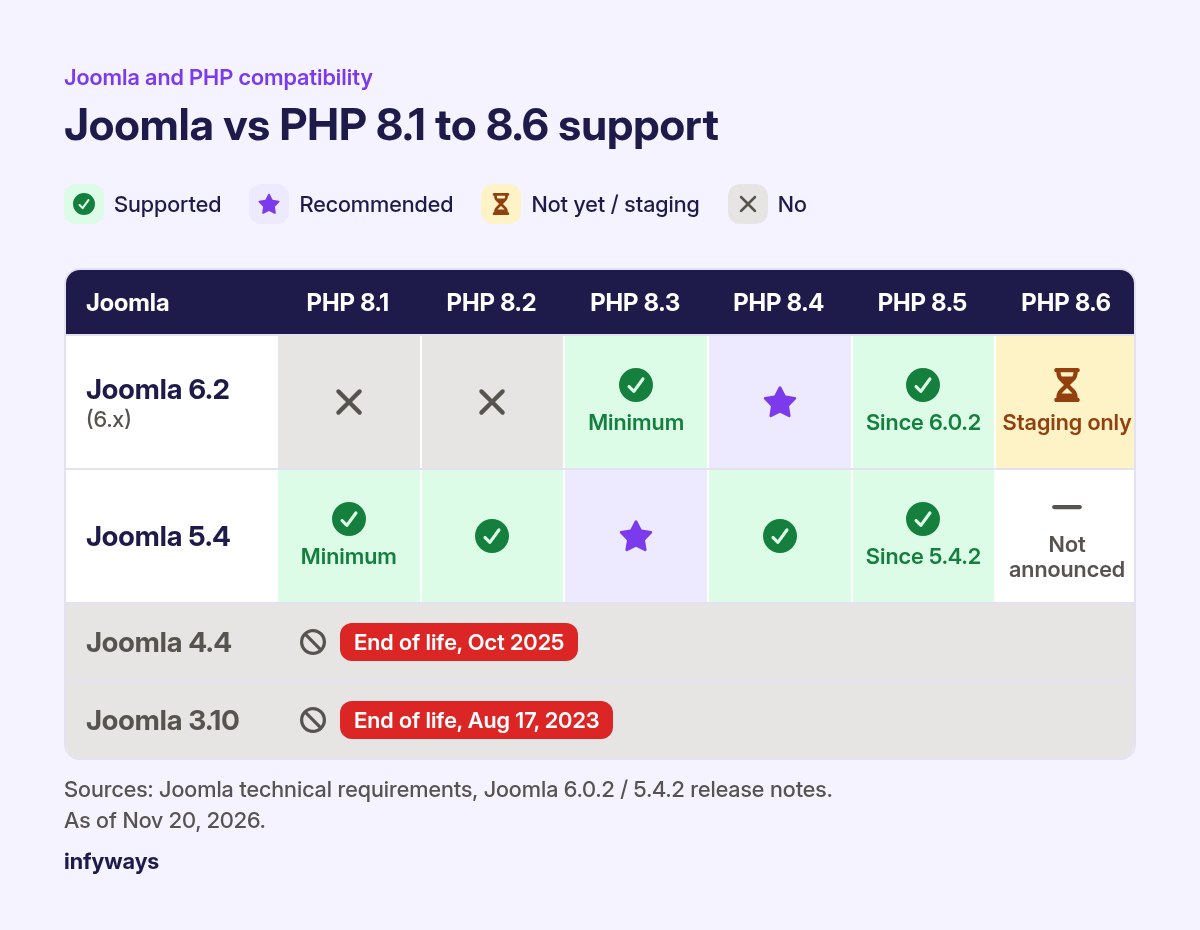
| Joomla | Support status | Minimum PHP | Recommended PHP | PHP 8.5 | PHP 8.6 |
|---|---|---|---|---|---|
| 6.2 (6.x) | Supported. Bug fixes to Oct 17, 2028, security to Oct 16, 2029 | 8.3.0 | 8.4 | Yes, since 6.0.2 | Not yet supported; staging only |
| 5.4 | Security fixes only, until Oct 12, 2027 (5.4.10 was the last bug-fix release) | 8.1.0 | 8.3 | Yes, since 5.4.2 | Not announced |
| 4.4 | End of life. Security support ended in October 2025 (last release 4.4.14) | 7.2.5 | 8.2 | No | No |
| 3.10 | End of life since Aug 17, 2023; extended LTS ended Feb 17, 2025 | 5.3.10 | 8.0 | No | No |
Which PHP versions are patched and supported?
Support dates are from php.net supported versions. Fixed versions are from the PHP 8 changelog
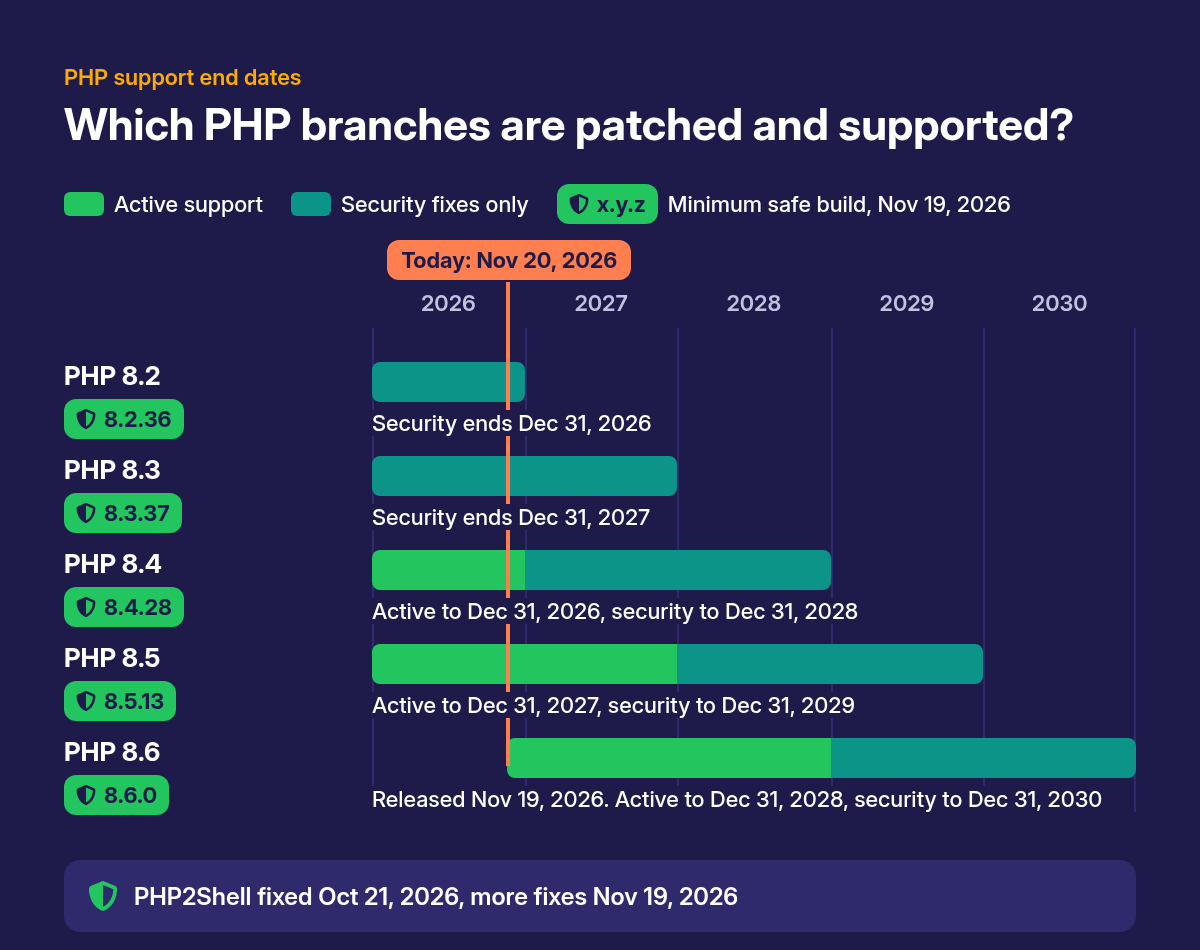
| PHP branch | Active support until | Security fixes until | PHP2Shell fixed in | Latest security release | Use with Joomla 6.2? |
|---|---|---|---|---|---|
| 8.6 | Dec 31, 2028 | Dec 31, 2030 | Fixed before release (8.6.0 RC4 onward) | 8.6.0 (Nov 19, 2026) | Staging only for now |
| 8.5 | Dec 31, 2027 | Dec 31, 2029 | 8.5.12 | 8.5.13 (Nov 19, 2026) | Yes |
| 8.4 | Dec 31, 2026 | Dec 31, 2028 | 8.4.27 | 8.4.28 (Nov 19, 2026) | Yes, recommended |
| 8.3 | Ended Dec 31, 2025 | Dec 31, 2027 | 8.3.36 | 8.3.37 (Nov 19, 2026) | Yes (minimum) |
| 8.2 | Ended Dec 31, 2024 | Dec 31, 2026 | 8.2.35 | 8.2.36 (Nov 19, 2026) | No (Joomla 5.4 only) |
| 8.1 and older | End of life | End of life | No official release | None | No |
PHP 8.2 loses all security support on December 31, 2026, so a Joomla 5.4 site on PHP 8.2 has about six weeks before its PHP stops getting fixes.
How has the security issue been addressed?
PHP: the October 21 emergency release
The PHP security team gave one day’s notice on October 20 and shipped PHP 8.5.12, 8.4.27, 8.3.36 and 8.2.35 on October 21, 2026. Both flaws are rated critical, CVSS v4.0 9.2 (GHSA-w8hw-w9fx-j79w, GHSA-6wmf-4rv5-p3rp):
- CVE-2026-109618, “RCE via OOM corruption”: when PHP runs out of memory mid-request, request data can be left half-initialized, and the cleanup step then trusts it. Oversized multipart uploads with huge numbers of headers or empty file fields are among the documented triggers.
- CVE-2026-109619, “RCE via stale global state”: internal state from one request can survive after its memory is freed, and the next request on the same PHP worker can use it.
The fix in every branch is the same changelog line: “Avoid state corruption via bailout.” PHP also published minimal source-only patches for 7.4, 8.0 and 8.1 for people who build PHP themselves, but no official releases for those end-of-life branches (php.net). On October 26, CISA added both CVEs to its Known Exploited Vulnerabilities catalog, which means it has evidence of active exploitation.
PHP: the October 23 follow-up and November 19 security releases
On October 23, php.net advised setting session.upload_progress.enabled=0 until the next release because of a related, unlikely session issue (CVE-2026-115560). After a “critical” pre-announcement on November 18 (php.net), PHP released 8.5.13, 8.4.28, 8.3.37 and 8.2.36 on November 19, alongside PHP 8.6.0, which includes the same fixes. php.net says the critical issues in this batch need non-default configuration or uncommon setups. Those most relevant to Joomla hosting:
| CVE | Problem | Who should care |
|---|---|---|
| CVE-2026-126714 | Partially overwritten session files can lead to remote code execution | Sites using file-based PHP sessions |
| CVE-2026-115560 | Session serializer mismatch can lead to remote code execution | Servers that switch the session serializer at runtime |
| CVE-2026-129496 | Timezone cache use-after-free can lead to remote code execution | All branches 8.2 to 8.6 |
| CVE-2026-129538 | PHP-CGI out-of-bounds read and write during PATH_INFO correction | Hosts running PHP as CGI |
| CVE-2026-129289 / 129291 | PHP-FPM request smuggling; PHP-FPM local privilege escalation | Most VPS and managed hosts (PHP-FPM) |
| CVE-2026-128090 | PHAR OpenSSL signature bypass via algorithm downgrade | Anything that verifies signed .phar files |
The full list, more than a dozen CVEs per branch, is in the PHP 8 changelog. If your host patched for PHP2Shell in October, you still need this November update.
Joomla: 26 core security fixes in August and September
Joomla cannot patch PHP, but the Joomla Security Strike Team has been busy with Joomla’s own code. Joomla 6.1.3 and 5.4.8 (August 18, 2026) fixed 10 issues, and Joomla 6.1.4 and 5.4.9 (September 29, 2026) fixed 16 more (release notes, Security Centre). Joomla 6.2.0 and 5.4.10 shipped after both and include them. The most serious:
| Joomla advisory | CVE | Impact | Affected | Fixed in |
|---|---|---|---|---|
| [20260914] MFA bypass through “remember me” cookies | CVE-2026-92227 | High | 4.0.0 to 5.4.8, 6.0.0 to 6.1.3 | 5.4.9 / 6.1.4 |
| [20260909] SSRF vectors in core extensions | CVE-2026-92222 | High | 4.0.0 to 5.4.8, 6.0.0 to 6.1.3 | 5.4.9 / 6.1.4 |
| [20260905] Arbitrary directory deletion via cache purge | CVE-2026-90915 | High | 4.0.0 to 5.4.8, 6.0.0 to 6.1.3 | 5.4.9 / 6.1.4 |
| [20260902] Unauthorized account creation via profile.save | CVE-2026-90907 | Moderate | 1.5.0 to 5.4.8, 6.0.0 to 6.1.3 | 5.4.9 / 6.1.4 |
| [20260915] / [20260916] InputFilter XSS filter bypasses | CVE-2026-92231 / 92232 | Moderate | 1.5.0 to 5.4.8, 6.0.0 to 6.1.3 | 5.4.9 / 6.1.4 |
| [20260807] MFA authentication bypass | CVE-2026-73337 | High | 4.0.0 to 5.4.7, 6.0.0 to 6.1.2 | 5.4.8 / 6.1.3 |
| [20260810] Unrestricted upload of SHTML files | CVE-2026-73373 | High | 1.0.0 to 5.4.7, 6.0.0 to 6.1.2 | 5.4.8 / 6.1.3 |
Look at the “Affected” column. Several of these go back to Joomla 1.5 or 1.0, which includes every Joomla 3 site. Those sites will never get a fix.
What changed in Joomla 6.2 for security
Joomla 6.2 adds a security flag for extension updates: developers can mark a release with a severity from None to Critical, and flagged updates are highlighted in System → Update → Extensions and on the dashboard (Joomla 6.2 release notes, PR #48127). The flag was backported to 5.4.9. Joomla 6.2 also adds XOAuth2 for SMTP, so the site no longer has to store your mail account password (see our Joomla SMTP OAuth2 guide).
What changed in PHP 8.6 that matters to Joomla?
PHP 8.6 is a feature release. Headline additions are partial function application, a \Time\Duration class, an Io\Poll API, clamp(), a SortDirection enum and default values for readonly properties (release announcement). Joomla core can’t use any of that syntax until PHP 8.6 becomes Joomla’s minimum. What affects Joomla sites today is the smaller print:
- Safer session defaults.
session.use_strict_modeandsession.cookie_httponlyare now on, andsession.cookie_samesitedefaults toLax. Joomla 6.2.0’s session code doesn’t set its own SameSite value, so the new default applies unless your php.ini sets one. Test anything that returns to your site with a cross-site POST, such as some payment gateways and single sign-on providers. - Session handlers must implement
create_sid()andvalidateId(), or PHP warns now and fails in PHP 9.0. - Deprecated functions include
spl_object_hash(),is_integer(),is_long(),is_double(),doubleval(),strcoll(),metaphone(), themb_ereg*()family andmb_split(),mysqli_get_charset()andmysqli_stmt_init()(full list). - Deprecated syntax:
returninsidefinally, returning a value from__construct()or__destruct(), a third argument todefine(), andlet,isor_as names. - Stricter functions: many now throw
ValueErrorfor invalid flags, out-of-range values or NUL bytes, includingarray_filter()with a bad mode,file_exists()andis_file()with NUL bytes, andnumber_format()with out-of-range decimals (backward-incompatible changes). - Quieter failures are now visible:
trim()also strips form feeds, andfclose(),file_put_contents()andcopy()returnfalsewhen flushing fails instead of ignoring it.
What exactly should Joomla site owners do?
Work through these steps in order. Steps 1 to 4 are urgent. Steps 5 and 6 are about PHP 8.6.
Step 1: Find your exact Joomla and PHP versions
In the Joomla administrator, open System → System Information. The System Information tab shows the PHP version, and the Joomla version is shown on the same page. Write down the full number, for example 8.4.27, not just 8.4. The last number decides whether you are patched. If you can’t log in, your hosting control panel shows the PHP version per domain.
Step 2: Get PHP onto a November 19 build
You are patched for PHP2Shell and the November fixes only on 8.5.13, 8.4.28, 8.3.37, 8.2.36 or 8.6.0 or newer. Linux distributions often backport fixes without changing the version number, so on a VPS also check your distribution’s security notices. On shared hosting, ask your host directly: “Is my account’s PHP built with the November 19, 2026 security fixes?” If your site runs PHP 8.1 or older, there is no official fix. Move to PHP 8.3 or newer, which for Joomla 3 and 4 also means upgrading Joomla (see below).
Step 3: Update Joomla core
Go to System → Update → Joomla and install 6.2.0, or 6.2.1 once it ships (scheduled for November 24). If you are staying on Joomla 5 for now, install 5.4.10, the last bug-fix release; 5.4 gets security fixes only until October 12, 2027 (Joomla 5.4.10 notes). Back up first. If an update fails, our guide to fixing Joomla update errors covers the usual causes.
Step 4: Update every extension and watch for the security flag
Open System → Update → Extensions, check for updates, and install them. On Joomla 6.2 and 5.4.9+, updates marked as security releases are highlighted, so do those first. Remove extensions you no longer use; an abandoned extension is a common way in.
Step 5: Keep live sites on PHP 8.4 or 8.5 for now
PHP 8.4 is Joomla 6’s recommended version and PHP 8.5 is fully supported. Both get security fixes until the end of 2028 and 2029. There is no security reason to rush to PHP 8.6: the November 19 releases bring 8.4 and 8.5 up to the same security level.
Step 6: Test PHP 8.6 on a staging copy
- Make a full copy of the site (files and database) on a staging subdomain, protected with a password.
- Switch only the staging copy to PHP 8.6.
- In System → Global Configuration → Server, set Error Reporting to “Maximum” on staging so notices are visible. Never do this on the live site.
- Test the administrator login (including two-factor), front-end login, forms, search, cart and checkout, payment returns and any single sign-on.
- Check the PHP error log and Joomla’s log folder, and note each warning’s file path. Paths under an extension’s folder tell you which developer to contact.
- Move the live site only after a Joomla release states PHP 8.6 support and your key extensions have done the same.
On the live site, keep Error Reporting at “System Default” or “None” and make sure your host has display_errors off. That single setting is what turns harmless deprecation notices into a broken login.
What do Joomla extension developers need to do?
Most PHP 8.6 work is small, mechanical changes. The examples below come straight from PHP 8.6’s deprecation list, and the first two are code Joomla 6.2.0 itself ships. Keep extension code compatible with PHP 8.3, Joomla 6’s minimum: don’t use PHP 8.6-only syntax such as partial application or readonly defaults until Joomla raises its minimum.
1. Replace spl_object_hash() with spl_object_id()
// Before: Joomla 6.2.0, libraries/src/Plugin/PluginHelper.php
$dispatcherHash = spl_object_hash($dispatcher);

// After: same uniqueness, an int instead of a string, no PHP 8.6 notice
$dispatcherId = spl_object_id($dispatcher);
If the value is used as an array key or concatenated into a cache key, cast it with (string) where a string is expected. This is the change proposed for core in PR #48520.
2. Drop the old type-check aliases
// Before (deprecated in PHP 8.6)
if (\is_integer($pk)) { /* ... */ }
$price = doubleval($input);
if (is_long($n) || is_double($x)) { /* ... */ }

// After
if (\is_int($pk)) { /* ... */ }
$price = floatval($input);
if (is_int($n) || is_float($x)) { /* ... */ }
3. Give custom session handlers create_sid() and validateId()
If your extension ships its own session storage, add both methods now. PHP 9.0 will make them part of SessionHandlerInterface.
final class MySessionHandler implements
    \SessionHandlerInterface,
    \SessionIdInterface,
    \SessionUpdateTimestampHandlerInterface
{
    // open(), close(), read(), write(), destroy(), gc() as before

    public function create_sid(): string
    {
        return bin2hex(random_bytes(16)); // 32-char ID from a CSPRNG
    }

    public function validateId(string $id): bool
    {
        // Return true only if this ID already exists in your storage.
        return $this->exists($id); // your own storage lookup
    }

    public function updateTimestamp(string $id, string $data): bool
    {
        return $this->touch($id); // refresh the stored timestamp
    }
}
4. Stop returning from finally blocks
// Before: deprecated, and it silently swallows the exception
try {
    $result = $model->save($data);
} finally {
    return $result ?? false;
}

// After: cleanup in finally, return after it
try {
    $result = $model->save($data);
} finally {
    $this->releaseLock();
}
return $result;
5. Move from mb_ereg functions to PCRE with the u modifier
// Before (deprecated; Oniguruma is no longer maintained)
$slug  = mb_ereg_replace('[^\p{L}\p{N}]+', '-', $title);
$parts = mb_split('\s+', $text);

// After
$slug  = preg_replace('/[^\p{L}\p{N}]+/u', '-', $title);
$parts = preg_split('/\s+/u', $text);
6. Convert objects before array-only functions
// Before (deprecated: passing an object where an array is expected)
$query = http_build_query($filterObject);
array_walk($registryObject, $callback);

// After
$query = http_build_query(get_object_vars($filterObject));
$data  = get_object_vars($registryObject);
array_walk($data, $callback);
7. Replace other deprecated calls
// strcoll() / SORT_LOCALE_STRING  ->  intl Collator
$collator = new \Collator('en_US');
$cmp = $collator->compare($a, $b);

// mysqli_stmt_init() + prepare()  ->  prepare() in one step
$stmt = $mysqli->prepare('SELECT id FROM #__my_table WHERE alias = ?');

// spl_classes()  ->  Reflection
$classes = (new \ReflectionExtension('spl'))->getClassNames();

// Constructors must not return values
public function __construct(private DatabaseInterface $db) {} // no "return $this;"
8. Find everything in one pass
Run this from your extension’s root folder to list the deprecated calls covered above:
grep -rnE --include='*.php' \
  'spl_object_hash\(|\bis_integer\(|\bis_long\(|\bis_double\(|\bdoubleval\(|mb_ereg|mb_split\(|strcoll\(|SORT_LOCALE_STRING|spl_classes\(|metaphone\(|stmt_init\(|get_charset\(|implements[^{]*SessionHandlerInterface' .
Then run your test suite on PHP 8.6 with error_reporting=E_ALL and display_errors=1, and add 8.6 to your CI matrix next to 8.3, 8.4 and 8.5. Static grep can’t find the new ValueError throws or the session cookie changes, so click through the extension’s real workflows too.
9. Flag your security releases
When you ship a security fix, add the new tag to that version’s entry in your update XML so Joomla 6.2 and 5.4.9+ highlight it:
<update>
    <name>My Extension</name>
    <element>com_myextension</element>
    <type>component</type>
    <version>2.4.1</version>
    <security>3</security> <!-- 0 None, 1 Low, 2 Medium, 3 High, 4 Critical -->
    <!-- downloads, targetplatform, etc. as usual -->
</update>
If you’d rather hand the porting work to someone who does it daily, our Joomla development team, which maintains 125 Joomla extensions, can audit and update custom extensions for PHP 8.6 and Joomla 6.
Still on Joomla 3 or Joomla 4? Upgrade now
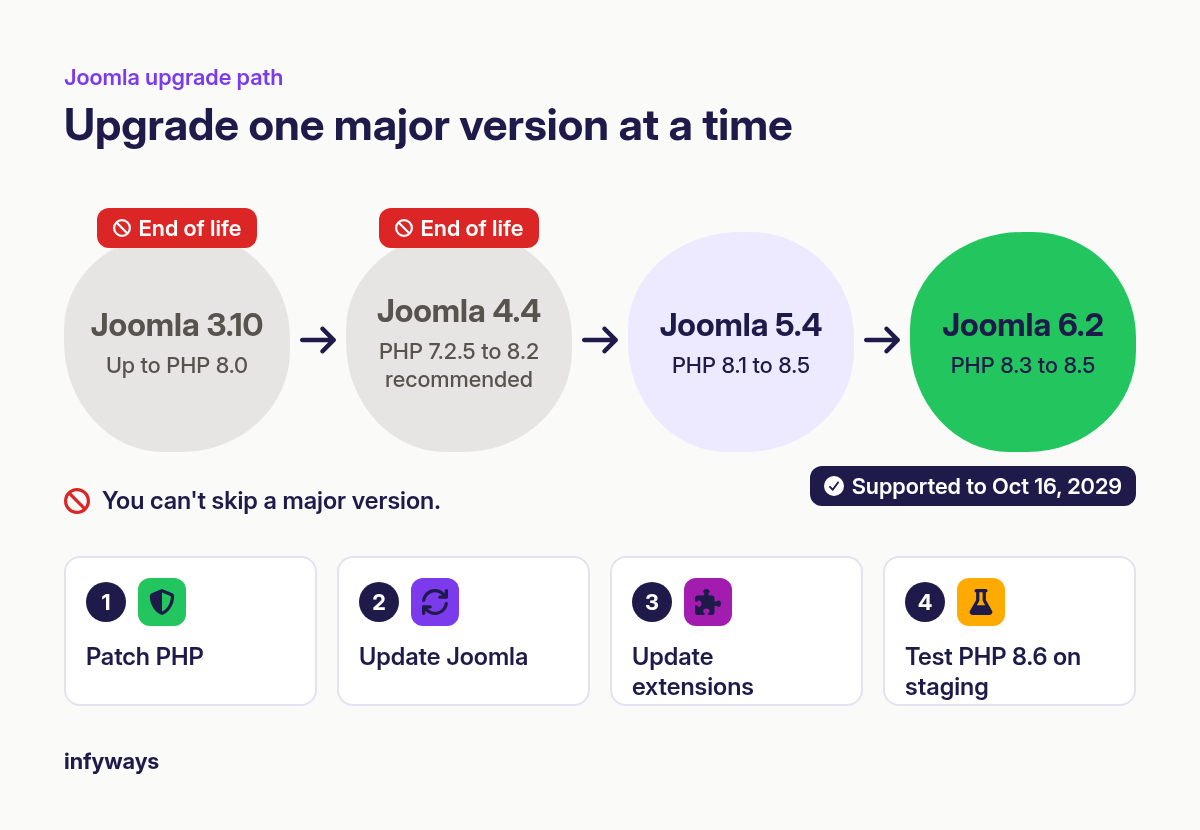
This is where the risk is concentrated. Joomla 3.10 is certified for PHP 8.0 at most (Joomla manual), and Joomla 4.4 lists PHP 8.2 as recommended. Every PHP branch that got the PHP2Shell fix is 8.2 or newer, and PHP 8.2 itself loses support on December 31, 2026. Joomla 3 and 4 also get no fixes for the Joomla core flaws above, several of which reach all the way back to Joomla 1.5.
- Staying on Joomla 3 or 4 means either an end-of-life PHP with no official PHP2Shell fix, or a newer PHP that the old Joomla was never built for, which usually means white screens and 500 errors.
- Joomla 6.2 runs on PHP 8.3 to 8.5 today, gets security fixes until October 16, 2029, and will be the version that gains PHP 8.6 support.
- The path is 3.10 → 4.4 → 5.4 → 6.2. You can’t skip a major version. Templates and extensions are usually the deciding factor, not core.
Our Joomla 3 to 6 upgrade guide walks through each hop, the free Joomla 6 compatibility check shows which extensions are ready, and common Joomla upgrade issues covers the errors people hit most. If you want it done for you, with the site tested on a patched PHP before go-live, that is exactly what our Joomla upgrade service covers.
What is the new course of action? Key dates
| Date | What happens | What you do |
|---|---|---|
| Now | PHP 8.2.36 / 8.3.37 / 8.4.28 / 8.5.13 and Joomla 6.2.0 / 5.4.10 are the safe builds | Patch PHP, update Joomla and extensions |
| Nov 24, 2026 | Joomla 6.2.1 and 5.4.11 scheduled; Joomla 6.3.0 Alpha 1 | Install 6.2.1 / 5.4.11 after a backup |
| Dec 31, 2026 | PHP 8.2 security support ends; PHP 8.4 moves to security-only | Move any PHP 8.2 site to 8.4 or 8.5 |
| Apr 13, 2027 | Joomla 6.3.0 scheduled; the core spl_object_hash() fix is labeled 6.3 | Recheck PHP 8.6 support in the release notes |
| Oct 12, 2027 | Joomla 5 security support ends | Be on Joomla 6 before this date |
| Dec 31, 2027 | PHP 8.3 security support ends (Joomla 6’s minimum) | Run Joomla 6 on PHP 8.4 or newer |
Dates are from the Joomla roadmap (last updated November 17, 2026) and php.net. Joomla notes its schedule can change.
Our recommendation for the next few months: run Joomla 6.2 on a fully patched PHP 8.4 or 8.5, subscribe to the Joomla Security Centre feed and php.net news, and move to PHP 8.6 in 2027 once a Joomla 6.x release and your extensions confirm support. Developers should fix PHP 8.6 deprecations now, while they are only notices.
Frequently asked questions
Is Joomla 6.2 compatible with PHP 8.6?
Not officially. Joomla 6.2 supports PHP 8.3 to 8.5 and recommends 8.4. On PHP 8.6 it shows deprecation notices and session warnings, and with error display on, the admin login can fail. Use PHP 8.6 on staging only until a Joomla release announces support.
Which PHP version should I use for Joomla right now?
PHP 8.4 (8.4.28 or newer) for Joomla 6, or PHP 8.5 (8.5.13 or newer). PHP 8.3.37 works but its security support ends December 31, 2027. Joomla 5.4 can also use 8.3, 8.4 or 8.5.
Does updating Joomla fix PHP2Shell?
No. PHP2Shell is a flaw in PHP itself, so only a fixed PHP build closes it: 8.2.35, 8.3.36, 8.4.27, 8.5.12 or newer, and ideally the November 19 releases. You still need to update Joomla for its own fixes.
Is PHP 8.6 more secure than PHP 8.5?
Not in a way that matters today. PHP 8.6.0 and 8.5.13 carry the same November 19 security fixes. PHP 8.6 adds safer session defaults, but a patched 8.4 or 8.5 is just as safe to run.
Can Joomla 3 run on a patched PHP version?
Not in a supported way. Joomla 3.10 is certified up to PHP 8.0, which gets no official fixes, and Joomla 3 itself has had no security updates since 2023. The lasting fix is upgrading to Joomla 6.2.
Will Joomla 5.4 get PHP 8.6 support?
Joomla hasn’t said. Joomla 5.4 is in security-only mode until October 12, 2027, so new PHP support isn’t guaranteed. Plan the move to Joomla 6 instead.
How do I know if an extension works on PHP 8.6?
Check the developer’s changelog or the Joomla Extensions Directory for a PHP 8.6 statement, then test it on a PHP 8.6 staging copy with error reporting at Maximum. Warnings naming the extension’s folder point to code that needs updating.
What is the Joomla security flag for updates?
A Joomla 6.2 feature, backported to 5.4.9, that lets developers mark an update as a security release with a severity from None to Critical. Flagged updates are highlighted in the update manager and on the dashboard.
Sources
- PHP 8.6 release announcement and migration guide (deprecations, incompatible changes)
- php.net: Supported versions
- php.net: Critical RCE security advisory, October 21, 2026; GHSA-w8hw-w9fx-j79w; GHSA-6wmf-4rv5-p3rp
- PHP 8 ChangeLog (8.2.36, 8.3.37, 8.4.28, 8.5.13, 8.6.0)
- CISA Known Exploited Vulnerabilities catalog
- Joomla Security Centre; Joomla 6.1.4 & 5.4.9 release; Joomla 6.2 release; Joomla 5.4.10 release
- Joomla 6.x technical requirements; Joomla 5.x requirements; Joomla 4.x and 3.x requirements (archived)
- Joomla roadmap
- joomla-cms #48218 (PHP 8.6 support); #48494; PR #48520; joomla-framework/session #69