Most people who want a Joomla helpdesk install osTicket next to Joomla and call it done. That is the mistake.
A Joomla helpdesk is a support ticket system that runs inside Joomla. Customers open and track tickets on your domain, with your users and ACL. osTicket is good software, and it is still a second PHP app. If you want an osTicket alternative for Joomla, that split is the whole decision.
A native Joomla helpdesk lives in the same site as your customers. osTicket sits beside it as another application.
I built Easy Helpdesk at Infyways after watching buyers log into Joomla, then get sent to another hostname to attach a screenshot. You do not need another case study. You have lived that ticket.
As of August 2026, Easy Helpdesk 1.0.31 is built for Joomla 5 and Joomla 6. It is on the JED and documented on JoomlaX.
What you will learn
- Why “osTicket plus Joomla” is not a Joomla helpdesk
- How a real Joomla support ticket should use your existing logins
- When osTicket is still the smarter call
- How to choose without reading a feature brochure
Why people install osTicket instead of a Joomla helpdesk
They need support tickets. They type Joomla helpdesk or Joomla support ticket into Google.
Then they install the first famous name they know.
osTicket shows up because it is free, old, and everywhere. Custom forms. Filters. SLA plans. A client portal. A knowledge base. All of that is real. Check the osTicket feature list if you want the source.
But wait.
osTicket is a separate PHP app with its own database and its own staff logins. Joomla already has PHP, MySQL, users, ACL, and a template.
So you now patch two stacks, brand two portals, and give the customer two “accounts.” That is the cost. Not the osTicket license. The community edition is free.
If you already run Joomla support and maintenance as a long-term site, a second helpdesk stack is extra work you will still be paying for in two years.
What a Joomla helpdesk actually is
A Joomla helpdesk installs as a Joomla package. Your visitor opens a support ticket in Joomla, tracks it on your domain, and an agent works the queue from a Joomla menu, not from a foreign admin skin on another subdomain.
If the desk does not use Joomla users, Joomla menus, and Joomla updates, it is not a Joomla ticketing system. It is a neighbour.
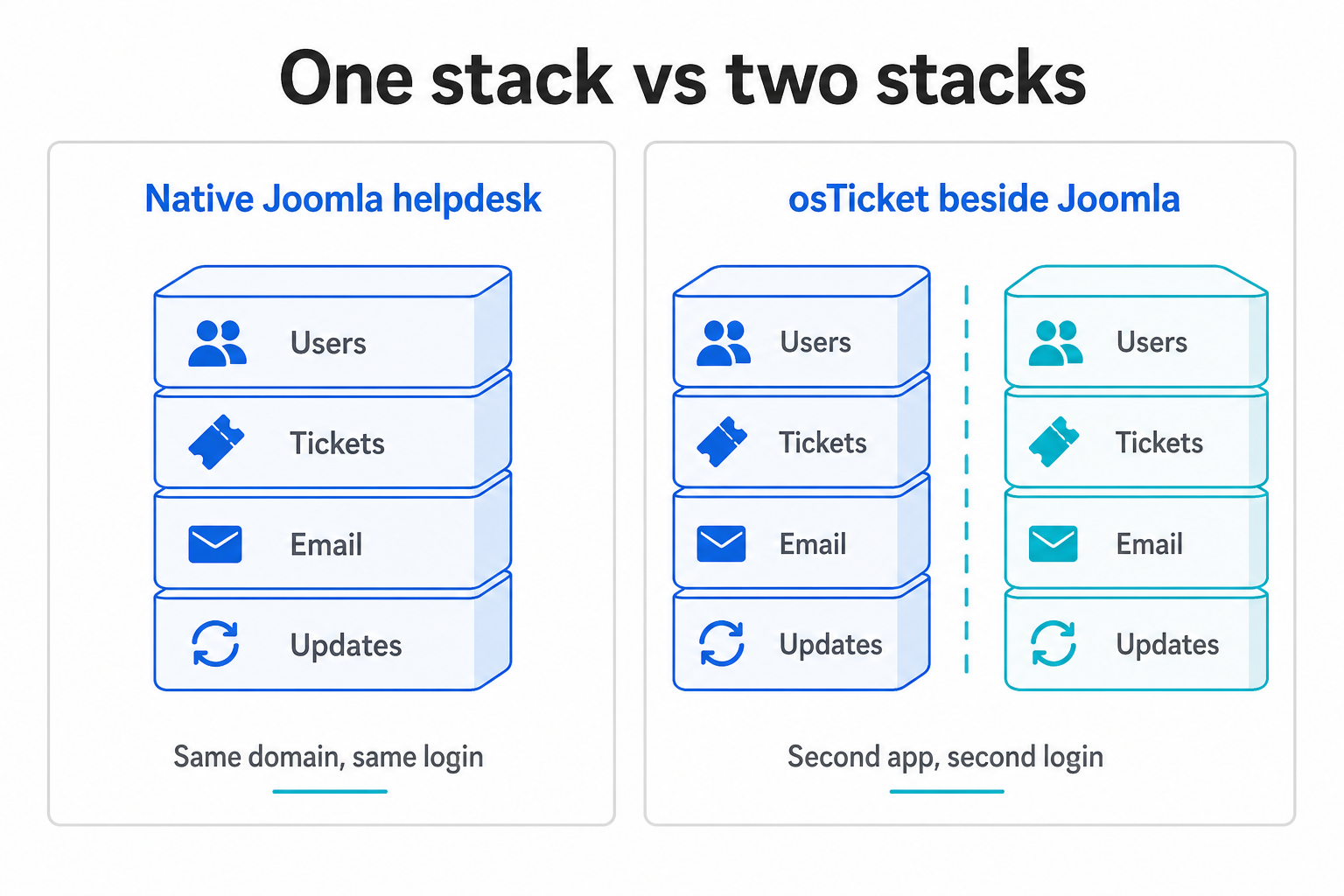
One stack means one login story. Two stacks means you patch Joomla and osTicket as separate products.
Easy Helpdesk is the native example I ship: portal, staff console, mail intake, SLA, knowledge base, reports. I am not going to paste the spec sheet here. You can open the JED or JoomlaX page if you want every toggle.
This is the same native-vs-bolted-on choice we keep making across the Joomla stack in 2026. Keep the product on the CMS when the CMS is the business.
Why this matters for your support tickets
Joomla is already the product. Support is part of that product.
When you bolt osTicket on the side, you teach customers that help is “over there.” They already have a Joomla login. They will not create another one for a screenshot.
Here’s why this matters.
A native Joomla support ticket reuses the session they have. Guests can still open a ticket without an account if you allow it, then come back by email link or ticket number. Agents can work the queue on the frontend so they are not living in /administrator all day.
osTicket can look fine. It still does not become Joomla unless you pay for glue you will own forever. Teams that already do custom Joomla development feel that glue as soon as ACL and membership collide.
5 checks before you pick an osTicket alternative for Joomla
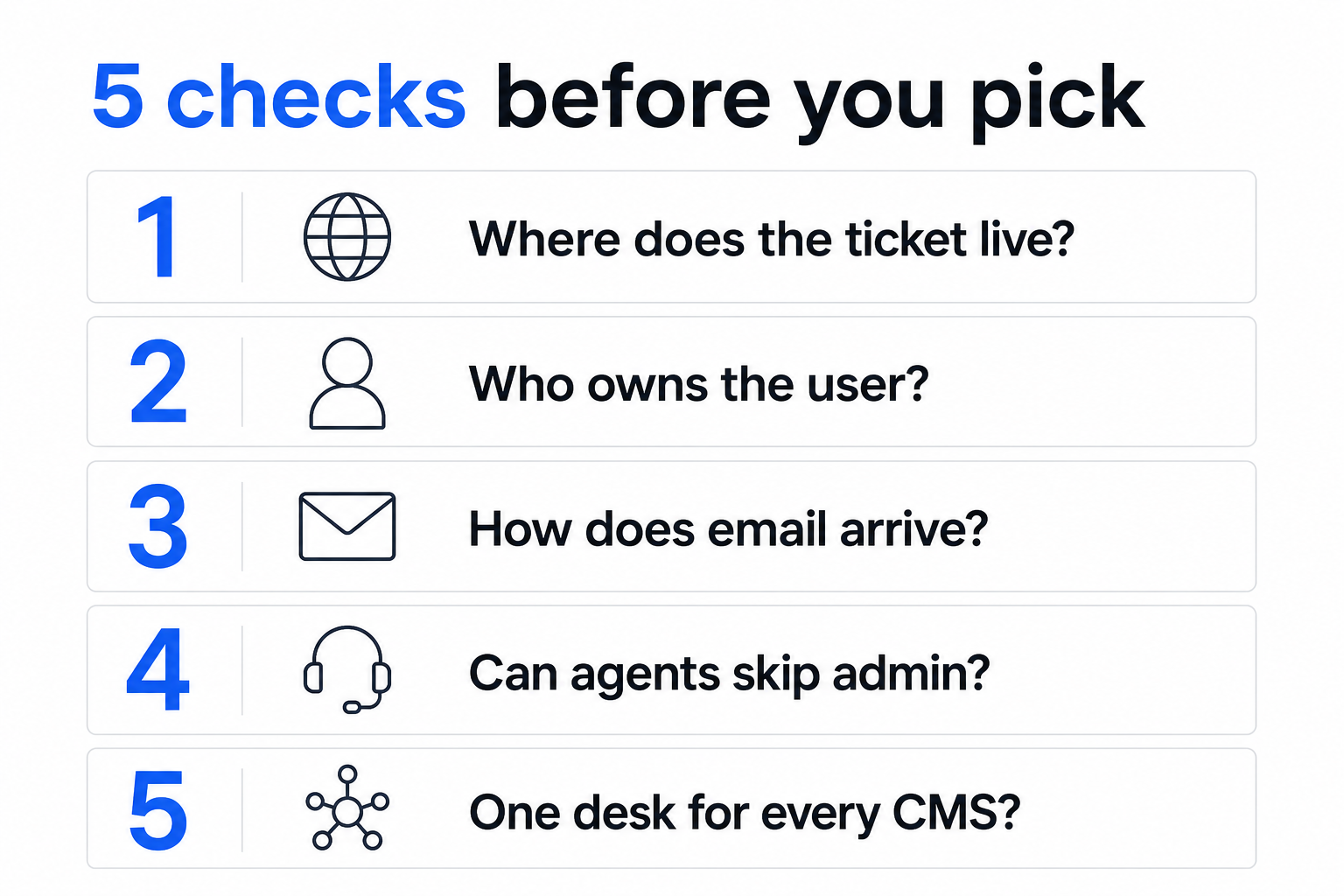
Use this as a buying filter. Not a slogan.
1. Where does the ticket live?
On your Joomla domain, or on support.somethingelse?
2. Who owns the user?
Joomla groups and ACL, or a second staff table?
3. How does email arrive?
Inside the same site’s scheduled tasks, or a mailbox only the other app understands?
4. Can agents work without the Joomla admin?
If the answer is no, your helpdesk will become a bottleneck.
5. Do you need one desk for every CMS?
If yes, stop. osTicket (or another standalone) is the honest fit.
If no, you want a native Joomla helpdesk.
Joomla helpdesk vs osTicket (the only table you need)
| Question | Native Joomla helpdesk | osTicket |
|---|---|---|
| What did you install? | A Joomla package | A second PHP app |
| Where does the customer sit? | Your site | osTicket’s portal |
| Logins | Joomla users | osTicket users |
| Knowledge base | Can sit in the Joomla workflow | Separate KB |
| Best for | Support tickets on one Joomla site | One queue for many platforms |
Bottom line: stay native if Joomla is the business. Stay on osTicket if the business is bigger than Joomla.
When you should still use osTicket
Do not force the alternative.
Use osTicket if you already trained a global team on it.
Use osTicket if WordPress, Shopify, and Joomla must share one queue.
Use osTicket if you want a free, CMS-agnostic core and you will treat hosting and upgrades as a second product.
Do not pick osTicket because it “sounds more enterprise.” A native Joomla desk can still do departments, SLA, canned replies, private notes, and ratings. The architecture is the differentiator. Not a vibe.
The money question, without the pitch
osTicket’s code is free.
A native Joomla helpdesk is usually a paid extension because someone has to keep it on Joomla 5 and 6.
You still pay for osTicket. You pay in extra server, extra logins, and tickets that never get filed.
That is the trade. Pick it with your eyes open.
Key takeaways
- A Joomla helpdesk runs on Joomla. osTicket runs beside it.
- Joomla support tickets should use your domain, your users, and your updates.
- Easy Helpdesk 1.0.31 (August 2026) is one osTicket alternative for Joomla 5 and 6. It is not the only possible native desk. It is the one built for this exact gap.
- Multi-CMS support still belongs on a standalone tool.
- Choose the architecture first. Then choose the product.
Frequently asked questions
Is Easy Helpdesk an osTicket alternative for Joomla?
Yes, if your support is Joomla-only. You get queues, email, SLA, and a knowledge base without a second user database. No, if one desk must cover several platforms.
What is the difference between a Joomla helpdesk and osTicket?
A Joomla helpdesk is an extension. osTicket is its own application. Same job on paper. Different home in production.
How should a Joomla support ticket work for the customer?
They submit on your site. They track it on your site. They do not create a second password unless you force that on purpose.
Can I just embed osTicket in Joomla?
You can iframe almost anything. You still have two apps to patch, two UIs to brand, and two identity models. That is a workaround, not a Joomla ticketing system.
Do I need Joomla administrator access to answer tickets?
You should not. Daily work belongs on a frontend staff queue. Admin is for setup and reports.
Is there a free osTicket alternative for Joomla?
osTicket is free, and it is not a Joomla extension. Native Joomla helpdesks are usually paid. You are buying the integration, not a slogan.
Conclusion
You have two honest options.
Run a Joomla helpdesk so a support ticket in Joomla stays on the site you already maintain.
Or run osTicket because you need a desk that does not care which CMS is in front.
Do not mix those goals and hope the customer will not notice.
If native is the call, look at how Easy Helpdesk is put together on JoomlaX and the JED listing. Then decide. Now it is your turn: pick the architecture this week, before you install another stack you did not need.