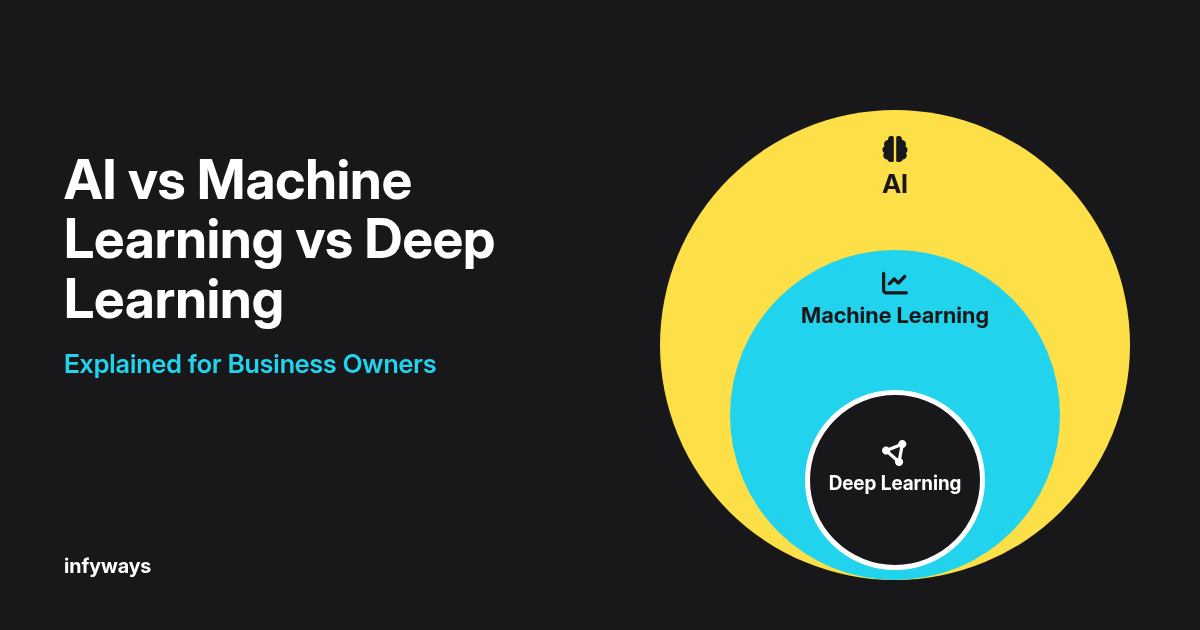
Artificial intelligence (AI) is the broad goal of making machines do tasks that need human-like intelligence. Machine learning (ML) is the main way to get there: systems that learn patterns from data instead of following fixed rules. Deep learning is a type of ML that uses many-layered neural networks, and it powers tools like ChatGPT.
Business owners hear these three terms used as if they mean the same thing. They don’t, and the difference matters when you pick a vendor, budget a project or judge a sales pitch. This guide explains each one in plain English, with a side-by-side table and examples, in the same format as our guide to generative AI vs AI agents vs agentic AI.
Key Takeaways
- AI is the umbrella term, ML is a subset of AI, and deep learning is a subset of ML.
- Classic ML works well on structured data such as spreadsheets and sales records.
- Deep learning handles unstructured data such as images, audio and text, but needs much more data and computing power.
- Most “AI” products businesses buy today are ML or deep learning under the hood.
- Start with the business problem and your data, not the technology label.
1. The Simple Picture: Three Nested Circles
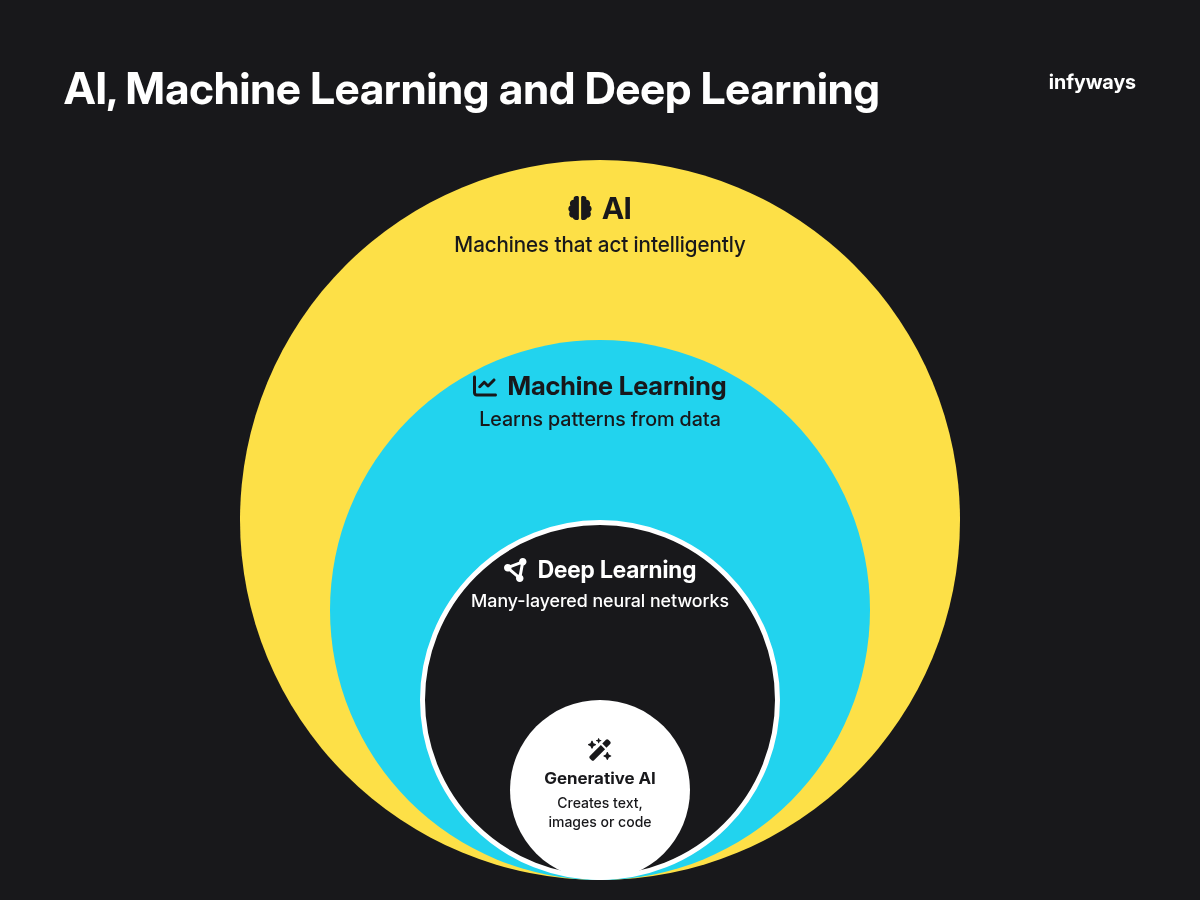
Think of AI, machine learning and deep learning as circles inside each other, from largest to smallest.
IBM describes them as a series of AI systems from largest to smallest, each encompassing the next: AI is the overarching system, machine learning is a subset of AI, deep learning is a subfield of machine learning, and neural networks are the backbone of deep learning. Google Cloud puts it more simply: AI is the broader concept, and ML is an application of AI that lets machines learn from data.
So every deep learning system is machine learning, and every machine learning system is AI, but not the other way round. A rule-based chatbot that follows a script is AI without machine learning.
2. What Is Artificial Intelligence?
AI is any technique that lets a computer do something we would normally call intelligent, such as understanding language, recognizing images or making decisions.
IBM defines AI as technology that enables computers and machines to simulate human learning, comprehension, problem solving, decision making, creativity and autonomy. That includes older approaches such as hand-written rules and expert systems, as well as modern learning systems.
- Business examples: a rules engine that flags orders over a set value for review, a chatbot that answers from a fixed FAQ, route planning software.
- Good to know: “AI” on a product page tells you little. Ask the vendor how the system actually works and what data it uses.
3. What Is Machine Learning?
Machine learning is AI that learns patterns from data, so it improves with examples instead of needing every rule written by hand.
AI pioneer Arthur Samuel defined machine learning in the 1950s as “the field of study that gives computers the ability to learn without explicitly being programmed”. MIT Sloan notes that when companies deploy AI today, they are most likely using machine learning. IBM’s guide to machine learning explains the main types: supervised learning from labeled examples, unsupervised learning that finds groups in unlabeled data, and reinforcement learning that learns by trial and reward.
- Business examples: sales forecasting, credit and fraud scoring, product recommendations, predicting which customers might cancel.
- Best with: structured data in rows and columns, such as CRM, order and finance records.
4. What Is Deep Learning?
Deep learning is machine learning that uses neural networks with many layers, which lets it learn directly from raw images, sound and text.
The “deep” refers to the number of layers. IBM says a neural network of more than three layers, including the inputs and the output, can be considered a deep learning algorithm. Deep learning took off in the late 2000s and early 2010s, helped by advances in GPUs that made the heavy computation practical. The 2015 Nature review by LeCun, Bengio and Hinton explains how deep learning lets models learn representations of data with multiple levels of abstraction, which drove big gains in speech and image recognition.
- Business examples: chatbots built on large language models, image recognition for quality control, speech-to-text, document reading and translation.
- Best with: unstructured data and problems where accuracy matters more than explaining each decision.
5. AI vs Machine Learning vs Deep Learning Compared
Here is the side-by-side view business owners usually need.
| Artificial intelligence | Machine learning | Deep learning | |
|---|---|---|---|
| What it is | The broad field of making machines act intelligently | A subset of AI that learns from data | A subset of ML that uses many-layered neural networks |
| How it works | Rules, search, logic or learning | Algorithms find patterns in examples | Layers of artificial neurons learn features automatically |
| Data needed | Varies; rules-based AI needs none | Moderate, often structured data | Large amounts, often unstructured data |
| Computing power | Low to high | Low to moderate; runs on ordinary servers | High; usually needs GPUs |
| Explainability | High for rules-based systems | Often fairly explainable | Hard to explain decision by decision |
| Typical examples | Rule engines, scripted chatbots, route planning | Forecasting, fraud scoring, recommendations | ChatGPT-style assistants, image and speech recognition |
Key insight: if your problem lives in a spreadsheet, classic machine learning is often cheaper, faster and easier to explain than deep learning.
6. Where Generative AI Fits
Generative AI, such as ChatGPT, Claude and Gemini, is a type of deep learning that creates new text, images or code.
Large language models are deep neural networks trained on huge amounts of text. That puts generative AI inside the deep learning circle. AI agents then build on these models to plan and take actions. Our guides to generative AI vs AI agents vs agentic AI and how to build an AI agent cover that next layer.
7. Which One Does Your Business Need?
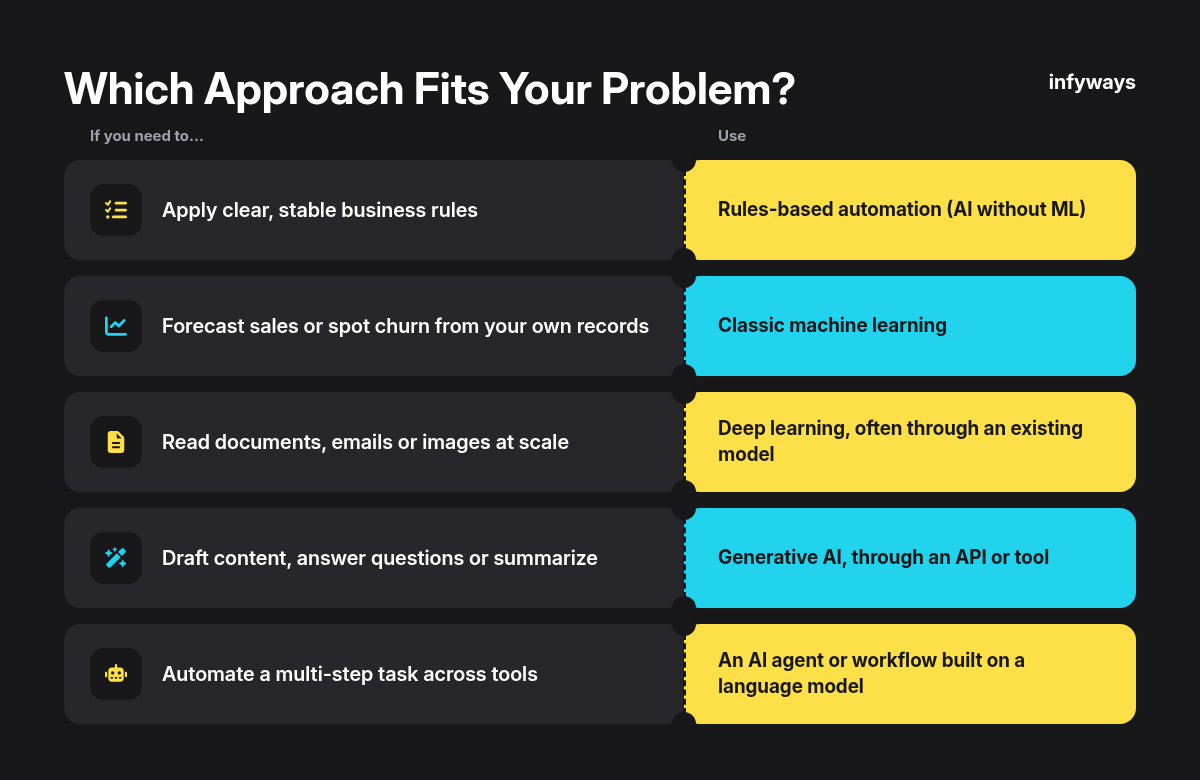
Pick the simplest approach that solves the problem with the data you already have.
| If you want to… | Usually the right fit |
|---|---|
| Apply clear, stable business rules | Rules-based automation (AI without ML) |
| Forecast sales or spot churn from your own records | Classic machine learning |
| Read documents, emails or images at scale | Deep learning, often through an existing model |
| Draft content, answer questions or summarize | Generative AI, through an API or tool |
| Automate a multi-step task across tools | An AI agent or workflow built on a language model |
AI use is now mainstream. Stanford’s 2025 AI Index reports that 78% of organizations reported using AI in 2024, up from 55% the year before. Most small businesses don’t need to train their own models: they use existing models through tools and APIs, and spend their effort on clean data and good processes. For managing risk, the NIST AI Risk Management Framework is a useful, free reference.
If you want help turning a use case into a working system, our team builds AI automation and agent workflows for small and mid-sized businesses.
8. Where to Start Learning
You can learn the basics for free, then go deeper if you or your team will build these systems.
- Elements of AI: a free online course for non-experts, created by the University of Helsinki and MinnaLearn.
- Google’s Machine Learning Crash Course: a practical introduction with videos, visualizations and exercises.
- Machine Learning Specialization: a beginner 3-course program by Andrew Ng, about 2 months at 10 hours a week.
- Deep Learning Specialization: an intermediate 5-course program, about 3 months at 10 hours a week.
- Practical Deep Learning for Coders: a free fast.ai course for people with some coding experience, with 9 lessons of about 90 minutes each.
If you are thinking about a career in the field, our roadmap on how to become an AI engineer sets out the skills and order to learn them.
Frequently Asked Questions
Is machine learning the same as AI?
No. Machine learning is a subset of AI. AI is the broad goal of making machines act intelligently, and machine learning is one way to reach it, by learning patterns from data. Some AI, such as rule-based systems, uses no machine learning at all.
What is the difference between deep learning and machine learning?
Deep learning is a type of machine learning that uses neural networks with many layers. Classic machine learning usually needs people to choose the features in the data, while deep learning learns features directly from raw images, audio or text. Deep learning needs much more data and computing power.
Is ChatGPT AI, machine learning or deep learning?
All three. ChatGPT is built on a large language model, which is a deep learning model. Deep learning is a type of machine learning, and machine learning is a type of AI. More specifically, ChatGPT is generative AI, because it creates new text.
Which is better for a small business, machine learning or deep learning?
Neither is better in general. Classic machine learning suits structured data such as sales and customer records and is easier to explain. Deep learning suits text, images and audio. Most small businesses use deep learning through ready-made tools rather than training their own models.
Do I need to understand AI to use it in my business?
You don’t need to understand the math, but knowing the basic difference between AI, machine learning and deep learning helps you ask vendors better questions, set realistic budgets and judge which problems are worth automating.
The Bottom Line
AI is the goal, machine learning is the main method, and deep learning is the powerful subset behind today’s generative AI.
Start with a clear business problem and the data you have, use the simplest approach that works, and lean on existing models before you build your own.
Sources
- IBM, “AI vs. Machine Learning vs. Deep Learning vs. Neural Networks”. Checked November 12, 2026.
- Google Cloud, “AI vs. machine learning”. Checked November 12, 2026.
- IBM, “What is artificial intelligence (AI)?”. Checked November 12, 2026.
- MIT Sloan, “Machine learning, explained”. Checked November 12, 2026.
- IBM, “What is machine learning?”. Checked November 12, 2026.
- IBM, “What is deep learning?”. Checked November 12, 2026.
- LeCun, Bengio and Hinton, “Deep learning”, Nature (2015). Checked November 12, 2026.
- Stanford HAI, “The 2025 AI Index Report”. Checked November 12, 2026.
- NIST, “AI Risk Management Framework”. Checked November 12, 2026.
- University of Helsinki and MinnaLearn, “Elements of AI”. Checked November 12, 2026.
- Google for Developers, “Machine Learning Crash Course”. Checked November 12, 2026.
- DeepLearning.AI and Stanford on Coursera, “Machine Learning Specialization”. Checked November 12, 2026.
- DeepLearning.AI on Coursera, “Deep Learning Specialization”. Checked November 12, 2026.
- fast.ai, “Practical Deep Learning for Coders”. Checked November 12, 2026.