Chris, a dedicated Joomla website owner, had recently installed the UniLogin plugin, making it easier for his users to log in using their email addresses.
However, Chris soon encountered another challenge. He noticed that the default Joomla registration form had too many fields, causing potential users to lose patience and abandon the registration process.
Who has the time or patience to fill out long forms? Have you ever been frustrated by a lengthy registration process? Chris realized that by simplifying the registration form, he could improve the user experience and increase the number of successful registrations.
The Search for a Solution
Chris wanted to streamline the registration process by removing the Username and Confirm Password fields, making the form quicker and easier to complete. He reached out to us with his problem statement, asking for a solution that wouldn’t require changes to Joomla’s core files or complex overrides.
To find a ready-made solution, we searched through the Joomla Extensions Directory (JED) but couldn’t find any plugins that met our needs and were compatible with Joomla 4 or Joomla 5. This led us to develop a custom plugin tailored to Chris’s requirements.
The Birth of Registration Simplifier
We understood Chris’s need for a more efficient registration process. So, we proposed developing a custom user plugin. This plugin would allow administrators to:
Remove Username Field: Simplifying the form by removing the username requirement.
Remove the Confirm Password Field: Further reducing the number of fields users need to fill out.
Set Username as Email During Registration: Streamlining the registration process by using the email address as the username.
Chris was excited about this solution, and thus, the Registration Simplifier plugin was born.
Implementation and User Experience
Once the plugin was developed, Chris installed the Registration Simplifier on his Joomla website. The process was straightforward:
Download and Install: Chris purchased the plugin from the JoomlaX Store for $30. He then installed it on his Joomla website.
Enable the Plugin: After installation, he enabled the plugin from the Joomla plugin manager.
Configure the Plugin: Chris configured the plugin settings to hide the username field and remove the confirm password field. The plugin automatically set the username as the email address during registration.
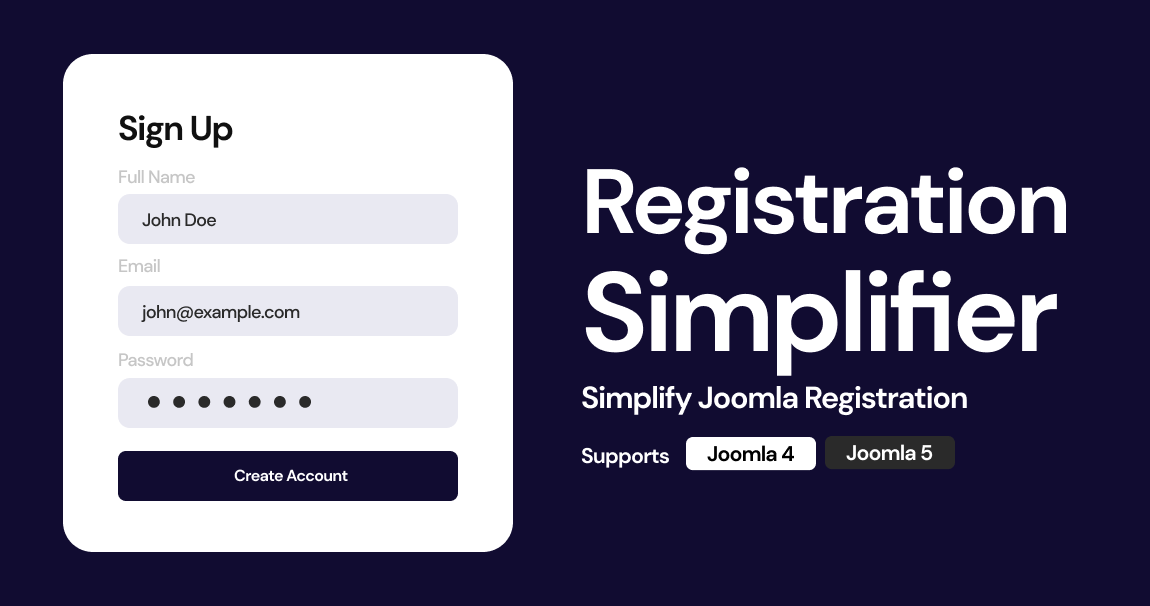
The new, simplified registration form now included only the fields for Name, Password, and Email. This streamlined approach significantly reduced the time and effort required for new users to create an account.
A Smoother Registration Process
Have you noticed users abandoning your site because the registration form is too long?
After implementing the Registration Simplifier plugin, Chris noticed a significant improvement. Users were no longer deterred by the lengthy form and could quickly complete their registration.
The simplified process led to an increase in successful registrations and a more satisfied user base.
Benefits of Registration Simplifier
Enhanced User Experience: By simplifying the registration form, users can quickly and easily create an account.
Increased Registration Success: Removing unnecessary fields reduces the chances of users abandoning the registration process.
Simple and Effective: The plugin is easy to install and configure, requiring minimal effort from site administrators.
Conclusion
Chris’s journey from facing registration challenges to achieving a streamlined process highlights the importance of user-friendly solutions.
The Registration Simplifier plugin transformed the registration experience for his users, ensuring a quick and easy process.
This plugin is compatible with both Joomla 4 and Joomla 5, making it a versatile solution for various Joomla versions.
Are you facing similar registration issues on your Joomla site? The Registration Simplifier is the perfect solution. It’s time to enhance your user experience and simplify your registration process.
Meet Chris, a dedicated Joomla website owner. Chris loves the flexibility and robustness of Joomla for managing his site. However, he noticed a recurring issue: his users struggled to log in because Joomla’s default option required a username.
Imagine being a regular visitor to a site, eager to log in and access your account, only to realize you’ve forgotten your username.
Frustrating, right? Chris’s users felt the same way. Many times, they would end up resetting their usernames, wasting valuable time and feeling annoyed.
Chris knew he needed a better solution, one that would allow users to log in with their email addresses, just like most modern platforms.
The Search for a Solution
Chris started his search for a plugin that would enable email logins on Joomla. He combed through the Joomla Extensions Directory (JED), hoping to find a perfect match.
He posted questions on forums, seeking advice from the Joomla community. Unfortunately, his efforts were in vain. None of the available solutions met his requirements or supported the latest Joomla versions.
Feeling a bit frustrated but not ready to give up, Chris decided to reach out to us for help. He pinged us on Skype, detailing his problem and asking if we could create a custom solution.
The Birth of UniLogin
We understood Chris’s predicament immediately. Changing core Joomla files wasn’t an option, as it could lead to issues during updates.
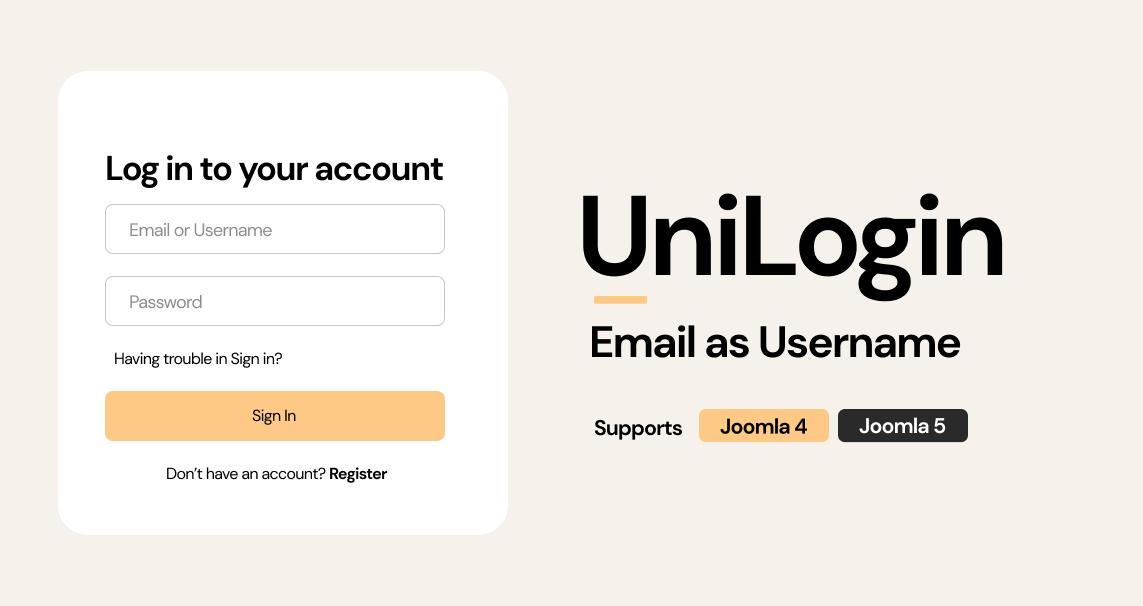
Instead, we proposed developing a custom authentication plugin that would allow users to log in using either their email address or username. Chris was thrilled with this idea, and thus, the UniLogin plugin was born.
The development process was smooth. We worked closely with Chris, ensuring every detail was perfect. Once the plugin was ready, we named it UniLogin, symbolizing a unified login experience.
Implementation and User Experience
Excited about the new solution, Chris installed the UniLogin plugin on his Joomla website. The installation process was straightforward:
Download and Install: Chris purchased the plugin from the JoomlaX Store for just $20. He then installed it on his Joomla website.
Enable the Plugin: After installation, he enabled the plugin from the Joomla Extensions Manager.
Update Login Text: To ensure clarity for his users, Chris updated the login form text from “Username” to “Email or Username”.
Here’s how he did it:
Updating the Login Form Text
For the Login Form:
Navigate to Extensions > Language(s) > Overrides.
Select your language.
Create a new override.
Search for COM_USERS_LOGIN_USERNAME_LABEL.
Set the override text to “Email or Username”.
For the Login Module:
Go to Extensions > Language(s) > Overrides.
Select your language.
Create a new override.
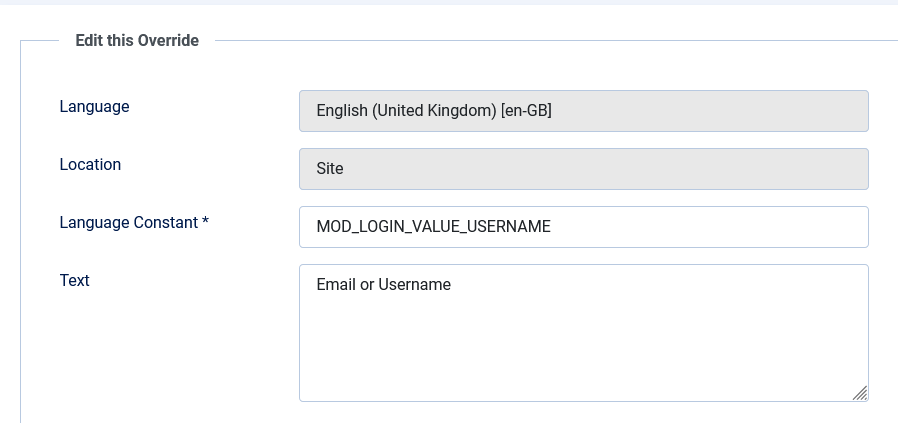
Search for MOD_LOGIN_VALUE_USERNAME.
Set the override text to “Email or Username”.
A Happier User Base
After implementing UniLogin, Chris noticed a significant change. His users no longer struggled with forgotten usernames. The login process became seamless, and user satisfaction soared. Returning customers were particularly happy, as they could now log in with ease, using their email addresses.
Benefits of UniLogin
Enhanced User Experience: The plugin eliminated the hassle of username resets, making users happier and more satisfied.
Increased Efficiency: The dual login option saved time for users and site administrators alike.
Simple and Effective: UniLogin was easy to install and use, requiring minimal configuration.
Conclusion
Chris’s journey from frustration to satisfaction with his Joomla website login process highlights the importance of user-friendly solutions. UniLogin transformed the login experience for his users, ensuring they could access their accounts effortlessly. This plugin is compatible with both Joomla 4 and Joomla 5, making it a versatile solution for various Joomla versions.
If you’re facing similar login issues on your Joomla site, UniLogin is the perfect solution. It’s time to enhance your user experience and simplify your login process.
Ready to simplify your login process?Download UniLogin now and give your users the seamless experience they deserve.
If you’re facing any issues with Joomla and can’t find a solution, don’t hesitate to reach out to us via Skype or our contact form. We are Joomla experts with over 15 years of experience, providing solutions to over 1,000 clients worldwide. Whether it’s troubleshooting, customization, or any other Joomla-related problem, you can be assured that we will find a solution to your problem.
Creating links to documents in Joomla is a straightforward process. In this guide, we’ll walk you through the steps to link documents using different methods available in Joomla.
Step 1: Prepare Your Document
Before you can link a document, you need to ensure it’s uploaded to your Joomla site. You can do this via the Joomla Media Manager or by directly uploading it to your server via FTP.
Using Joomla Media Manager:
Navigate to Media Manager:
Go to Content > Media.
Create a New Folder (Optional):
If desired, create a new folder named docs to organize your documents.
Upload Your Document:
Click on Upload.
Select your document file (e.g., PDF, DOCX) and upload it.
Get the Document Link:
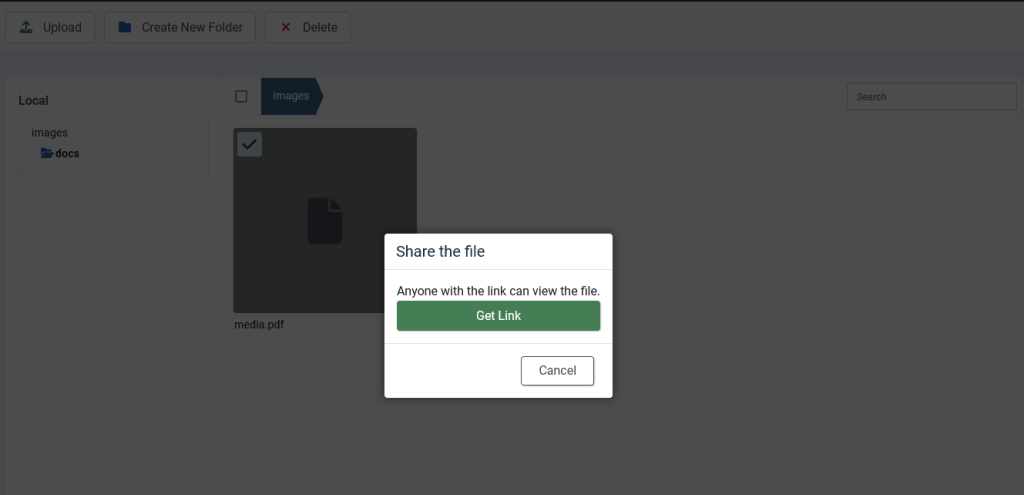
Once the file is uploaded, click the three dots in the top corner of the file.
Select the Get Link option. A popup will appear with a Get Link button.
Click this button to copy the link to your clipboard for later use.
Troubleshooting Upload Issues
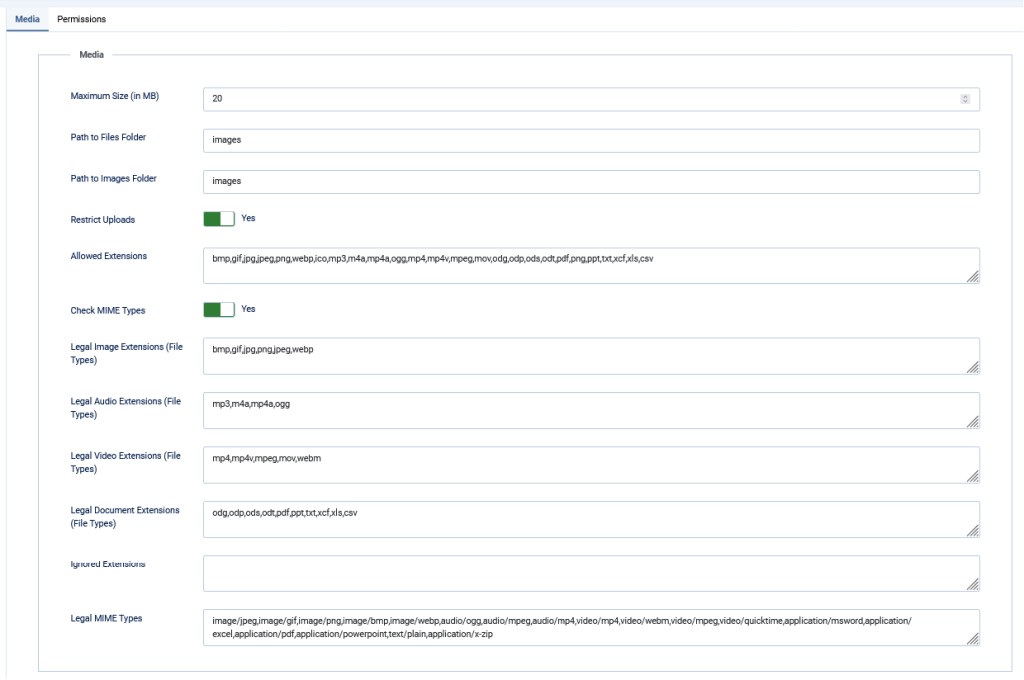
If you encounter the error “Unable to upload file or This file type is not supported.,” you can address this issue by adjusting the Media Manager options. Here’s how to do it:
Go to the options of the Media Manager and check the configurations as described in the troubleshooting section of this guide.
Maximum Size (in MB):
Description: This setting specifies the maximum size of a file that can be uploaded via the Media Manager.
Current Setting: 10 MB.
Usage: Files larger than this size will be rejected during upload. Adjust this value based on your needs and server limitations.
Path to Files Folder:
Description: This sets the directory path where non-image files (like documents, audio, video) are stored.
Current Setting: images.
Usage: You can change this path if you prefer to organize your files in a different directory within your Joomla installation.
Path to Images Folder:
Description: This sets the directory path where image files are stored.
Current Setting: images.
Usage: Similar to the files folder, you can change this to organize your images in a different directory.
Allowed Extensions:
Description: This is a comma-separated list of file extensions that are allowed to be uploaded via the Media Manager.
Current Setting: bmp,gif,jpg,jpeg,png,webp,ico,mp3,m4a,mp4a
Usage: Ensure that all required file types for your website are included in this list to prevent upload issues.
Check MIME Types:
Description: This toggle ensures that the file’s MIME type is checked against the allowed MIME types list.
Current Setting: Enabled (Yes).
Usage: This adds an extra layer of security to verify the file type being uploaded matches its MIME type.
Legal Image Extensions (File Types):
Description: This is a list of image file extensions that are legally allowed to be uploaded.
Current Setting: bmp,gif,jpg,png,jpeg,webp.
Usage: Defines which image formats are permissible for upload.
Legal Audio Extensions (File Types):
Description: This is a list of audio file extensions that are legally allowed to be uploaded.
Current Setting: mp3,m4a,mp4a,ogg.
Usage: Defines which audio formats are permissible for upload.
Legal Video Extensions (File Types):
Description: This is a list of video file extensions that are legally allowed to be uploaded.
Current Setting: mp4,mp4v,mpeg,mov,webm.
Usage: Defines which video formats are permissible for upload.
Legal Document Extensions (File Types):
Description: This is a list of document file extensions that are legally allowed to be uploaded.
Current Setting: odg,odp,ods,odt,pdf,ppt,txt,xcf,xls,csv.
Usage: Defines which document formats are permissible for upload.
Ignored Extensions:
Description: This is a list of file extensions that should be ignored during the upload process.
Current Setting: Empty.
Usage: Use this to specify any file types that should be excluded from upload considerations.
Legal MIME Types:
Description: This is a list of MIME types that are legally allowed to be uploaded.
Current Setting: A comprehensive list of MIME types including image/jpeg, image/gif, image/png, image/bmp, image/webp, audio/ogg, audio/mpeg, video/mp4, application/msword, application/excel, etc.
Usage: This ensures that only files with these MIME types can be uploaded, adding a layer of security to prevent malicious uploads.
These settings collectively manage the types of files that can be uploaded to your Joomla site, their sizes, and their storage locations. Adjusting these configurations can help resolve common upload issues and ensure your site operates smoothly.
Alternately you can upload file through FTP if you have FTP access.
Using FTP:
Connect to your website’s server using an FTP client.
Upload your document to a directory within your Joomla installation (e.g., images/docs).
Step 2: Create a Menu Item or Article
To create a link to your document, you can either insert it into an article or create a direct menu link.
Inserting a Link in an Article
Create or Edit an Article:
Go to Content > Articles > Add New Article (or open an existing article).
In the editor, type the text you want to link (e.g., “Download PDF”).
Link the Text to Your Document:
Highlight the text you want to link.
Click on the Insert/Edit Link icon (usually represented by a chain link).
In the URL field, enter the path to your document (e.g., images/docs/yourfile.pdf).
Set the Target to _blank if you want the document to open in a new tab.
Click Insert.
Creating a Direct Menu Link
Create a New Menu Item:
Navigate to Menus > [Your Menu] > Add New Menu Item.
In the Menu Item Type field, click on External URL.
Link to Your Document:
In the Link field, enter the full URL of your document (e.g., http://yourwebsite.com/images/docs/yourfile.pdf).
Set other parameters like Menu Title and Target Window.
Click Save & Close.
Best Practices for Linking Documents
Keep URLs Short and Descriptive: Ensure your document URLs are concise and meaningful to improve readability and SEO.
Use Clear Link Text: The text for your links should clearly describe the document. For example, use “Download Annual Report” instead of “Click Here”.
Organize Your Documents: Use folders and subfolders to keep your documents organized, making them easier to manage.
Conclusion
Linking documents in Joomla is a simple yet powerful way to provide resources to your site visitors. Whether you’re inserting links into articles or creating direct menu links, Joomla offers flexible options to meet your needs. By following the steps outlined above, you can enhance your site’s functionality and provide valuable content to your audience.
The digital landscape constantly evolves, and content management systems like Joomla are no exception. With the upgrade from Joomla 4.4 to Joomla 5, many users were startled to see the absence of the default Joomla Captcha plugins. This absence can be disconcerting, especially when considering the essential role Captcha plays in safeguarding websites against spam attacks. However, as with most tech challenges, there’s a solution awaiting discovery.
The Rising Need for Captcha in Today’s Digital Age
In the contemporary web environment, user data protection and website security have become paramount. Spam attacks can not only disrupt user experience but also pose security threats, such as DDoS attacks or database breaches. Captchas act as the first line of defense against such attacks, differentiating human users from malicious bots.
The ReCaptcha 3 Solution for Joomla 5
Understanding the pressing need for a resilient and user-friendly Captcha solution, we took the mantle and developed the ReCaptcha 3 plugin for Joomla 5. This state-of-the-art plugin offers a seamless user experience while maintaining the integrity of site security.
A Simple Setup Process:
Installation: Download and install the ReCaptcha 3 plugin onto your Joomla platform.
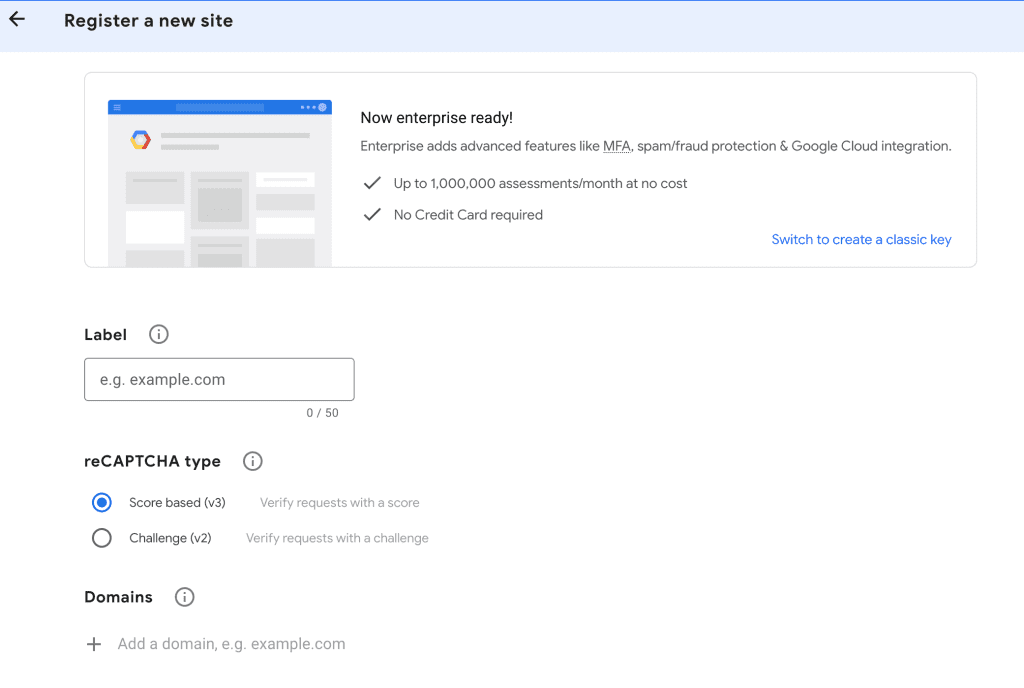
Create a new site by clicking on the ‘+’ icon. Ensure you select ‘reCAPTCHA v3’ and register your domain.
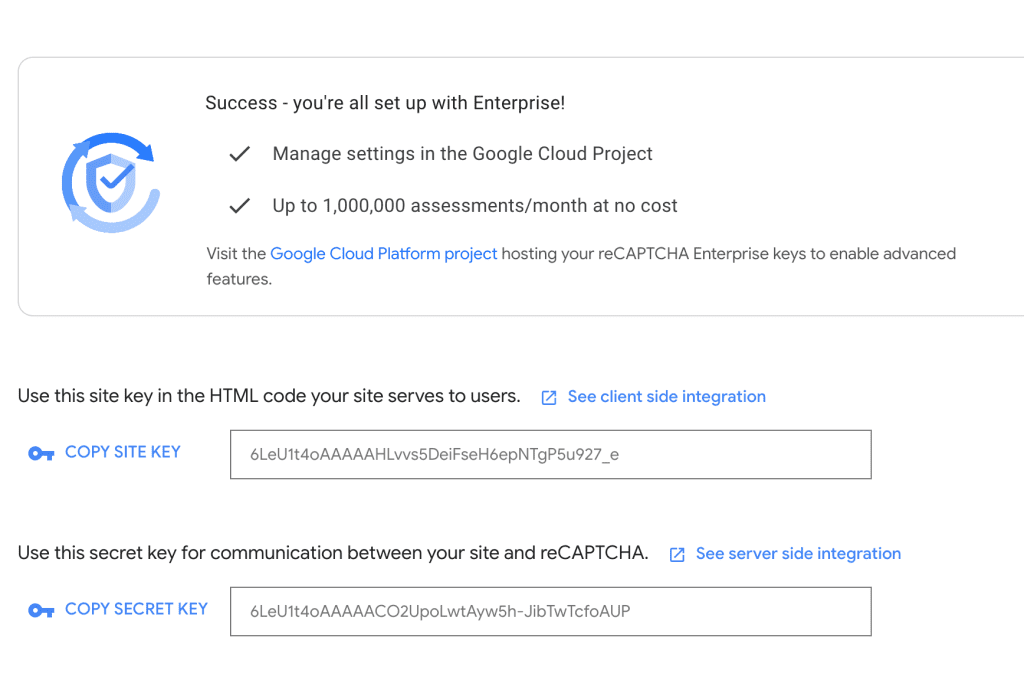
Upon completion, Google will generate a ‘Site Key’ and a ‘Secret Key’ for you.
Joomla Configuration:
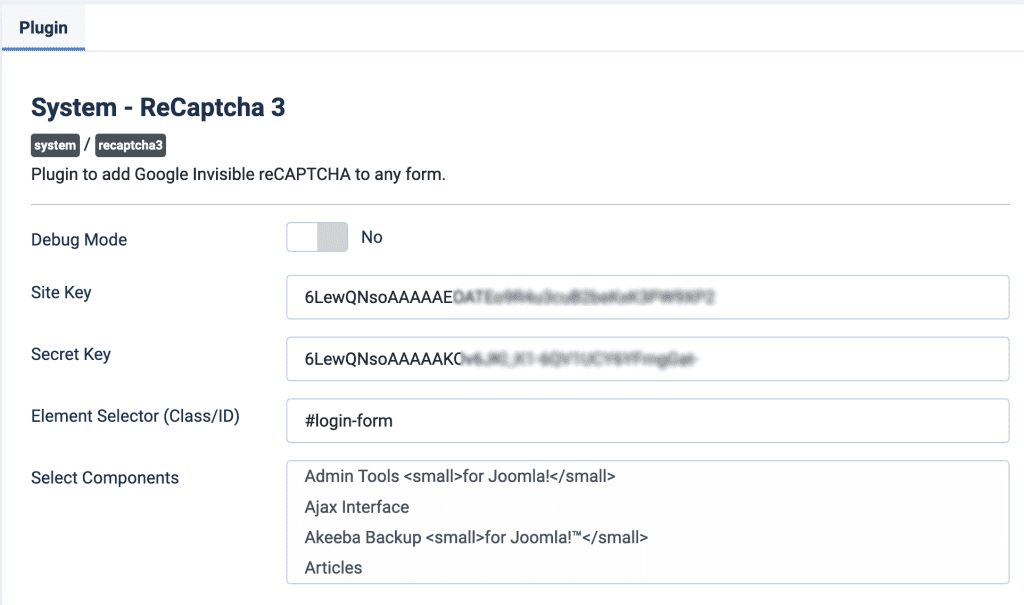
Navigate to the plugin settings in your Joomla backend.
Input the ‘Site Key’ and ‘Secret Key’ in their respective fields.
Invisible ReCaptcha V3: A Revolution in User Experience
The core difference between older versions of ReCaptcha and V3 lies in the user experience. Previous iterations often required manual input from users – identifying images, inputting distorted texts, or clicking checkboxes. ReCaptcha V3, often termed as Invisible ReCaptcha, operates discreetly in the background. It assesses user behavior and provides a score, determining the likelihood of a user being a bot. This silent operation ensures that genuine users enjoy an uninterrupted browsing experience.
Standout Features of the ReCaptcha 3 Plugin
Granular Component Control: Tailor the areas of your site where ReCaptcha operates by activating the feature for distinct Joomla components.
Debug Mode for Streamlined Setup: Especially useful during the initial stages, the debug mode highlights form-specific ID and class details, ensuring you configure the plugin correctly.
Customizable Form Targeting: Use CSS selectors to focus on particular forms. This flexibility is invaluable for sites with diverse forms requiring varying levels of protection.
Regular Updates: Our commitment doesn’t end with the installation. We offer periodic updates to maintain compatibility with Joomla’s evolving versions and to adapt to any changes in the ReCaptcha API.
Wrapping Up
Transitioning to Joomla 5 presents many new opportunities, but also some challenges. However, with tools like our ReCaptcha 3 plugin, website administrators can ensure that their platforms remain as secure as ever. Beyond just security, it’s about offering users a seamless experience without compromising on safety. In today’s digital age, it’s not just about building a website; it’s about building trust. And with the right tools, you’re always one step ahead.
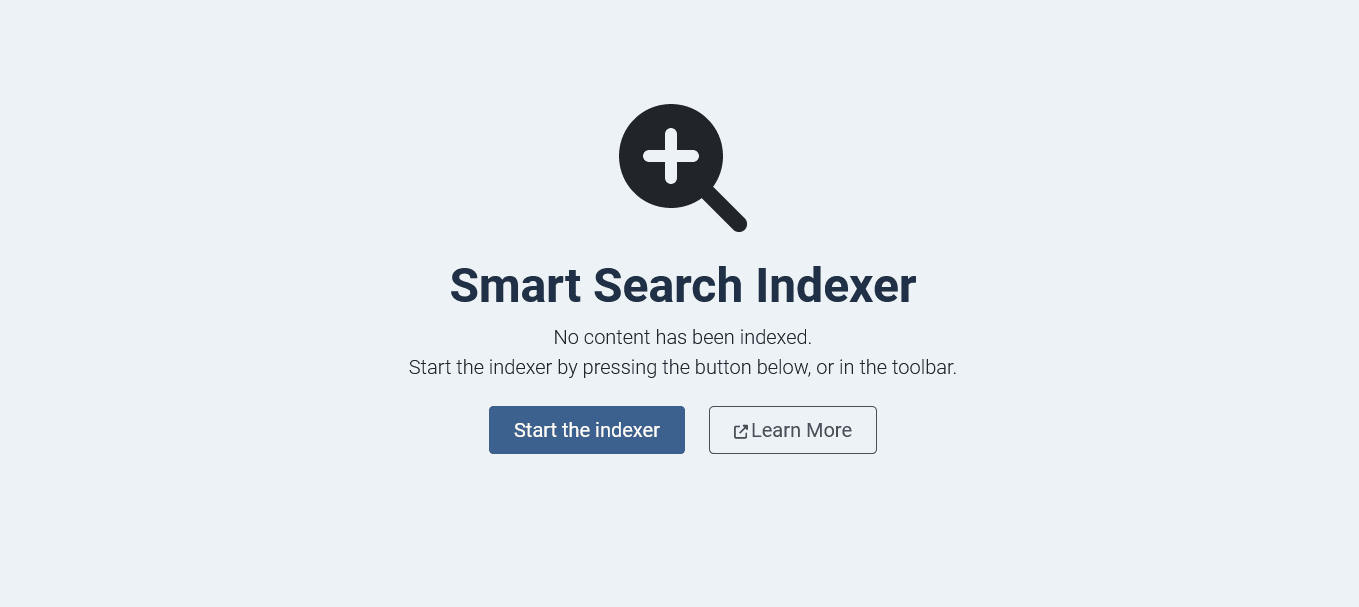
Do you know that the com_search is not available in Joomla 5?
If you’re planning to upgrade from Joomla 4.4 to Joomla 5.0, there’s an important step you shouldn’t overlook. The com_search component is no longer supported in Joomla 5. To ensure a hassle-free upgrade, it’s recommended to uninstall com_search beforehand. In this post, we’ll guide you through this process and introduce you to the enhanced features of com_finder (Smart Search) in Joomla 5.
Goodbye, Search (com_search)
For years, Joomla users have relied on the com_search component to power their website’s search capabilities. It was straightforward and got the job done. But as with all technology, change is inevitable. With the release of Joomla 5, com_search has been phased out, signaling the end of its journey.
Hello, Smart Search (com_finder)
Joomla 5 introduces us to com_finder, better known as Smart Search. It’s not entirely new; Joomla veterans might remember it co-existing with com_search in earlier versions. But now, it stands alone as the default search solution in Joomla 5. Smart Search boasts a range of improvements:
Advanced Indexing: Smart Search creates a detailed index of all content, making search results more accurate.
Filtering Options: Users can narrow down their search results using various filters, enhancing user experience.
Extensible Plugins: With a rich array of plugins, you can customize Smart Search to cater specifically to your site’s needs.
Search vs Smart Search
Functionality and Complexity
com_search: Provides a straightforward search function. It allows users to query for content but may not offer refined results.
com_finder (Smart Search): Offers an advanced and flexible search system that enables users to filter their search results and allows for indexing, making search results more relevant and accurate.
Integration with Extensions
com_search: Uses plugins that directly query the database for results. This might cause more database load, especially for large sites.
com_finder: Uses an indexer that pre-gathers content from the site. This reduces the direct database load during a search, providing quicker search results.
Search Flexibility
com_search: Offers basic search capabilities with limited options for refining or filtering search results.
com_finder: Allows users to apply various filters and facets to narrow down their search, making it easier to find precise content.
System Existence
com_search and com_finder coexisted in Joomla versions since 2.5. However, as Joomla evolves, there is a push towards adopting the more advanced Smart Search (com_finder), suggesting it might be the future direction of search in Joomla.
Search Indexing
com_search: Doesn’t have its own indexing system; it pulls content directly from the database during each search query.
com_finder: Utilizes an indexing system where content is indexed beforehand. This not only speeds up search results but also ensures that the search is comprehensive, including all aspects of the site’s content.
Both systems have their merits, but for a more advanced, efficient, and comprehensive search experience on a Joomla website, com_finder (Smart Search) is the recommended choice.
Smart Search & Third Party Components
Joomla’s Smart Search (com_finder) is designed to be extensible and can work with third-party components. This is achieved through Smart Search plugins. Here’s how it functions:
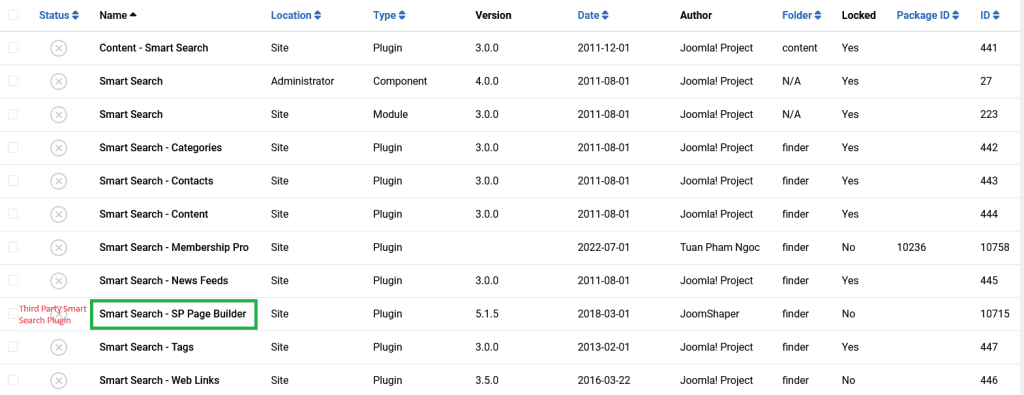
Plugins for Indexing: For Smart Search to index and search content from third-party components, there needs to be a specific Smart Search plugin for that component. Joomla core comes with several Smart Search plugins for its core components.
Third-Party Extensions: Many third-party Joomla extension developers provide their own Smart Search plugins to ensure their components’ content can be indexed and searched using Smart Search. When you install such a third-party component, it’s common for it to come with its Smart Search plugin which you can enable to integrate the component’s content into Smart Search.
Custom Plugins: If a third-party component doesn’t come with a Smart Search plugin, it’s possible for developers to create a custom Smart Search plugin for that component. This involves coding a plugin that tells Smart Search how to index the component’s content.
Filters and Advanced Search: Apart from basic content indexing, Smart Search plugins can also provide advanced functionality, such as custom filters. This allows users to refine their search results based on specific criteria related to the third-party component.
Conclusion
Joomla’s transition from com_search to Smart Search (com_finder) in Joomla 5 represents its dedication to enhancing user experience with improved search capabilities. Smart Search offers not only faster and more precise results but also integrates effortlessly with third-party components. As com_search fades, Smart Search emerges as the future of Joomla’s search functionality, promising users a more efficient and enriched web experience.
Do you know that Joomla 5 just took a massive leap in the SEO game? With its launch on 17th October 2023 , they’ve integrated Schema directly into their core plugins. This isn’t just a minor tweak—it’s a full-blown strategy to supercharge your site’s visibility and SEO prowess.
Website’s search rankings are not just about keywords anymore. Let me show you how Joomla 5 is making structured data simpler and more impactful than ever.
Ready to dominate those search results? Let’s go!
Table of Contents
What is Schema Markup?
Schema markup, a form of microdata, is added to the HTML of a webpage to define exactly what it contains. Search engines then use this data to display enhanced snippets in search results. The end result? Improved visibility and a higher click-through rate.
How to Integrate Schema in Joomla 5?
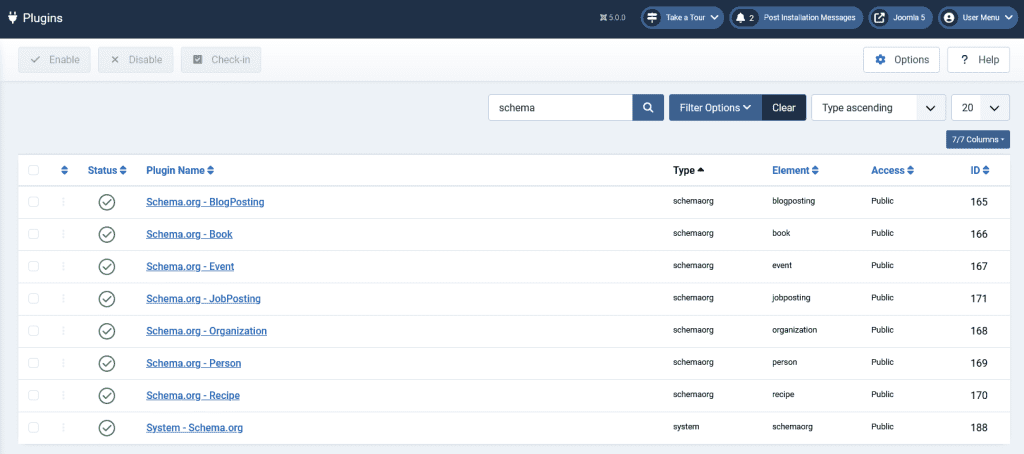
If you have upgraded your website from Joomla 4.4 to Joomla 5 or installed a new version of Joomla 5, in the plugin section of the website you will find the list of plugin available for use by default. You will find 7 different type of Schema plugins and a System Schema plugin.
So, to use the plugins into your Joomla article or other components that support Schema the plugin must be enabled.
System – Schema.org
Schema.org – BlogPosting
Schema.org – Book
Schema.org – Event
Schema.org – JobPosting
Schema.org – Organization
Schema.org – Person
Schema.org – Recipe
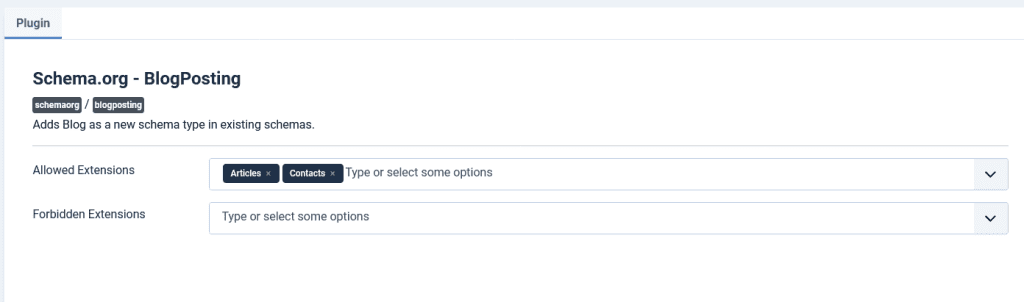
These plugins excluding the System – Schema.org have the same configuration as shown in the screenshot.
The plugins have two options.
Allowed Extensions: If you specify certain extensions (components) here, then the schema integration will only be applied to those selected extensions. For instance, if you only want the “BlogPosting” schema to be applied to articles from the “Content” component and not to other components like “Events” or “Products”, you can select the “Content” extension in the “Allowed Extensions” dropdown.
Forbidden Extensions: This is the opposite of “Allowed Extensions”. Any extension you select here will be excluded from schema integration, regardless of what’s chosen in the “Allowed Extensions”. For example, even if you’ve allowed the “Content” extension in the previous setting, but then you add it to the “Forbidden Extensions”, the schema will not be applied to the “Content” component.
If you’re not in the mood to dive deep into configurations, just let it be.
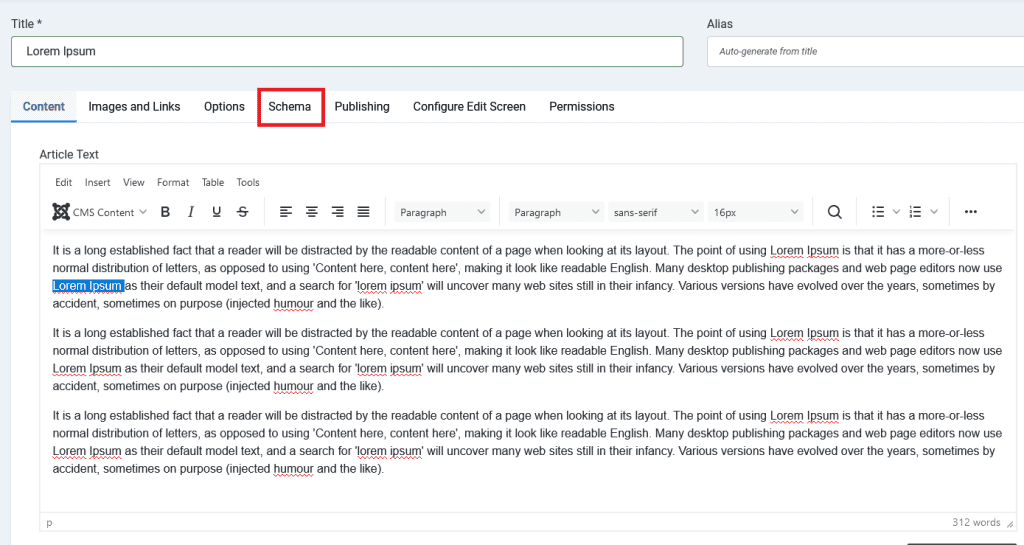
Now, lets start setting up the schema for a Joomla article. To do that open a existing Joomla article or create a new article. You will now find a new tab called “Schema” in the edit article page.
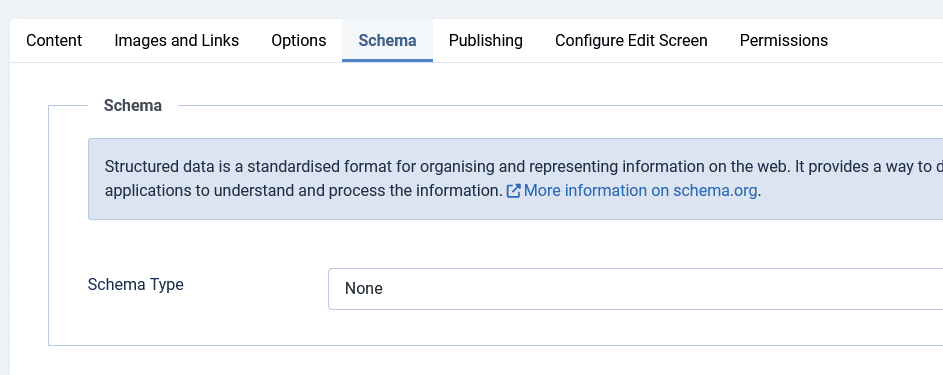
Click on the Schema Tab to start setting up the Schema for the particular article. You will find the Schema Type Set to None. Lets understand the different type of schema and start configuring.
Types of Schema Supported in Joomla 5
As I have mentioned that Joomla 5 supports 7 different type of Schemas. Lets discuss all the schema and its attributes one by one.
BlogPosting
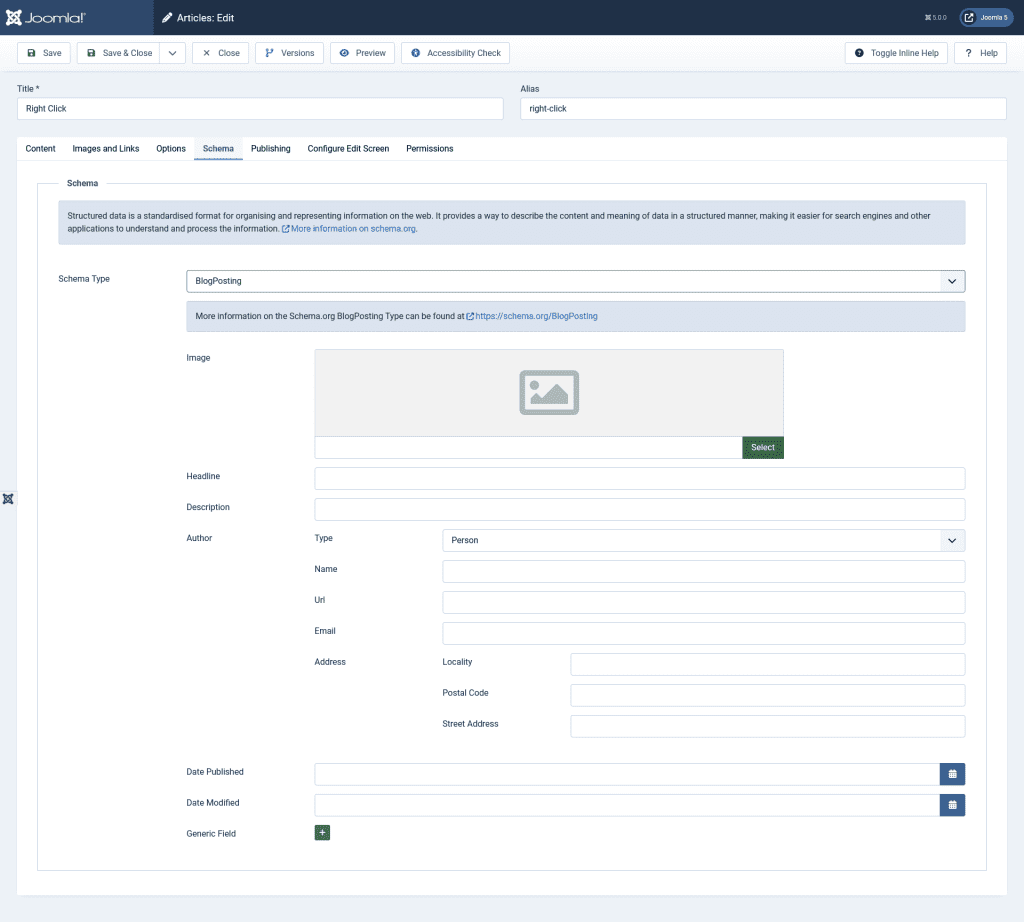
When you select “BlogPosting” for the Schema Type in Joomla 5, it provides a series of fields tailored to the attributes commonly associated with blog posts. Here’s a breakdown of what each section represents:
Image: This allows you to select an image that represents the blog post. This image will be used in structured data, which can be displayed in rich results on search engines.
Headline: This should be the main title or headline of your blog post.
Description: A brief summary or overview of what the blog post is about.
Author: This section provides fields related to the author of the blog post:
Type: The type of entity the author is, commonly set to “Person”. There might be other options like “Organization” depending on your Joomla setup.
Name: The name of the author.
Url: A link to the author’s personal website or profile page.
Email: The author’s email address.
Address: If necessary, you can provide location details of the author, including:
Locality: City or region.
Postal Code: Postal or ZIP code.
Street Address: Exact street address.
Date Published: The date when the blog post was first published.
Date Modified: The date when the blog post was last updated or modified.
Generic Field: This could be a customizable field where you can add additional structured data attributes that might not be covered by the default options.
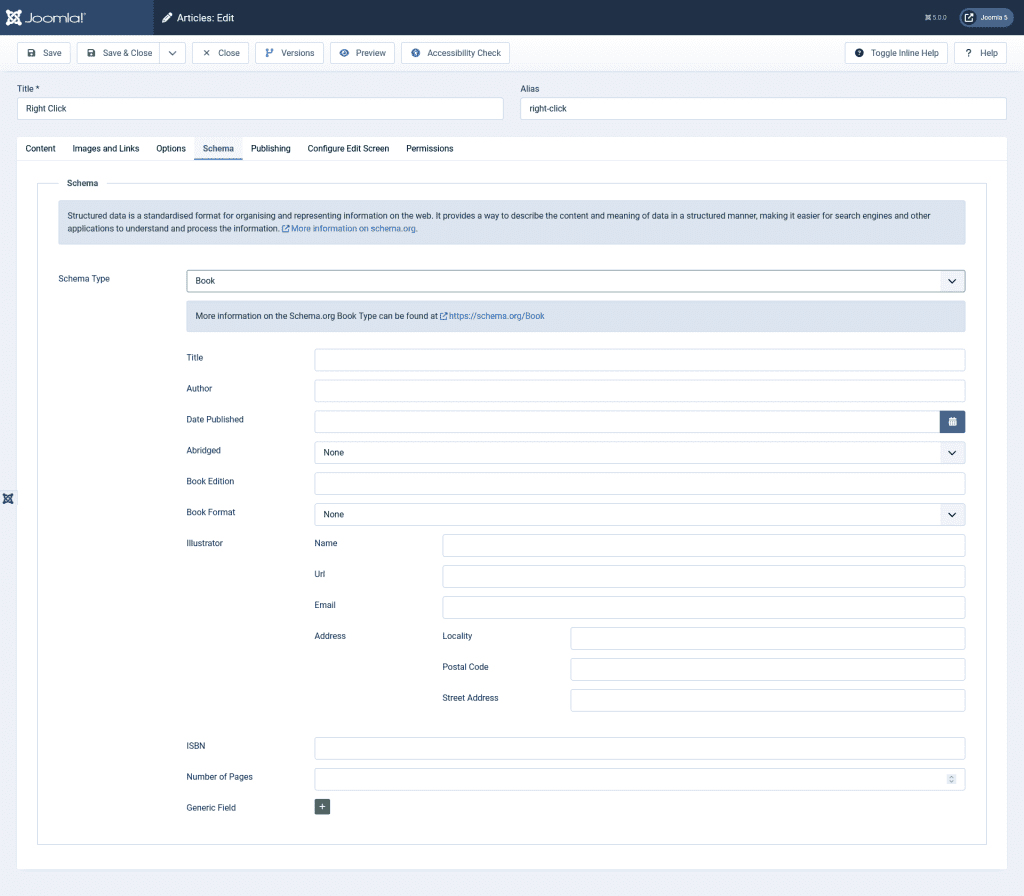
Book
Upon Selecting “Book” for the Schema Type in Joomla 5, it provides the following set of fields tailored to the attributes commonly associated with books. The details are as follows.
Title: The title of the book.
Author: The name of the book’s author. You can provide additional details like URL, email, and address for the author as well, similar to the “BlogPosting” schema.
Date Published: The date the book was published.
Abridged: An option to specify whether the book is an abridged version or not. Abridged books are shortened versions, often cutting out non-essential parts to make the content more concise.
Book Edition: Details about the specific edition of the book, if applicable. For example, “2nd Edition” or “Revised Edition”.
Book Format: The format in which the book is available. This could be options like “Hardcover”, “Paperback”, “eBook”, etc.
Illustrator: If the book contains illustrations, this section allows you to provide details about the illustrator, similar to the author details. This includes:
Name: The illustrator’s name.
Url: A link to the illustrator’s website or profile.
Email: The illustrator’s email address.
Address: Location details of the illustrator:
Locality: City or region.
Postal Code: Postal or ZIP code.
Street Address: Exact street address.
ISBN: The International Standard Book Number, a unique identifier for books.
Number of Pages: The total number of pages in the book.
Generic Field: Like in the “BlogPosting” schema, this is a customizable field where you can add any additional structured data attributes related to the book that might not be covered by the default options.
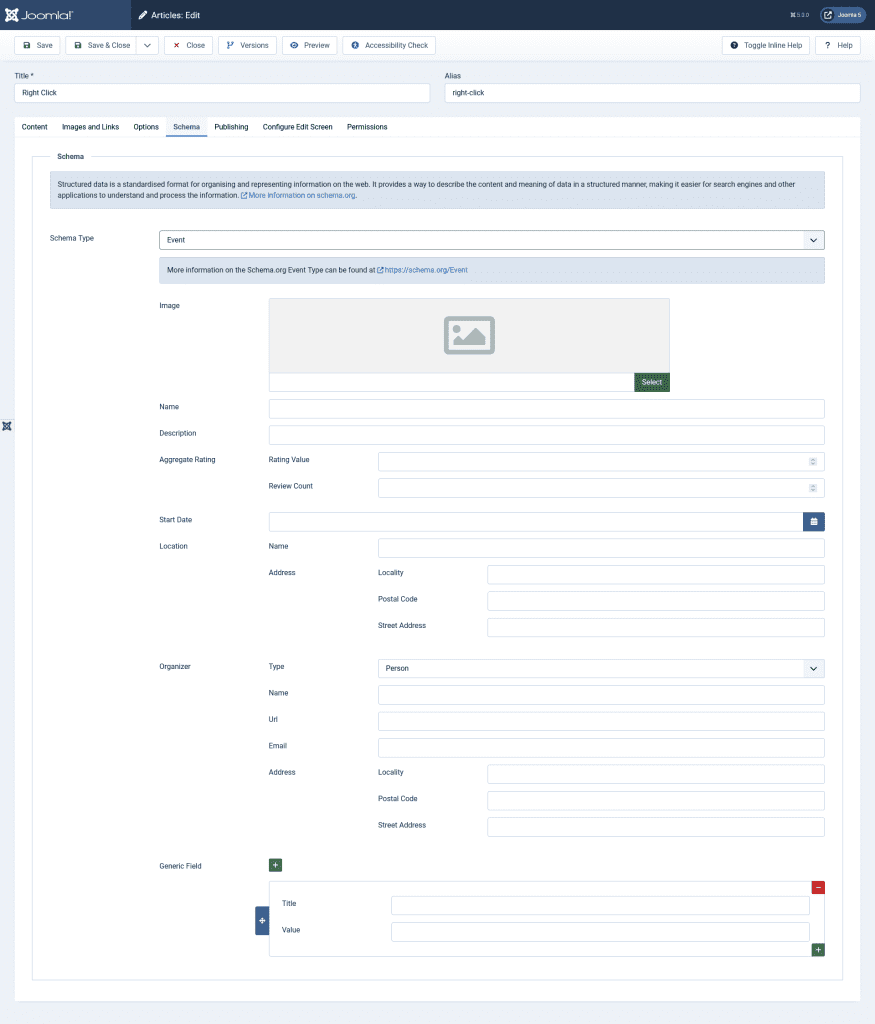
Event
Event” for the Schema Type in Joomla 5 provides a set of fields designed to capture information related to events. Here’s a breakdown of the fields provided:
Image: A field where you can upload or select an image that represents the event.
Name: The official name or title of the event.
Description: A brief overview or summary of the event.
Aggregate Rating: This section is for the overall rating or feedback given to the event, if applicable.
Rating Value: The average rating value.
Review Count: The number of reviews or ratings the event has received.
Start Date: The commencement date and time of the event.
Location: The venue or place where the event is scheduled to take place.
Name: The name of the location or venue.
Address: The address details of the location, which include:
Locality: City or region.
Postal Code: Postal or ZIP code.
Street Address: Exact street address.
Organizer: Information about the individual or organization responsible for organizing the event.
Type: Whether the organizer is a person, organization, or another entity type.
Name: The name of the organizer.
Url: A link to the organizer’s website or profile.
Email: Contact email for the organizer.
Address: Location details of the organizer, similar to the location address fields.
Generic Field: A customizable field where you can add any additional structured data attributes related to the event that might not be included in the default options. This section consists of a “Title” and “Value” pair.
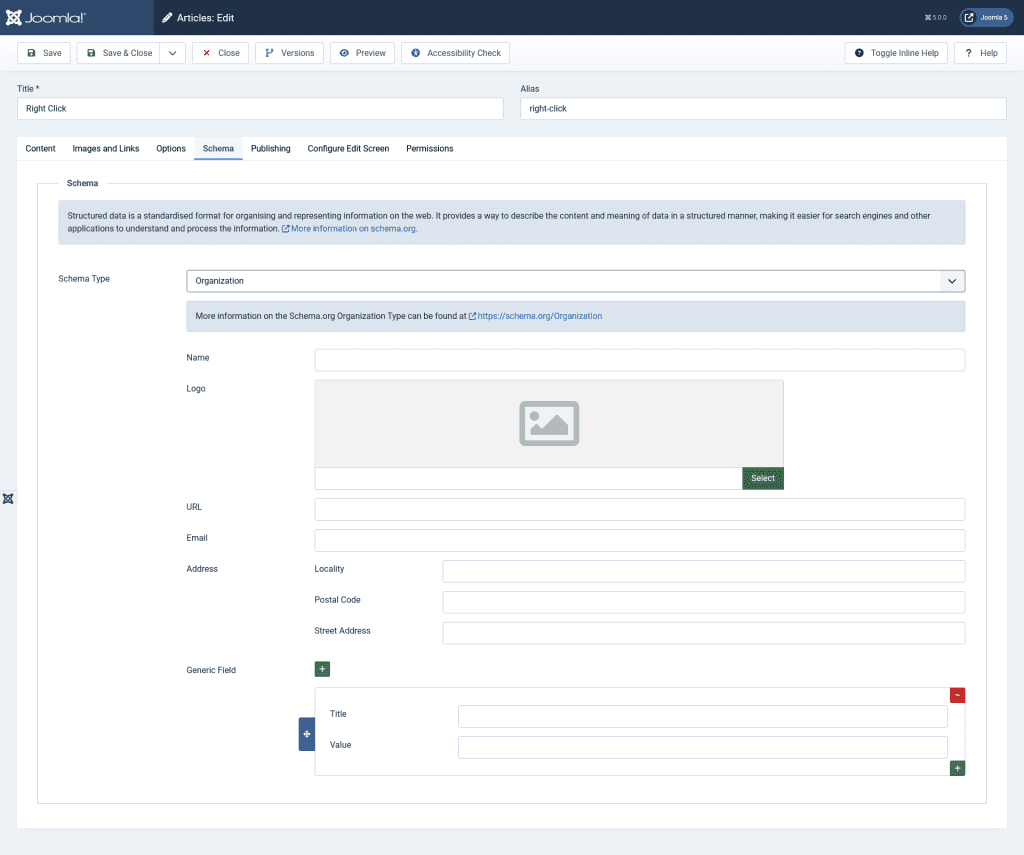
Organization
Organization” for the Schema Type in Joomla 5, it provides a set of fields tailored to capture information related to organizations. Here’s a detailed description of the fields you see:
Name: The official name of the organization.
Logo: A field to upload or select the organization’s logo, providing a visual representation of the entity.
URL: The official website URL or main online presence of the organization.
Email: The primary contact email for the organization.
Address: The physical address of the organization, broken down into:
Locality: The city or locality where the organization is situated.
Postal Code: The postal or ZIP code for the location.
Street Address: The detailed street address of the organization.
Generic Field: A customizable section to accommodate any additional structured data attributes related to the organization that might not fit into the predefined categories. This section provides a “Title” and “Value” pair for custom entries.
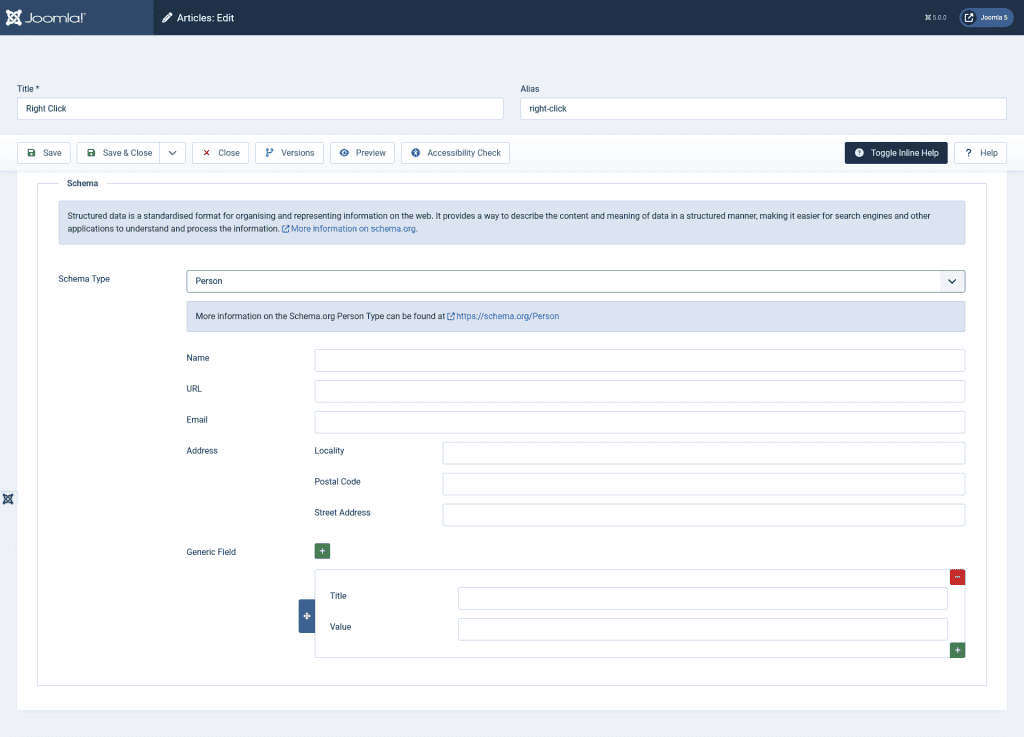
Person
Name: The full name of the person.
URL: The personal website or main online presence of the individual, such as a blog or portfolio.
Email: The primary contact email for the person.
Address: The physical residence or contact address of the person, further broken down into:
Locality: The city or locality where the person resides.
Postal Code: The postal or ZIP code for the location.
Street Address: The detailed street address.
Generic Field: This is a flexible section that allows you to include any additional structured data attributes related to the person that might not fit into the predefined categories. You can enter a custom “Title” and its corresponding “Value” in this section.
Recipe
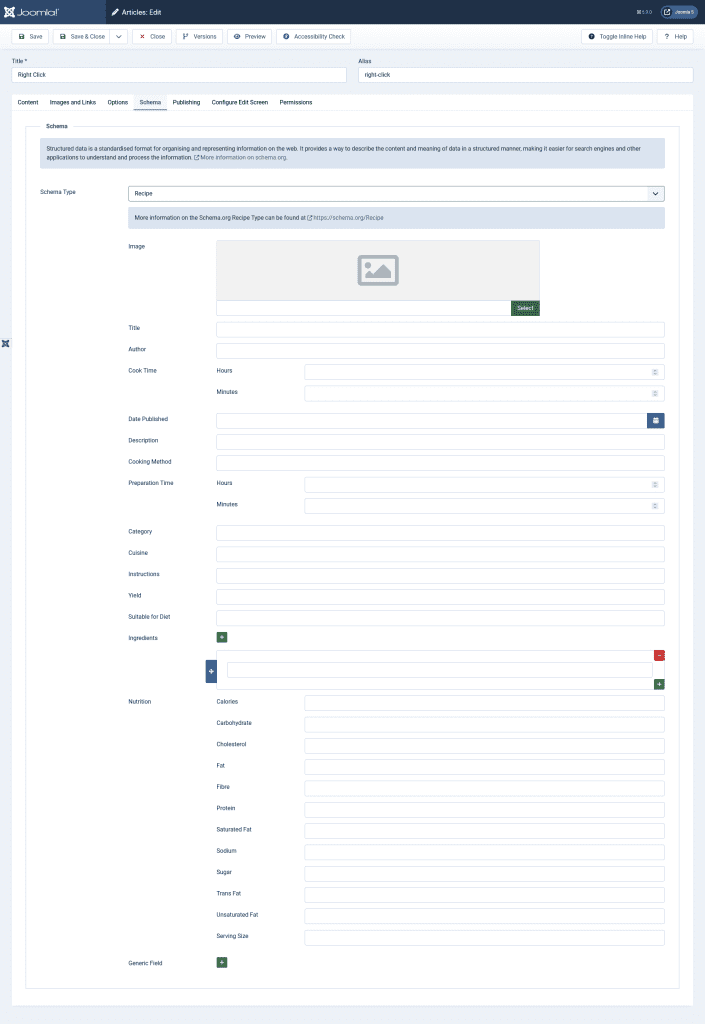
Recipe Schema Type within Joomla 5 allows you to input structured data specifically tailored for recipes. Here’s an overview of the fields provided:
Image: This is where you can upload or link to an image representing the recipe.
Title: The name of the recipe.
Author: The individual or entity that created or is credited with the recipe.
Cook Time: The time it takes to cook the dish. You can specify the duration in hours and minutes.
Date Published: The date on which this recipe was originally published.
Description: A brief overview or summary of the recipe.
Cooking Method: The technique used for cooking the dish (e.g., baking, frying, steaming).
Preparation Time: The amount of time it takes to prepare the ingredients and the dish before cooking. Again, you can specify the duration in hours and minutes.
Category: The type or classification of the dish (e.g., dessert, main course, appetizer).
Cuisine: The culinary style or tradition the recipe belongs to (e.g., Italian, Chinese, American).
Instructions: Step-by-step directions on how to prepare and cook the dish.
Yield: The quantity or servings the recipe produces.
Suitable for Diet: Any specific dietary considerations the recipe adheres to (e.g., vegan, gluten-free).
Ingredients: A list of all the ingredients required for the recipe.
Nutrition: Detailed nutritional information about the dish, including:
Calories
Carbohydrate
Cholesterol
Fat
Fibre
Protein
Saturated Fat
Sodium
Sugar
Trans Fat
Unsaturated Fat
Serving Size
Generic Field: Similar to the person schema, this flexible section lets you include any additional structured data attributes related to the recipe not covered by the predefined categories.
JobPosting
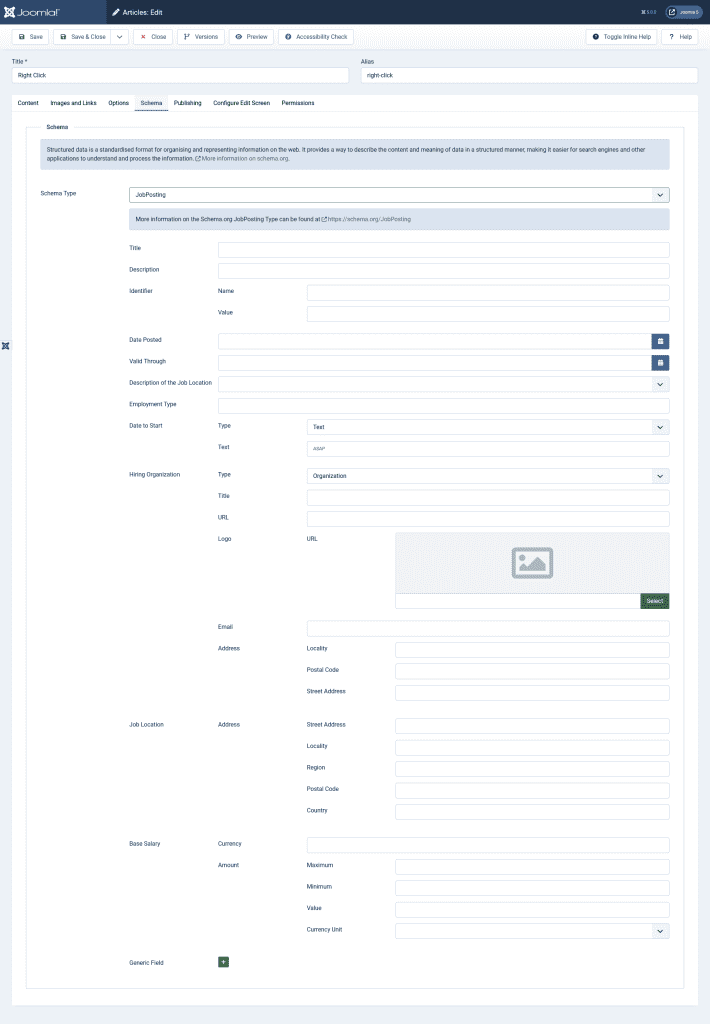
The “JobPosting” Schema Type within Joomla 5 allows you to input structured data tailored for job listings. This helps search engines to better interpret and display content related to job postings. Here’s an overview of the fields provided:
Title: The title or name of the job position being advertised.
Description: A brief overview or summary of the job position, its responsibilities, and other key details.
Identifier: This section allows you to input a unique identifier for the job posting, with both a “Name” for the type of identifier and a “Value” for the actual identifying information.
Date Posted: The date the job listing was originally published.
Valid Through: The expiration date of the job listing after which it may no longer be valid.
Description of the Job Location: Additional details about the job location.
Employment Type: The nature of the job in terms of its duration or commitment (e.g., Full-Time, Part-Time, Contract).
Date to Start: The date on which the selected candidate is expected to commence their duties.
Hiring Organization: Information about the organization hiring for the position:
Type: Specifies that it’s an organization.
Title: The name of the organization.
URL: A link to the organization’s website.
Logo: A link or upload area for the organization’s logo.
Email: The contact email address related to the job listing.
Address: This section captures detailed address information for the hiring organization, including:
Locality: City or town.
Postal Code: ZIP or postal code.
Street Address: The exact street address of the organization.
Job Location: Information about where the job will be based, similar to the address fields mentioned above but specific to the job’s location.
Base Salary: Details about the salary offered for the position:
Currency: The currency in which the salary is offered.
Amount: Specific details about the salary amount, with fields for the maximum, minimum, and a specific value. There’s also an option to specify the unit of the salary, such as per hour, per month, etc.
Generic Field: This flexible section lets you include any additional structured data attributes related to the job posting not covered by the predefined categories.
Now that you have learnt integrating the schema plugin, time to test it.
Testing the schema Markup
Follow these steps, and you’ll be good to go:
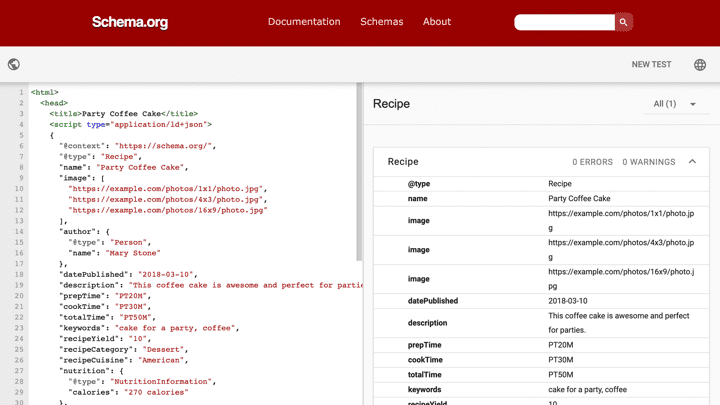
Grab Your URL: First things first, copy the URL of the page you want to test.
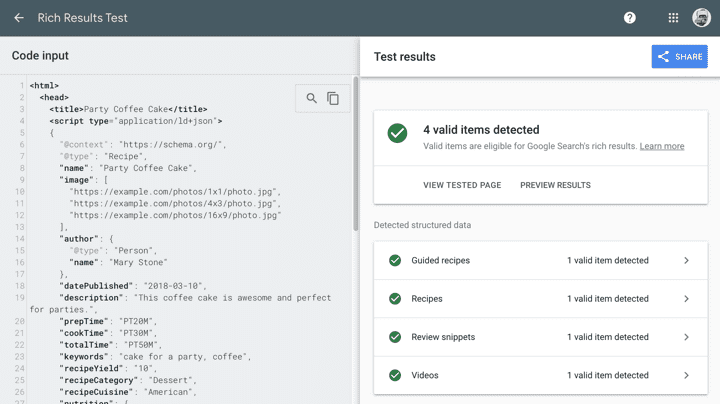
Paste & Run: Drop your URL into the search bar and hit ‘Test URL’.
Review the Results: Once the test runs, you’ll see if your markup is valid or if there are any issues you need to tackle.
Absolutely! Let’s break it down in a style reminiscent of Neil Patel:
Schema.org vs. Rich Snippets: What’s the difference?
Alright, here’s the thing. When you’re diving deep into the SEO world, you’ll come across terms like Schema.org and Rich Snippets. At first glance, they might seem like the same thing, but they play distinct roles in the SEO game. Let’s demystify this:
Schema.org:
What Is It? Think of Schema.org as a library. It’s a standardized collection of schemas, or, in simpler terms, a set of codes you can add to your website. This code helps search engines understand your content better. It’s like giving them a guidebook to your site.
Why Use It? By implementing Schema.org markup, you’re giving search engines a clearer picture of what’s on your page. Whether it’s a recipe, product, or event, you’re spelling it out.
Rich Snippets:
What Is It? Rich Snippets are the visual result of using that Schema.org markup. When you search something on Google, sometimes you see results with star ratings, images, or product prices. Those are Rich Snippets in action!
Why Use Them? They make your search result stand out! It’s like putting on a fancy outfit for a party. You get more clicks, better engagement, and, ultimately, higher traffic.
In a Nutshell: Schema.org is the behind-the-scenes code, while Rich Snippets are the front-and-center stars of the show in search results.
Wrapping It Up
Joomla 5’s Rich Snippets isn’t just an update; it’s a revolution. It streamlines structured data optimization, paving the way for a stellar search experience. Expect a surge in your site’s traffic and engagement. So, if you’re all about amplifying your online clout, it’s time to harness the might of Rich Snippets in Joomla 5. Let’s elevate your website game!
Joomla, a renowned open-source content management system (CMS), has consistently been the preferred choice for numerous web developers and site owners. With the much-anticipated release of Joomla 5 on 17th October 2023, the community is abuzz with excitement. This guide delves deep into the reasons, benefits, and the step-by-step process of upgrading from Joomla 4.4.x to Joomla 5.
Table of Contents
Joomla 5 Release Date
Joomla 5 was officially released on 17th October 2023. This release marked a significant milestone in Joomla’s journey, introducing a host of new features, improvements, and security enhancements. The release was eagerly awaited by the Joomla community, and since its launch, it has been widely adopted by web developers and site owners worldwide.
Few Important Things to Know
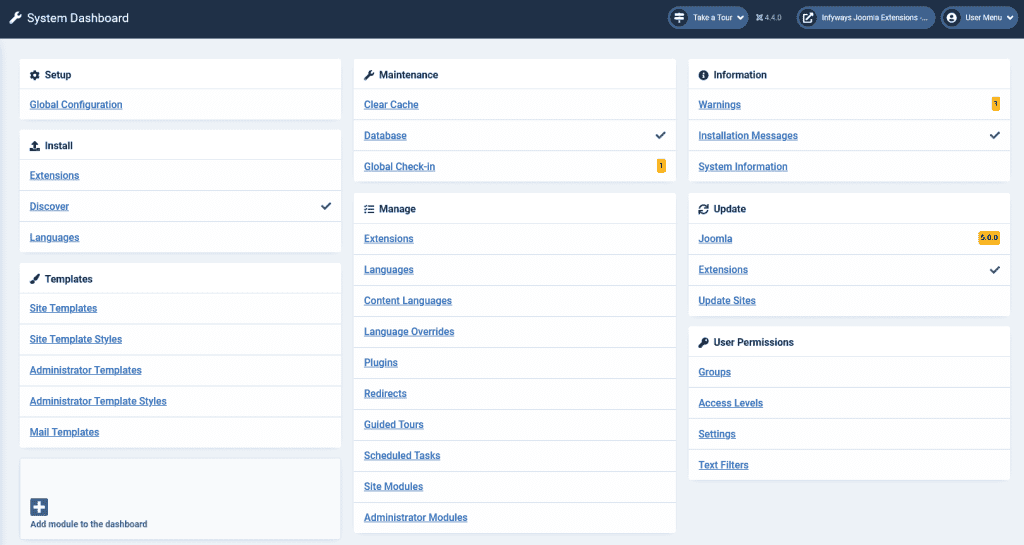
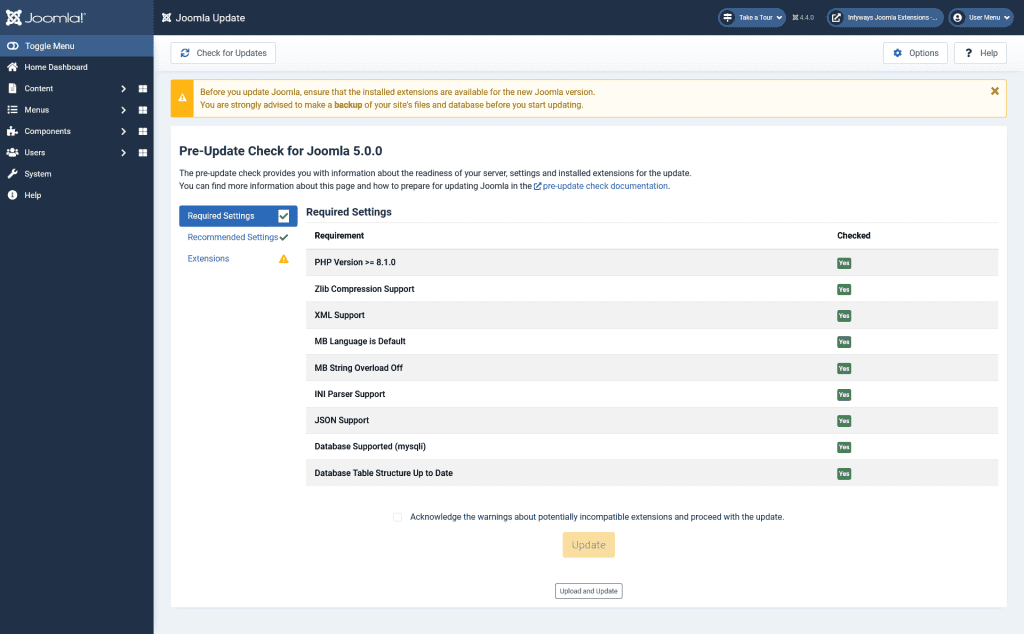
The 5.0.0 update notification will only show up if you have upgraded your Joomla to 4.4.0
The transition from Joomla 4.4.x to 5.x is an upgrade, not a migration. This is great news for two primary reasons:
Joomla 4 (J4) extensions that have removed all deprecated code and use up-to-date Joomla code will function in Joomla 5 (J5).
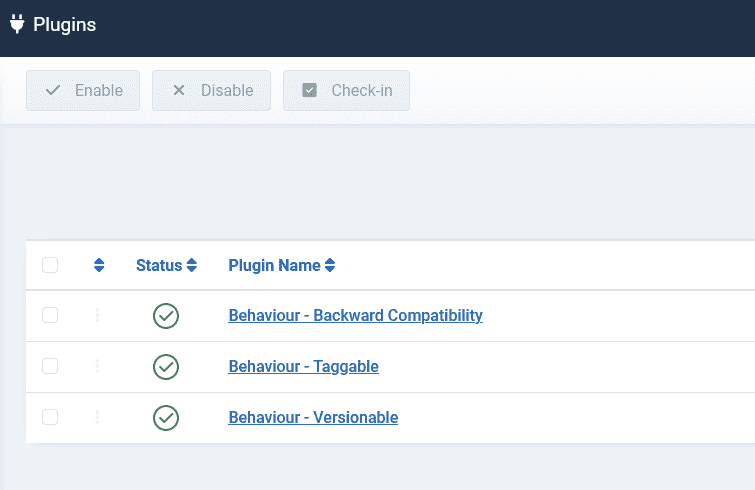
Most other extensions will operate with the new Behaviour – Backward Compatibility Plugin enabled.
What to Do If You Don’t See the Joomla 5 Upgrade Notification?
There might be instances where the Joomla 5.0.0 upgrade notification doesn’t appear in the System or Home Dashboard of your administrator panel. Don’t worry; a minor adjustment can help you view the notification and proceed with the upgrade. Here’s how:
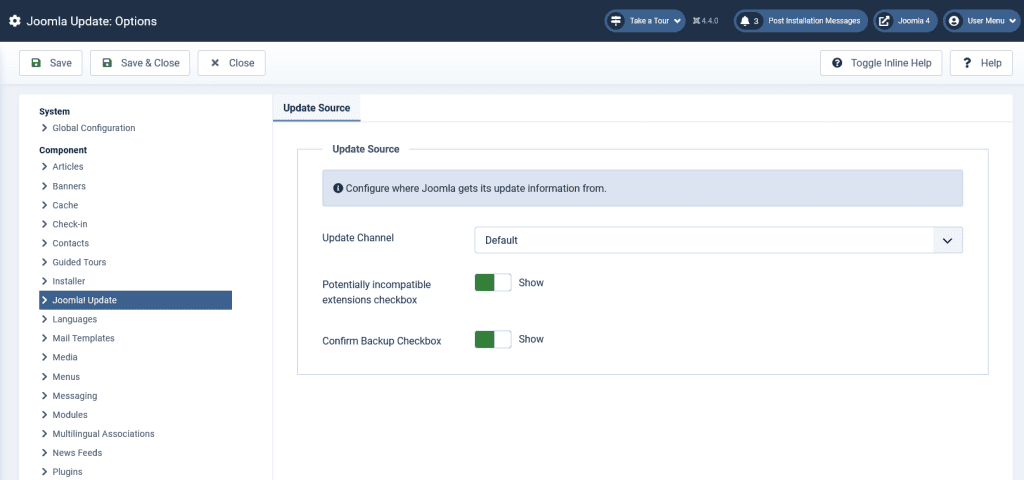
Navigate to the Global Configuration in your Joomla administrator panel.
On the left side, click on the Joomla Update menu.
In the ensuing screen, locate the Update Source tab.
Change the Update Channel from its default setting to Joomla Next.
Save your changes.
Upon saving, you’ll be redirected to https://YOUR_DOMAIN/administrator/index.php?option=com_joomlaupdate.
Why should I Upgrade Joomla 4.4 to Joomla 5?
With the introduction of Joomla 5, the question arises: should you upgrade from Joomla 4.4 to Joomla 5? Here’s a comprehensive look at the reasons to consider this upgrade.
1. Advanced Features and Functionalities
Joomla 5 brings a plethora of advanced features that make content management even more efficient. Whether you’re looking to build a personal blog, an e-commerce site, or a community portal, Joomla 5 offers unlimited possibilities to cater to your specific needs.
2. Ease of Use
One of the primary reasons Joomla has been chosen by many is its ease of use. The CMS is designed to be user-friendly, even for those without extensive technical knowledge. With Joomla 5, this user experience is further enhanced, allowing you to manage your site’s content with minimal effort.
3. Award-Winning CMS
Joomla’s reputation as an award-winning CMS is well-deserved. Over the years, it has bagged numerous accolades, including the “Best Free CMS” and “Best Open Source CMS” by the 2021 CMS Critic Awards. Such recognition is a testament to Joomla’s commitment to excellence and innovation.
4. Robust Community Support
Joomla boasts a vibrant community of volunteers, developers, and enthusiasts. This community-driven approach ensures that you have access to extensive support, be it in the form of tutorials, forums, or plugins. With over 109,088 members and growing, the Joomla forum is a treasure trove of knowledge and expertise.
5. Enhanced Security
Joomla 5 places a strong emphasis on security. With regular updates and quick responses to potential security breaches, you can be assured that your website is in safe hands. Moreover, Joomla ensures valid HTML and CSS, further enhancing the security and integrity of your site.
6. Flexibility with Extensions
Joomla 5 offers a wide range of extensions, including components, modules, plugins, and templates. These tools provide added functionality to your website, allowing you to customize it according to your preferences. Whether you’re looking for specific content management solutions or design templates, Joomla 5 has got you covered.
7. Future-Proofing Your Website
Upgrading to Joomla 5 ensures that your website is equipped with the latest technologies and features. As the digital landscape evolves, it’s crucial to have a CMS that can adapt and grow with the times. Joomla 5 offers just that, ensuring your website remains relevant and competitive.
8. Seamless Upgrade Process
Unlike previous versions, upgrading from Joomla 4.4.x to 5.x is straightforward. Joomla has made significant strides in ensuring that the upgrade process is as seamless as possible. With detailed guides and documentation available, even those new to Joomla can navigate the upgrade with ease.
9. Enhanced Extension Management
Joomla 5 offers improved management of third-party extensions. While the core Joomla upgrade is relatively simple, managing third-party extensions can sometimes be challenging. Joomla 5 has streamlined this process, ensuring that extensions are more compatible and easier to manage.
10. Improved Documentation and Support
Joomla’s commitment to its community is evident in its extensive documentation and support. With the release of Joomla 5, there’s an abundance of resources available to guide users through every step of their Joomla journey, from installation to advanced customization.
11. Optimized for Modern Web Standards
Joomla 5 is designed with modern web standards in mind. Whether it’s ensuring valid HTML and CSS or optimizing for mobile responsiveness, Joomla 5 ensures that your website is ready for the modern web.
12. Cost-Efficient
Being an open-source platform, Joomla offers a cost-efficient solution for website management. With Joomla 5, users can access advanced features and functionalities without incurring additional costs.
13. Community-Driven Innovations
Joomla’s vibrant community is its backbone. With continuous feedback and contributions from its community members, Joomla 5 is packed with features that cater to real-world needs. This community-driven approach ensures that the CMS remains relevant and user-centric.
How to Check if an Extension is Compatible with Joomla 5
1. Visit the Joomla Extension Directory (JED)
The Joomla Extension Directory (JED) is the official repository for Joomla extensions. Start by searching for the extension you want to check.
2. Check the Extension’s Details Page
Once you’ve found the extension in JED, click on its title to view its details page. Here, you’ll find information about the extension, including its compatibility.
3. Look for Joomla 5 Compatibility
On the extension’s details page, there should be a section or badge indicating which Joomla versions the extension supports. Ensure that Joomla 5.x is listed.
4. Visit the Developer’s Website
If the JED doesn’t provide clear information, visit the extension developer’s official website. Most developers will have a dedicated page or section for each extension, detailing its features, requirements, and compatibility.
5. Check for Updates in Your Joomla Backend
If you already have the extension installed on your Joomla 4.4.x site:
Go to Extensions > Manage > Update.
If there’s an update available for your extension, it might be for compatibility with Joomla 5. However, always verify this by checking the release notes or the developer’s website.
6. Contact the Developer Directly
If you’re still unsure about an extension’s compatibility, consider reaching out to the developer directly. They can provide the most accurate and up-to-date information. Most extension developers are responsive to user queries, especially concerning compatibility issues.
7. Check User Reviews and Forums
Sometimes, other users’ experiences can provide insights into compatibility issues. Check the reviews on the JED or Joomla-related forums to see if other users have successfully used the extension with Joomla 5.
8. Test in a Staging Environment
If you’re still uncertain, the best approach is to test the extension in a staging or local environment. Clone your live site and upgrade the clone to Joomla 5. Then, test the extension thoroughly to ensure it works as expected.
Planning Your Upgrade
Hosting and Technical Specifications
Before initiating the upgrade, ensure your hosting environment meets the following requirements:
PHP 8.1
MySQL 8.0.13
MariaDB 10.4.x
PostgreSQL 12.0
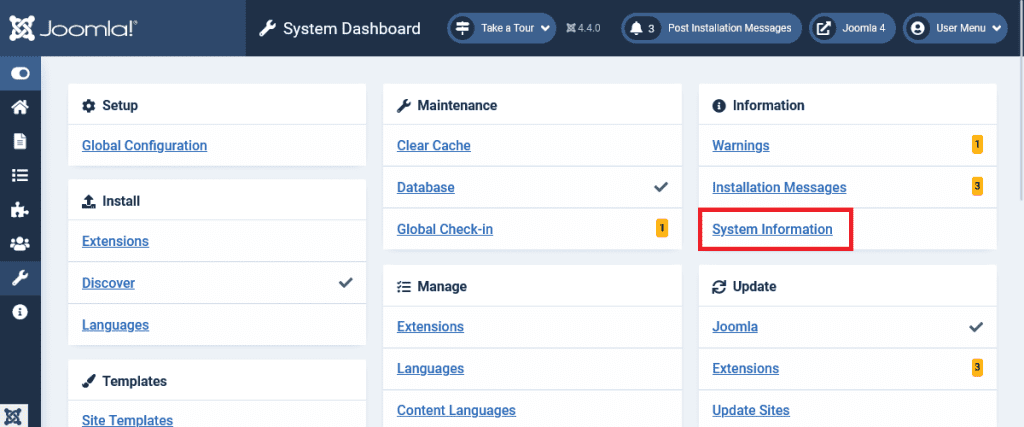
You can verify your system information in Joomla 4 by navigating to System -> System Information. If your server doesn’t meet these requirements, contact your hosting provider.
Checking Extensions for Compatibility
Extensions play a crucial role in your Joomla website. Before upgrading, it’s essential to:
Ensure all extensions are compatible with Joomla 5.
Determine if extensions require the backward compatibility plugin.
Identify any extensions that might break your site.
The Behaviour – Backward Compatibility Plugin allows third-party extensions to use classes no longer included in Joomla 5. This plugin will be enabled by default during the upgrade from J4.4.x to J5.
Key Components to Consider
Cassiopeia: This will remain the frontend template for Joomla 5. Ensure your customizations are compatible.
Google reCAPTCHA: Replace Google reCAPTCHA
with Invisible reCAPTCHA before upgrading to Joomla 5, as Joomla 5 will no longer support the former. Alternatively, consider using a third-party solution.
com_weblinks: As of September 2023, the Weblinks extension functions in J5 with the backward compatibility plugin enabled. However, its future compatibility beyond J5 remains uncertain.
Schema.org Plugin: Joomla 5 introduces a dynamic way of handling rich snippets based on schema.org. To customize the output, navigate to System => Manage => Plugins and search for the system plugin “Schema.org – System”. Edit the plugin to add your site information.
com_search: This component is not available in Joomla 5. Before upgrading, uninstall it and switch to Smart Search (com_finder).
Trial Run
Before executing the upgrade on your main site, conduct a trial run on a subdomain or local environment. This step ensures that the upgrade process works flawlessly and allows you to identify potential issues.
If using Google reCAPTCHA, switch to Invisible reCAPTCHA.
Enable Debug mode (Global Configuration -> System tab -> Debug System setting to Yes).
Backup your website again and test the backup restoration.
Navigate to System -> Update -> Joomla.
Click on Options in the Top Toolbar on the right-hand side and change the Update Channel to “Joomla Next”.
Follow the on-screen instructions to complete the upgrade.
After the upgrade, test both the frontend and backend of your site.
Disable Debug mode.
Set up Smart Search and the schema plugin as needed.
Celebrate your successful upgrade!
Troubleshooting and Support
If issues arise during the upgrade, utilize the Debug mode to identify problematic extensions. Consider restoring from a backup and addressing the issues in a test environment. Use the Database Fix option in the System Dashboard to resolve database structure issues. For further assistance, consider reaching out to the Joomla Forum: Migration & Upgrade Board 5.x.
Conclusion
The transition from Joomla 4.4.x to Joomla 5 is a significant leap forward, offering a myriad of benefits from enhanced features to robust community support. This guide provides a holistic view of the upgrade process, ensuring a smooth transition. Embrace the future with Joomla 5!
In case you are facing issues in upgrade, you can contact us. Our team of experienced Joomla Developers will help you with the process.
Joomla, one of the most versatile content management systems, powers millions of websites worldwide. While Joomla’s core codebase is already optimized for performance, certain server-side configurations, especially PHP.ini settings, can further enhance your website’s speed and functionality.
In this guide, we’ll explore some of the best PHP.ini adjustments for enhancing Joomla’s performance. But before diving into the modifications, let’s first identify the file’s location and understand how to modify it.
Table of Contents
Where can I find Joomla php.ini file?
The php.ini file is a critical configuration file for PHP, used by servers to control the PHP settings. In Joomla, you don’t directly edit the php.ini file through the CMS, but Joomla does allow you to view your server’s PHP settings.
Joomla’s System Information Tool:
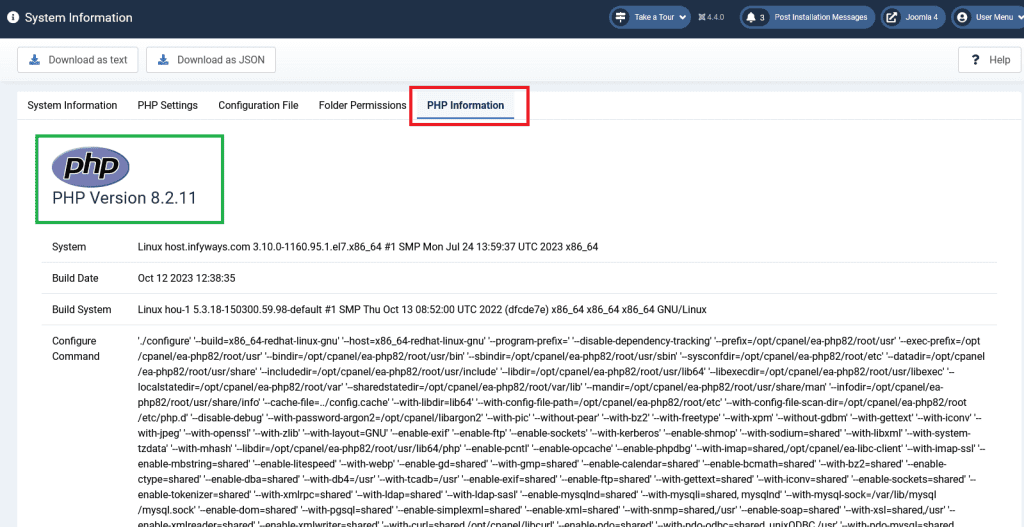
Once you’ve logged into your Joomla backend, navigate to ‘System’ in the left menu.
Click on ‘System Information’.
Navigate to the ‘PHP Information’ tab. Here, you’ll find details about your server’s PHP configuration, including the settings from the php.ini file.
Direct Access via Hosting Account:
If you have access to your hosting account (e.g., cPanel, Plesk, or direct server access), you can find and edit the php.ini file directly.
In cPanel/WHM, for instance, there’s a “Select PHP Version” option, and from there, you can manage some of the PHP settings.
For those with server access, the php.ini file is usually located in the etc directory. Its location can vary depending on server configuration and PHP installation.
🔍 Tip: For optimal performance, Joomla 4 recommends using PHP 8.2, though it can run on a minimum of PHP 7.2.5. As for Joomla 5, it requires at least PHP 8.1.0 with PHP 8.2 as the recommended version. More technical details here.
How to edit PHP.ini using WHM?
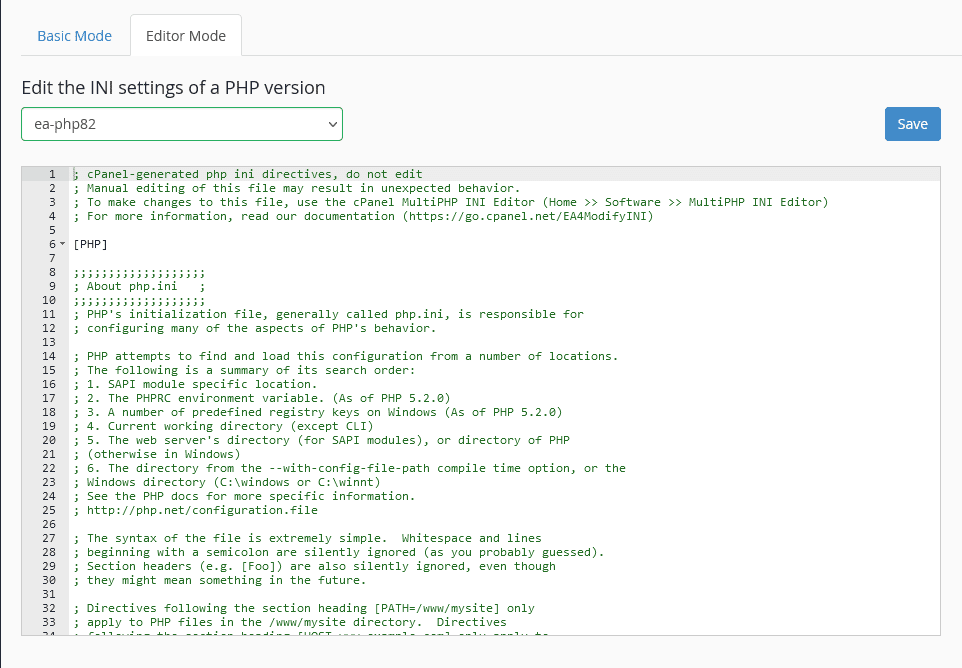
The MultiPHP INI Editor in WHM (Web Host Manager) is a tool that allows you to configure PHP settings for different versions of PHP installed on your server. You can use it to edit the php.ini file for each PHP version.
Here’s a step-by-step guide on how to edit the php.ini file using the MultiPHP INI Editor in WHM:
Log in to WHM:
Navigate to your WHM login page, typically found at https://your-server-ip:2087 or https://your-domain.com:2087.
Enter your WHM username and password to log in.
Navigate to MultiPHP INI Editor:
In the left sidebar, search for “MultiPHP”.
Click on “MultiPHP INI Editor” under the “Software” section.
Choose the PHP Version:
You’ll see two tabs: “Basic Mode” and “Editor Mode”.
“Basic Mode” allows you to adjust common PHP settings using dropdowns and input fields.
“Editor Mode” provides a text area where you can manually edit the php.ini file.
For more control, click on the “Editor Mode” tab.
From the dropdown menu, select the PHP version you want to edit.
Edit the php.ini File:
In the text area, you’ll see the contents of the php.ini file for the selected PHP version.
Make the necessary changes to the configuration. Be cautious and ensure you understand the implications of the changes you’re making.
Save Changes:
After making your edits, scroll down and click the “Save” button to apply the changes.
Restart Services (if necessary):
Depending on the changes you made, you might need to restart the web server (like Apache or nginx) or the PHP-FPM service for the changes to take effect.
You can do this from WHM or via the command line on your server.
Editing PHP.ini using WHM
Overriding Default PHP Settings in Joomla
1. Access Your Joomla Root Directory:
First, you need to access your Joomla root directory. You can do this using an FTP client like FileZilla or directly through your hosting cPanel’s File Manager.
2. Create or Edit the php.ini file:
If there isn’t already a php.ini file in your Joomla root directory, you can create one using a text editor.
If there’s already a php.ini file present, you can edit it to add or modify the desired rules.
3. Add Your Rules:
Enter the PHP directives you want to change. For instance:
If you’ve created the php.ini file offline, upload it to your Joomla root directory using the FTP client. If you’re working directly through the cPanel File Manager, simply save the file.
5. Test Your Changes:
After making your adjustments, it’s essential to ensure they’ve taken effect. You can do this by:
Checking the PHP settings from within Joomla’s backend (System > System Information > PHP Information).
Creating a simple PHP file, say info.php, with <?php phpinfo(); ?> and uploading it to your root. Accessing this file via your browser will display all PHP configurations.
Important Points to Note:
Some hosting providers might not allow overriding the server’s php.ini settings using this method. In such cases, you’ll need to contact your hosting support.
Alternatively, on some servers, you might have to use a .user.ini file instead of a php.ini file for overrides, especially on servers running PHP as CGI/FastCGI.
Always backup your site before making changes. This ensures you can quickly revert if something goes wrong.
Configuring php.ini in XAMPP:
1. Locate the php.ini File:
Navigate to the directory where XAMPP is installed. By default, on Windows, this would typically be C:\xampp. For macOS, it might be in the Applications/XAMPP directory. Within the XAMPP directory, navigate further to php. Here, you’ll find the php.ini file.
2. Backup the Original File:
Before making any changes, it’s a good practice to create a backup of the original php.ini file. This way, if something goes wrong, you can always revert to the original settings.
3. Edit the File:
Open php.ini using a text editor of your choice, such as Notepad++ or Sublime Text. Once open, you can modify any settings as required. Some common changes include adjusting the upload_max_filesize, post_max_size, and memory_limit values.
4. Search Efficiently:
The php.ini file can be quite extensive. Using the “search” or “find” function (usually Ctrl + F or Cmd + F) in your text editor can help you quickly locate the specific directives you want to change.
5. Save and Restart:
After making your desired changes, save the php.ini file and close it. For the changes to take effect, you must restart Apache. You can do this via the XAMPP Control Panel by stopping and then starting the Apache service.
6. Verify Changes:
To ensure your changes have been applied, you can:
Check the PHP settings using the phpinfo() function. Create a PHP file, for instance info.php, with the content <?php phpinfo(); ?> in your htdocs directory and access it through your browser.
A Few Tips:
If you’re unsure about a particular directive in the php.ini file, there’s usually a comment above it that explains its function.
Remember, any change in the php.ini file in your XAMPP setup only affects your local environment and not your live site.
Tweaking the PHP.ini file
Memory Limit
One of the most common settings to adjust is the PHP memory limit. This setting determines the maximum amount of memory a PHP script can use.
memory_limit = 256M
While Joomla’s requirements start from 64MB, extensions and plugins might require more. Increasing it to 256M ensures smooth operation for most sites.
Upload File Size
If you often find yourself needing to upload large files, templates, or extensions, you can increase the maximum allowed upload size.
upload_max_filesize = 64M
post_max_size = 64M
The above lines will increase the maximum file upload size to 64MB.
Execution Time
Prevent script timeouts, especially during backups, updates, or data processing.
max_execution_time = 300
Error Reporting
While Joomla has its own error reporting mechanism, you can further refine PHP’s error logging.
display_errors = Off
log_errors = On
error_log = /path/to/php-error.log
This ensures that errors aren’t displayed to users but are logged for the administrator to review.
Date Timezone
Set the correct timezone for your Joomla site, ensuring timely operations and cron jobs.
date.timezone = "America/New_York"
Replace "America/New_York" with your timezone.
OPCache
OPcache improves PHP performance by storing compiled script bytecode in shared memory, removing the need for PHP to load and parse scripts on each request.
By enabling OPCache, you can significantly speed up PHP execution times.
Session Settings
To ensure users have a smooth experience, especially when logging in or filling out forms, you should tweak session settings to optimize session management.
session.gc_maxlifetime determines the session garbage collection’s maximum lifetime. A value of 1440 seconds means sessions will be cleaned up after 24 minutes of inactivity. Adjust this according to your site’s needs.
Meanwhile, session.save_path defines where PHP session data is stored. Make sure the directory is outside the public_html or www directory to prevent unauthorized access.
Disable Functions
For security reasons, you might want to disable certain PHP functions that can be exploited.
This will disable a range of potentially harmful PHP functions, bolstering security.
Resource Limits
Prevent any single PHP process from hogging all server resources.
max_input_time = 60
memory_limit = 256M
max_input_time limits how long a PHP script can take to parse input data, and increasing the memory limit ensures Joomla and its extensions have enough resources.
Conclusion
Customizing the PHP.ini file allows you to harness the full potential of your Joomla site, optimizing both performance and security. While the settings provided above serve as a starting point, it’s essential to continuously monitor and adjust them based on your specific needs. Always remember to back up your current PHP.ini file before making changes, so you can easily revert if needed.
Need assistance configuring your Joomla php.ini? Consider our expert Joomla Support Services. We’re here to help!
So, does that mean my Joomla 3.x stop working? The answer is NO!
Your Joomla 3 website will work as it is working but you won’t receive any security or feature upgrades. Joomla community and its developer will now focus more on the new versions of Joomla 4 and Joomla 5.
So, lets check discuss about the benefits of Joomla Migration and the new features that Joomla 4 offers to us.
Why Migrate?
As I said above that Joomla 3 won’t stop working even if you don’t get support and updates. But here are some of the reasons you should consider to migrate.
It’s faster, smarter, and easier to use.
Easy-to-Use Interface: The backend or the adminstrator of the site is much easy to use as compared to J3. The backend comes with a Guided Tours that can help you learn things faster.
Better Codebase: Joomla 4’s code is modern and sharp. It’s a step up from Joomla 3. Adding new features? Now it’s simpler.
Streamlined Media Manager: Manage photos and media without fuss. Drag, drop, and organize. It’s that simple.
Fast Performance: Your site will load quickly. That’s good for users.
Tougher Security: Joomla 4 is like a fortress. It’s built to fend off threats. Hackers? They’ll have a harder time breaking in.
Mobile Friendly: More people these days use mobile to browse. J4 is responsive and easily accessible using mobile phones.
Migration is not just a shift, but a leap! Its about growth, transformation and evolution! It’s about making your site better in every way.
Pro Tip : Always backup the website before attempting to upgrade. A simple mistake can land you in difficulty. Use Akeeba for Joomla to take backup.
So, Now How to migrate?
Now that you have learnt the benefits of Joomla migration, it time to upgrade Joomla 3 to Joomla 4.
Before diving into the sleek world of Joomla 4, there’s groundwork to be done. It’s like checking the depth before a dive.
Pre-Check: Compatibility is Key
You’ve got components, plugins, and modules working in harmony on your current setup. But will they play nice with Joomla 4? Here’s how to ensure a smooth transition:
List Everything: Jot down all the components, plugins, and modules you’re using. Know your tools.
Check for Updates: Visit the official Joomla Extensions Directory. See if there are updates available for your listed items.
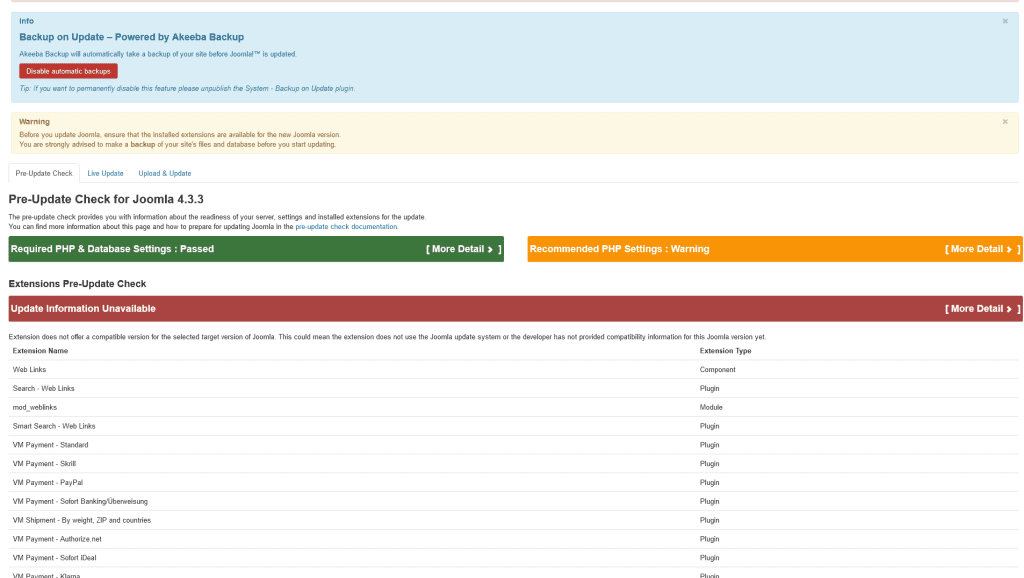
Compatibility Check: This is crucial. Ensure each item is Joomla 4-ready. If it’s not, you might face glitches post-migration.
Upgrade PHP Version: Although Joomla 4 works on PHP 7.4 but I will recommend you to upgrade php version of the server to PHP 8.2
Seek Alternatives: Found a component that’s not compatible? Time to hunt for an alternative that offers similar features and is Joomla 4-friendly.
Backup, Backup, Backup: Before making any changes, backup your site. It’s your safety net.
Remember, preparation is half the battle won. Ensure compatibility, and your transition to Joomla 4 will be smooth sailing.
But what if the pre-checkup fails?
Here’s a guide from my hands-on experience with a vast number of Joomla websites:
Pre-Check Hiccups? : If your initial compatibility check doesn’t go as planned, don’t hit the panic button just yet.
Disable the Troublemakers: Turn off those plugins and components that aren’t playing nice. They can be revisited after the upgrade.
Modules? They’re Trustworthy: Having upgraded 500+ Joomla sites, one thing’s clear: modules are reliable. They’ve consistently shown no conflicts during the upgrade process.
Proceed with Confidence: With potential roadblocks out of the way, confidently move forward with your Joomla 4 upgrade.
While upgrades might seem difficult, a bit of prep and my past experience help you with a smooth journey.
In Conclusion
As per the official Joomla website which says “Migration is like moving to a new house or a remodel” . Which means you get a lot of new features, new functionalities, designs, navigation and what not.
In the process of upgrading you might face few challenges, but those are worth it.
In case you face any issues during the upgrade you can contact us. Our Joomla Developers can help you with the upgrade process.