To become an AI engineer, learn Python and core machine learning, then learn to build software on top of large language models (LLMs): prompting, retrieval-augmented generation (RAG), agents, evaluation and deployment. Ship two or three real projects, add one cloud AI certification if your target employers ask for it, and apply for roles where software and AI meet.
That is the short answer. The longer one matters, because advice online ranges from “just learn prompting” to “get a PhD first”, and neither is right for most people.
The demand is real. LinkedIn ranked AI engineer as the fastest-growing job in the U.S. in its Jobs on the Rise 2026 list, and AI skills appeared in 2.5% of all U.S. job postings in 2025, up 55% on the year before, according to Lightcast data for the Stanford AI Index.
This guide turns that demand into a plan: what the role is, what it pays, the skills employers list, a step-by-step roadmap, and which courses and certifications are worth your time in 2027.
Key takeaways
- AI engineers build products on top of AI models. The most common skills on LinkedIn profiles for the role are LangChain, RAG and PyTorch.
- Most people move into the role from another tech job. LinkedIn found the median prior experience is 3.7 years, usually as a software engineer, data scientist or full-stack engineer.
- There is no BLS category called “AI engineer”. The closest federal data puts the median software developer wage at $135,980 and the median computer and information research scientist wage at $140,300 (May 2025).
- Python, LLM application patterns (RAG, agents, evaluation) and cloud deployment are the core of the job. A portfolio of shipped projects carries more weight than any single certificate.
1. What Is an AI Engineer?
An AI engineer is a software engineer who designs, builds and runs applications that use AI models, especially large language models, in real products.
LinkedIn describes AI engineers as people who develop and implement AI models that perform complex tasks typically requiring human decision-making, like problem-solving and prediction. It also notes the title overlaps with “machine learning engineer”.
In practice, most AI engineering work in 2026 sits one layer above the model. You pick a foundation model, connect it to company data, give it tools, test its answers and keep it running at a sensible cost.
Typical day-to-day tasks include:
- Building chat, search and assistant features with an LLM API or an open-weight model.
- Designing retrieval-augmented generation (RAG) pipelines so the model answers from your own documents.
- Building agents that call tools and APIs to finish multi-step tasks.
- Writing evaluations that measure accuracy, safety, speed and cost.
- Deploying, monitoring and improving those systems in production.
If the difference between generative AI, AI agents and agentic AI is still fuzzy, start with our guide to generative AI vs AI agents vs agentic AI.
Key insight: an AI engineer is judged on whether the AI feature works reliably for users, not on how impressive the demo looked.
2. AI Engineer vs ML Engineer vs Data Scientist vs Software Developer
AI engineers build AI-powered products, ML engineers train and serve models, data scientists find answers in data, and software developers build the wider application.
The titles overlap, and many job ads mix them. Here is the usual focus of each role.
| Criteria | AI engineer | ML engineer | Data scientist | Software developer |
|---|---|---|---|---|
| Main goal | Ship AI features that work in a product | Train, deploy and scale ML models | Turn data into insights and predictions | Build and maintain applications |
| Typical work | LLM apps, RAG, agents, evaluation | Training pipelines, feature stores, model serving | Analysis, statistics, experiments, dashboards | Front end, back end, APIs, testing |
| Core language | Python (plus TypeScript for apps) | Python | Python, SQL, R | Varies (JavaScript, Java, C#, Python…) |
| Key tools | LLM APIs, LangChain, vector databases, PyTorch | PyTorch, MLOps and cloud ML platforms | pandas, SQL, notebooks, BI tools | Frameworks, databases, CI/CD |
| Math depth needed | Moderate | High | High (statistics) | Low to moderate |
| Usual way in | From software engineering or data science | From data science or software engineering | From statistics, math or analytics | Computer science degree, bootcamp or self-taught |
| Closest BLS median pay (May 2025) | $135,980 (software developers) | $140,300 (research scientists) | $120,230 | $135,980 |
LinkedIn data backs up the “usual way in” row: the top roles people moved from into AI engineering are software engineer, data scientist and full-stack engineer.
3. AI Engineer Salary and Job Outlook in the U.S.
BLS does not track “AI engineer” as its own job, but the closest occupations pay median wages between about $120,000 and $140,000 and are projected to grow much faster than average.
BLS figures for the three nearest occupations:
- Software developers: median pay of $135,980 in May 2025, with the top 10% earning more than $214,670. Employment of software developers is projected to grow 10% from 2025 to 2035.
- Computer and information research scientists: median pay of $140,300 in May 2025 and projected growth of 22% from 2025 to 2035. BLS says this role typically needs a master’s degree.
- Data scientists: median pay of $120,230 in May 2025 and projected growth of 35% from 2025 to 2035.
For comparison, the median wage for all U.S. occupations was $50,980 in May 2025.
Demand signals point the same way. CBS News reported that, between 2023 and 2025, LinkedIn added 639,000 AI-related job postings in the U.S., 75,000 of them for AI engineer roles.
Location still matters. Lightcast found that California had 170,881 AI job postings in 2025, followed by Texas and New York, and LinkedIn lists San Francisco, New York City and Dallas as the top hiring areas for AI engineers.
Key insight: treat salary figures as ranges, not promises. Pay depends on location, seniority and whether the employer sees the role as research, product engineering or something in between.
4. AI Engineer Skills Employers Ask For
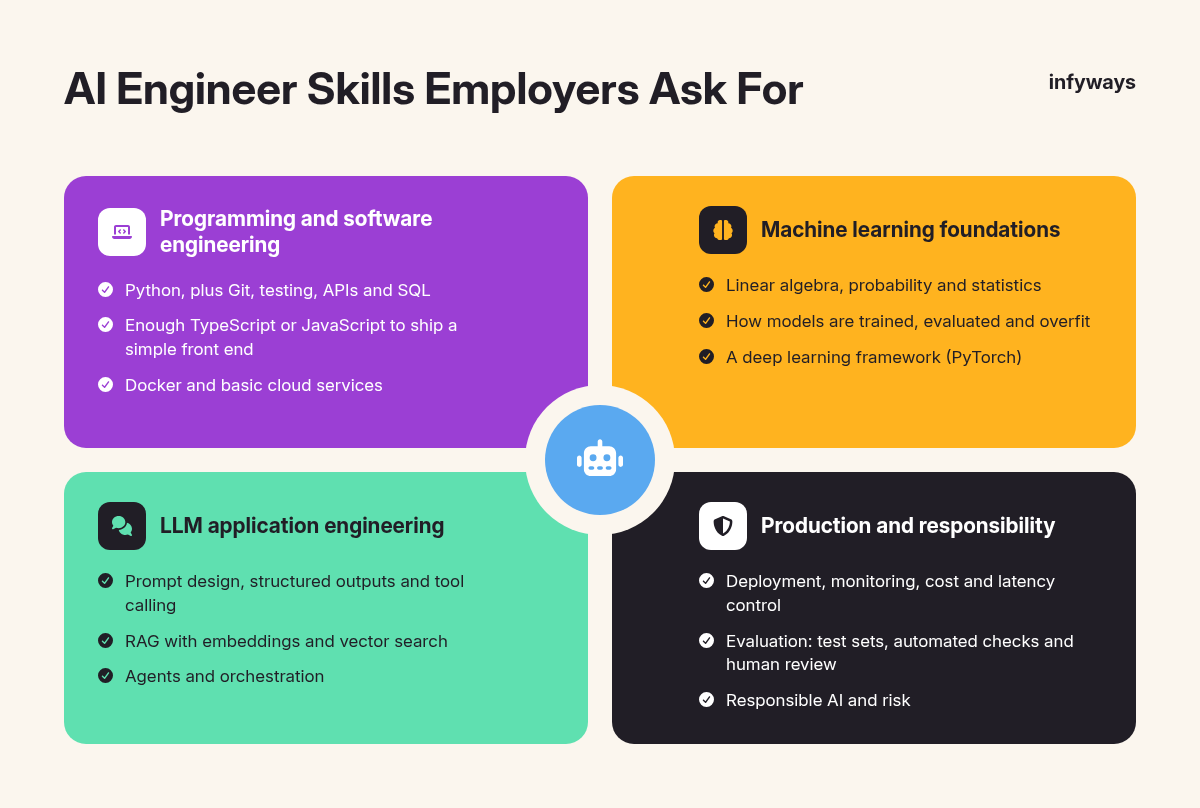
Employers want strong Python and software engineering first, then hands-on experience with LLM application patterns, cloud deployment and evaluation.
Python leads the list. Lightcast found Python was the most in-demand specialized skill in AI job postings, appearing in 258,674 postings, up nearly 30% from 2024. Stack Overflow’s survey also shows Python adoption rose 7 percentage points from 2024 to 2025.
The skills that show up most often fall into four groups:
Programming and software engineering
- Python, plus Git, testing, APIs and SQL.
- Enough TypeScript or JavaScript to ship a simple front end.
- Docker and basic cloud services.
Machine learning foundations
- Linear algebra, probability and statistics at a working level.
- How models are trained, evaluated and overfit.
- A deep learning framework. LinkedIn lists PyTorch among the top three AI engineer skills.
LLM application engineering
- Prompt design, structured outputs and tool calling.
- RAG with embeddings and vector search. Our guide to a production RAG pipeline covers what changes after the prototype.
- Agents and orchestration. Lightcast reports the agentic AI skill cluster grew from 0.06% of U.S. postings in 2024 to 0.23% in 2025, about 90,000 postings.
- Connecting models to tools with the Model Context Protocol (MCP). You can try it hands-on by building your first MCP server with TypeScript.
- Fine-tuning, when prompting and RAG are not enough. See our step-by-step Unsloth fine-tuning tutorial.
Production and responsibility
- Deployment, monitoring, cost and latency control. Lightcast notes that Amazon Web Services, scalability and workflow management were among the fastest-growing skills over the long term.
- Evaluation: test sets, automated checks and human review.
- Responsible AI and risk. The NIST AI Risk Management Framework is a practical U.S. reference.
5. AI Engineer Roadmap: How to Become an AI Engineer Step by Step
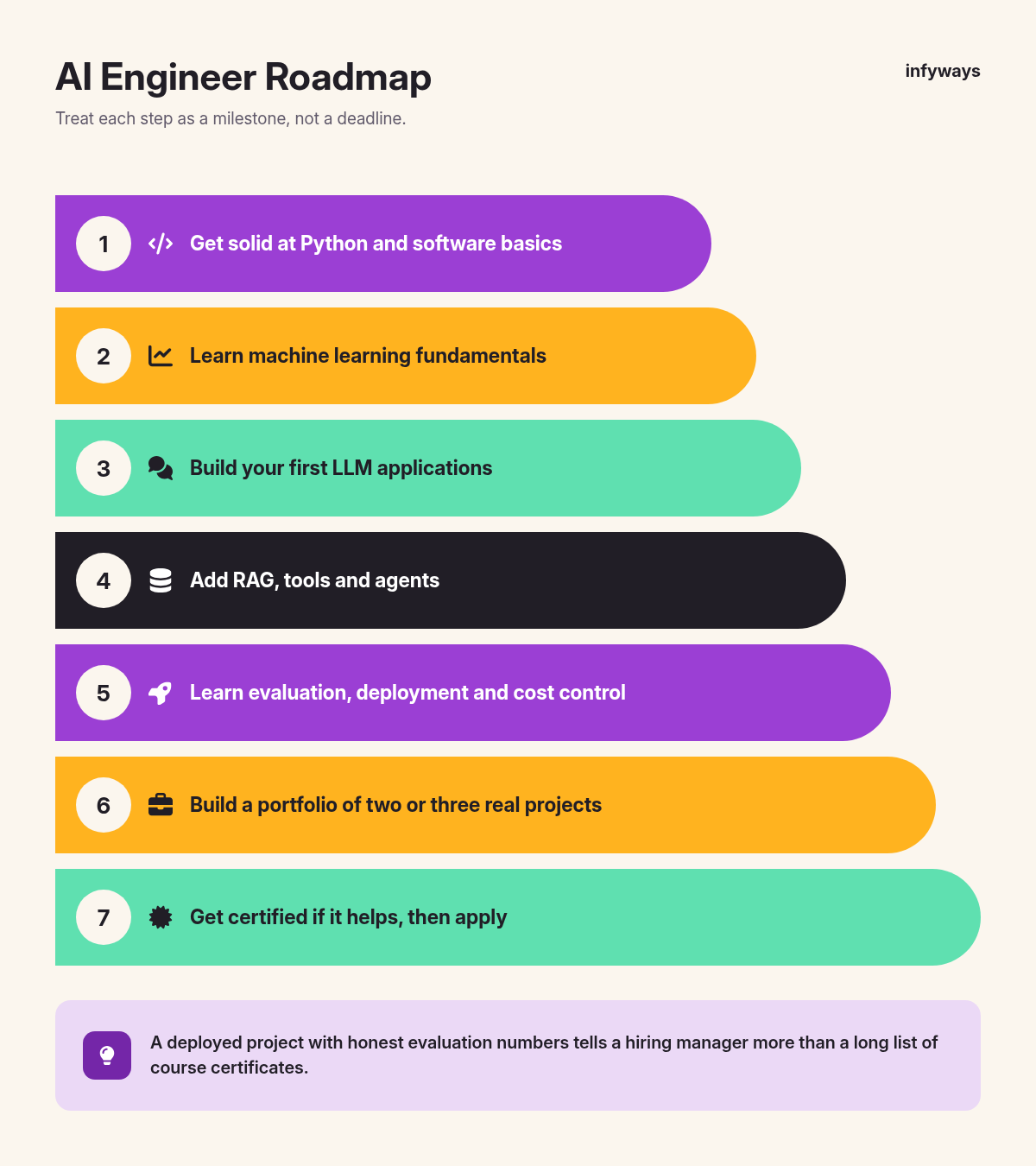
The fastest route for most people is seven steps: Python, ML basics, LLM apps, RAG and agents, evaluation and deployment, a portfolio, then targeted applications.
Treat each step as a milestone, not a deadline. A working developer will move faster than a complete beginner.
Step 1: Get solid at Python and software basics
Learn Python well enough to write clean, tested code, call APIs, handle data with pandas and use Git. If you already work as a developer, focus on Python idioms and data handling.
Step 2: Learn machine learning fundamentals
Learn how supervised learning, loss functions, evaluation metrics and neural networks work. Good starting points include the Machine Learning Specialization from DeepLearning.AI and Stanford Online, a three-course program, and fast.ai’s Practical Deep Learning for Coders, which fast.ai offers as a free course for people with some coding experience.
Step 3: Build your first LLM applications
Use an LLM API to build a small chatbot, a summarizer and a structured-data extractor. The Hugging Face LLM Course, which Hugging Face describes as completely free, covers transformers and open models. Our guide to writing prompts that produce production-ready code helps with the prompting side.
Step 4: Add RAG, tools and agents
Connect a model to your own documents with embeddings and a vector database. Then give it tools, such as search, a database or an API, and build a simple agent that completes a multi-step task.
Step 5: Learn evaluation, deployment and cost control
Write tests for your AI features, measure accuracy and failure cases, and deploy on a cloud platform with logging. Track cost per request and response time from the start.
Step 6: Build a portfolio of two or three real projects
Pick problems with real users or real data: a support assistant for a real knowledge base, a document-processing pipeline or an internal agent. Publish the code, a short write-up and the evaluation results for each one.
Step 7: Get certified if it helps, then apply
Add one cloud certification if your target employers use that cloud (see the next section). Apply for AI engineer, applied AI and LLM engineer roles, and for software roles on AI product teams. These are often the easiest way in.
Key insight: a deployed project with honest evaluation numbers tells a hiring manager more than a long list of course certificates.
6. AI Engineer Certifications and Courses Worth Considering
Certifications are optional. They help most when they match the cloud your target employer uses, and they work best alongside a portfolio.
| Certification | Provider | Exam fee (U.S.) | Format | Recommended experience | Best for |
|---|---|---|---|---|---|
| Machine Learning Engineer – Associate | AWS | $150 (MLA-C02 beta: $75) | 65 questions, 130 min (MLA-C01); 85 questions, 170 min (MLA-C02 beta) | About 1 year with SageMaker AI, Bedrock and other AWS ML services | ML and MLOps engineers on AWS |
| Generative AI Developer – Professional | AWS | $300 | 75 questions, 180 min | 2+ years of cloud experience (per AWS) | Developers shipping generative AI on AWS |
| Professional Machine Learning Engineer | Google Cloud | $200 (plus tax where applicable) | 50–60 multiple-choice questions, 2 hours | 3+ years in industry, including 1+ year on Google Cloud | ML engineers on Google Cloud |
| Azure AI Apps and Agents Developer Associate (AI-103) | Microsoft | Associate exams typically $165 (Microsoft FAQ) | 120 min, proctored | Python app development, familiarity with generative AI and Azure | AI engineers building agents on Azure |
One change to note: Microsoft retired the Azure AI Engineer Associate (AI-102) exam on June 30, 2026. AI-103 is the current Azure exam for this role.
For learning (as opposed to certification), these structured options cover the roadmap above:
- ML fundamentals: the Machine Learning Specialization on Coursera.
- Deep learning: fast.ai Practical Deep Learning for Coders.
- LLMs and open models: the Hugging Face LLM Course.
- Applied generative AI and agents: a structured university or bootcamp program can add mentoring and deadlines if you learn better with outside structure. Check the syllabus for RAG, agents, evaluation and a capstone project before you enroll.
7. Which Path Fits You?
The right first step depends on what you already know.
| If you are… | Start with | Skip or postpone |
|---|---|---|
| A software developer | Steps 3–5: LLM apps, RAG, agents and evaluation | A full math refresher; learn the math as you need it |
| A data scientist or analyst | Steps 4–5: production engineering, APIs and deployment | Basic ML courses you have already covered |
| A complete beginner | Steps 1–2: Python and ML fundamentals | Professional-level certifications until you have shipped projects |
| A career changer from a non-tech field | Steps 1–3, plus one domain project from your current industry | Expensive programs before you know you enjoy the work |
One practical tip: LinkedIn reports that 26.2% of AI engineer jobs were remote and 27.1% hybrid. That widens the pool if you live outside the main hiring hubs.
Frequently Asked Questions
How long does it take to become an AI engineer?
It depends on where you start. A working software developer can often build job-ready LLM projects within several months of focused study. A complete beginner usually needs longer, because Python and ML basics come first. LinkedIn found that people hired as AI engineers had a median of 3.7 years of prior work experience, so most arrive from another tech role.
Do you need a degree to become an AI engineer?
Not always, but it helps. BLS says software developers typically need a bachelor’s degree in computer science or a related field, and research scientist roles typically need a master’s degree. For product-focused AI engineering jobs, many employers weigh shipped projects and engineering experience heavily, so a strong portfolio can offset a non-traditional background.
How much does an AI engineer make in the U.S.?
BLS does not publish an “AI engineer” category. The closest occupations had May 2025 medians of $135,980 for software developers, $140,300 for computer and information research scientists and $120,230 for data scientists. Actual offers vary widely by location, seniority and employer.
Which programming language should an AI engineer learn first?
Learn Python first. Lightcast found that Python was the most in-demand specialized skill in AI job postings in 2025, and nearly every major AI framework and model API has a Python SDK. Add TypeScript or JavaScript later if you want to build full AI products with a web front end.
Is an AI engineer certification worth it?
A certification is worth it when it matches the cloud your target employer uses, such as AWS, Google Cloud or Azure. It does not replace a portfolio, so earn it alongside real projects, not instead of them.
The Bottom Line
To become an AI engineer in 2027, get strong at Python, learn enough ML to understand your models, then build and ship real LLM applications with RAG, agents and proper evaluation.
Pick one cloud, add a certification only if your target employers use that cloud, and let two or three deployed projects do the talking. The demand data is on your side, but shipped work is what gets you hired.
If you are on the other side of the table and need AI features built into your product, our team at Infyways builds Python, machine learning and AI solutions for businesses.
Sources
- LinkedIn News, “LinkedIn Jobs on the Rise 2026: The 25 fastest-growing roles in the U.S.”. January 7, 2026.
- Lightcast, “The Stanford AI Index Report 2026” (labor market highlights). 2026.
- U.S. Bureau of Labor Statistics, Occupational Outlook Handbook: Software Developers, Quality Assurance Analysts, and Testers. Last modified august 27, 2026.
- U.S. Bureau of Labor Statistics, Occupational Outlook Handbook: Computer and Information Research Scientists. Last modified august 27, 2026.
- U.S. Bureau of Labor Statistics, Occupational Outlook Handbook: Data Scientists. Last modified august 27, 2026.
- CBS News, “This is the fastest-growing job for young workers, LinkedIn says”. 2026.
- Stack Overflow, “2025 Developer Survey: Technology”. 2025.
- Model Context Protocol, official documentation. Checked november 12, 2026.
- NIST, “AI Risk Management Framework”. Checked november 12, 2026.
- DeepLearning.AI and Stanford Online on Coursera, “Machine Learning Specialization”. Checked november 12, 2026.
- fast.ai, “Practical Deep Learning for Coders”. Checked november 12, 2026.
- Hugging Face, “LLM Course”. Checked november 12, 2026.
- AWS, “AWS Certified Machine Learning Engineer – Associate”. Checked november 12, 2026.
- AWS, “AWS Certified Generative AI Developer – Professional”. Checked november 12, 2026.
- Google Cloud, “Professional Machine Learning Engineer”. Checked november 12, 2026.
- Microsoft Learn, “Microsoft Certified: Azure AI Apps and Agents Developer Associate”. Checked november 12, 2026.
- Microsoft Learn, “Exam frequently asked questions” (exam pricing). Checked november 12, 2026.
- Microsoft Learn, “Exam and assessment lab retirement”. Checked november 12, 2026.